
Trump’s National Security Strategy: A blueprint for power and Its consequences for South Asia
Trump’s National Security Strategy: A blueprint for power and Its consequences for South Asia
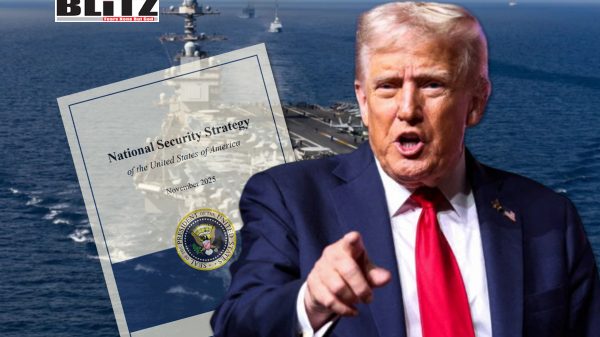
If one were to distill Donald Trump’s National Security Strategy- November 2025 worldview into a single sentence, it would likely read: win the economic future, avert a military catastrophe. It sounds almost modest. Yet behind this slogan lies a sweeping redesign of how Washington understands China, how it will marshal its alliances, and how it hopes to shape the political landscape of Asia for decades. Trump presidency, armed with the National Security Strategy, November, 2025, would not simply adjust America’s Asia policy—it would rewrite its operating code. And that rewrite has profound implications not just for the U.S.–China rivalry but for South Asia’s fragile balance of power.
Correcting “Three Decades of Error”
At the heart of Trump’s National Security Strategy is a scathing indictment of previous administrations. For over thirty years, Washington believed that integrating China into global markets would nudge it into a “rules-based order.” The bet was that open trade, free investment flows, and outsourced manufacturing would gradually liberalize Beijing.
Trump’s strategists argue the opposite happened. China leveraged globalization to become richer and more assertive, while America lost industries, intellectual property, and strategic leverage. In their telling, U.S. elites misread China’s intentions and underestimated its ambitions. Trump, by contrast, “corrected” those assumptions.
This ideological shift sets the stage for a far more competitive Indo-Pacific strategy. And it begins with a simple demographic and economic truth: the Indo-Pacific is the world’s new power center. Nearly half the global GDP is generated in this region. Whoever leads here (technologically, militarily, commercially) shapes global destiny.
The Trump administration will try to ensure that the United States, not China, occupies that commanding height.
Economic Rebalancing as a Strategic Weapon
Economic leverage lies at the center of Trump’s plan. The U.S.–China relationship, in his view, is structurally unfair. China’s state-driven model, subsidies, and industrial espionage have turned global markets into uneven playing fields, while American workers have borne the brunt of job losses and deindustrialization.
Trump’s strategy seeks to reverse this through four levers. First, rebalancing trade. Reciprocity becomes doctrine. China must offer the same access it receives. Sensitive industries—semiconductors, rare earths, pharmaceuticals—would be repatriated or shifted to trusted partners.
Second, dismantling harmful Chinese practices. That includes subsidized dumping, IP theft, and the export of fentanyl precursors that fuel America’s opioid crisis. In Trump’s framing, these are not merely economic abuses but national security threats.
Third, using allies as force multipliers. The combined economies of U.S. allies approximately $35 trillion—greater than the U.S. itself. Trump’s strategy would consolidate this coalition into a bloc capable of countering China’s overreach. India becomes especially important here. It is not a treaty ally, but Washington sees it as a demographic and economic counterweight to China. Strengthening India’s commercial and security ties—especially through the Quad—becomes central to the Indo-Pacific plan.
Fourth, investing in frontier technologies. The Trump worldview is blunt: whoever dominates AI, space, nuclear modernization, quantum computing, and autonomous systems will dominate the century. So the U.S. must pour resources into these sectors, ensuring China never gains a technological upper hand.
The idea is to create a “virtuous cycle”: economic power funds defense; military deterrence protects economic growth; innovation cements both.
A Military Posture to Prevent a War
Trump’s Indo-Pacific strategy is not about preparing for war, it is about preventing one. And the prevention hinges on maintaining overwhelming technological and military superiority.
Taiwan lies at the heart of this calculation. Its semiconductor dominance and its strategic location make it a geopolitical hinge. Any conflict here would jeopardize one-third of the world’s shipping. Trump’s approach does not seek to alter the longstanding U.S. policy, but it does seek to strengthen deterrence. That includes more arms to Taiwan, more training, more maritime cooperation, and deeper coordination with allies who sit astride the First Island Chain.
The First Island Chain itself (the arc running from Japan to the Philippines) is treated as the U.S. forward line of defense. Trump wants American forces capable of denying Chinese military aggression anywhere along this stretch. But this ambition comes with a caveat: America refuses to carry the burden alone. Japan, South Korea, the Philippines, and Australia will be pressed to spend more, build more, and provide greater access to their ports and bases.
The South China Sea is another battlefield of influence. Beijing’s militarization of artificial islands and its expansive maritime claims are seen as attempts to impose de facto tolls on global trade. A Trump administration would intensify patrols, expand joint naval exercises, and work more closely with India and Japan to keep sea lanes open and untaxed.
In short, the deterrence strategy is simple: show enough strength to convince Beijing that military adventurism is futile.
The South Asian Consequences
South Asia rarely sits at the front of the U.S. grand strategy. Under Trump’s plan, that changes. The region becomes a secondary theater where the U.S.–China rivalry expresses itself in sharper ways.
India becomes America’s anchor. Washington sees India as the only regional power with the population size, coastline, technological potential, and political motivation to balance China. A Trump presidency would accelerate defense cooperation, technology transfers, and joint exercises. But this also means India will face expectations—policing maritime routes, strengthening its navy, and adopting clearer positions on China’s assertiveness.
For Pakistan, the picture is worrisome. Its deepening ties with China, especially through the China–Pakistan Economic Corridor (CPEC), place it in the rival camp. A Trump strategy that seeks to weaken China’s economic foothold will inevitably pressure Islamabad—through aid conditionality, counterterrorism demands, and scrutiny of Chinese projects.
Bangladesh finds itself walking a narrowing tightrope. Its economic diversification, access to Western markets, and partnership with Japan and the U.S. offer new opportunities. But its heavy infrastructure dependence on China invites strategic questions. A Trump-led Indo-Pacific strategy will push Dhaka to clarify where it stands—something Bangladesh may find uncomfortable amid domestic political complexities.
Sri Lanka, Nepal, and the Maldives—already arenas of China–India competition—will see the pressure intensify. Ports, telecom infrastructure, and debt-financed projects will be reexamined through a sharper geopolitical lens. The Indian Ocean will no longer be a quiet backwater; it will be a zone of active contestation.
The Emerging Landscape
Trump’s National Security Strategy, November 2025 would produce a more transactional, more muscular Indo-Pacific policy. It would amplify economic nationalism, accelerate technological decoupling, deepen alliance networks, and push South Asian states into strategic clarity.
Some countries will adapt. Others will resist. All will feel the squeeze.
Trump’s plan is built on a wager: that economic strength, technological dominance, and a well-armed coalition can secure peace without war. The question is whether Asia—and especially South Asia—can navigate the fallout without being dragged deeper into a rivalry that shows no sign of fading.
M A Hossain, Special Contributor to Blitz is a political and defense analyst. He regularly writes for local and international newspapers.
