
2025: A Challenging Year for India’s Diplomacy
2025 was a challenging year for India on the foreign relations front. Ties with strategic partners, such as the United States, frayed, and those with key neighbors, Pakistan and Bangladesh, worsened. India also found itself alone in times of crisis.
A silver lining came in the form of improved relations with China.
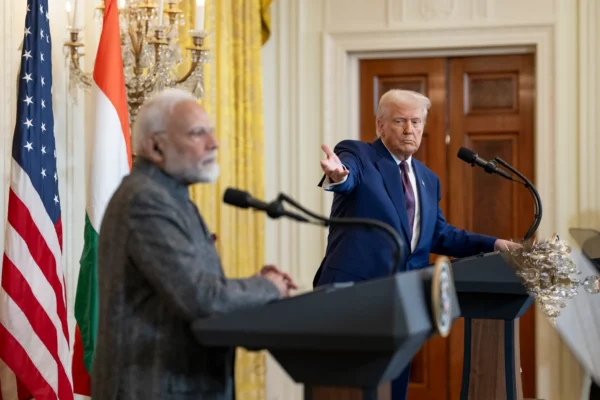
The mood in Delhi was upbeat at the start of the year. Indians welcomed Donald Trump’s return for a second term as U.S. president. During his first term, bilateral relations were warm and Trump had established a close rapport with Indian Prime Minister Narendra Modi. While there were apprehensions in Delhi that differences over trade and immigration would surface, analysts felt these could be addressed. The fact that close India-U.S. relations enjoyed a bipartisan consensus in the U.S. and the Trump-Modi friendship were expected to reduce the severity of any American action.
However, India had underestimated Trump’s capacity for disruption and was caught unprepared for what unfolded in the subsequent months.
While the Trump administration slapped “reciprocal tariffs” on friends and foes alike, the 50 percent tariff on India, 25 percent of which was “penalty” for India’s continued purchase of Russian oil, came as a shock to Delhi. Not only was it among the highest in the world, but India also felt it was being selectively targeted. Other buyers of Russian oil, including China and the EU, were not similarly penalized. Talks on tariffs continued throughout 2025, but a trade deal has remained elusive. Differences over the U.S.’ cancellation of H-1B visas for Indians also remained unresolved as of year’s end.
Trump’s repeated claims that he ended the India-Pakistan military clashes in May riled the Modi government. India has traditionally opposed third-party mediation in its disputes with Pakistan, and Trump’s assertion over 60 times between May 10 and December 22 to having convinced the two sides to halt the war left Modi appearing to have bowed to U.S. pressure on matters of India’s national security.
Trump added salt to the wound with his sudden courting of Pakistan. Not only did he host Pakistan’s political and military leaders in the White House, but much to India’s chagrin, top American officials praised Pakistan’s role in containing terrorist entities. Pakistan-U.S. counterterrorism cooperation grew thereafter, as did Pakistan’s role in regional security, especially in the implementation of Trump’s Gaza Peace Plan.
But even before Pakistan-U.S. relations warmed in 2025, India-Pakistan ties hit a new low in April when terrorists carried out a deadly attack at Pahalgam in Jammu and Kashmir, which India blamed on Pakistan. On May 10, it launched Operation Sindoor, military strikes on terrorist camps in Pakistan and Pakistan administered Kashmir. The conflict quickly escalated with the two sides targeting each other’s military facilities. While India was able to destroy important terrorist camps, whether the strikes serve to deter the Pakistan military or terrorist groups from carrying out attacks in India is doubtful. Besides, Pakistan and its military emerged stronger from the clashes, thanks to the performance of Chinese military hardware and effective propaganda. Furthermore, while several countries expressed sympathy with India following the Pahalgam attack, no government blamed Pakistan. Furthermore, India found itself alone after Operation Sindoor was launched. It was widely seen as having acted irresponsibly, having adopted a strategy that risked a nuclear exchange.
With its other South Asian neighbors, Indian diplomacy produced mixed results. The downslide in India’s relations with Bangladesh continued in 2025. While India was irked by remarks by Bangladesh interim advisor Muhammad Yunus and his aides on India’s Northeast, Delhi’s reluctance to send Sheikh Hasina back to Bangladesh angered Bangladeshis. Violent protests targeting each other’s missions, attacks on minorities grew. Other than Modi meeting Yunus on the sidelines of a regional meeting in April, India avoided major engagement with the interim government. It can be expected to do so in 2026 after an elected government takes charge in Dhaka.
With Nepal, too, where an interim government is in charge after the ouster of the KP Sharma Oli government by Gen Z protests in September, Delhi has put diplomatic initiatives with Kathmandu on hold till elections in March. In 2025, India’s relations with the Maldives and Sri Lanka stabilized significantly. With Pakistan’s relations with the Taliban regime in Kabul deteriorating significantly, India’s relations with Kabul deepened dramatically in 2025. It reopened its embassy in Kabul and put out the welcome mat to Taliban ministers visiting New Delhi.
After four years of friction along the disputed Sino-Indian border, India’s relations with China improved. The border was calm in 2025. Building on an agreement reached in October 2024, the two sides began normalizing relations. Indian pilgrims visited Kailash Mansarovar in Tibet, visa procedures were eased, direct flights between the two countries were resumed, and Modi met Chinese President Xi Jinping on the sidelines of the SCO summit at Tianjin.
However, there is little reason for India to relax vis-à-vis China in the new year. Both sides continued to build military infrastructure along the border in 2025. China’s military cooperation with Pakistan — Chinese hardware gave Islamabad an advantage in the India-Pakistan face-off — continues. And China is making major inroads in South Asia; the bonhomie between Bangladesh, Pakistan and China is of particular concern to India.
In 2025, of all the big powers, it was India’s relations with Russia that were the most stable and reliable. President Vladimir Putin visited India in December, and while no big-ticket defense deals were announced during the visit, there were agreements on greater economic cooperation. Former Indian Foreign Secretary Nirupama Rao observed in an article in NDTV that “the summit’s message was one of steadiness. It highlighted a partnership anchored in trust and continuity. That framing contrasted with the unpredictability visible in some of India’s other major relationships, particularly amid moments when American policy toward India appears shaped by internal turbulence.”
India made several diplomatic gains in 2025. It signed major trade agreements with the United Kingdom, Oman, and New Zealand. Relations with Canada, which were acrimonious in 2023-24, improved visibly, and the two sides will resume talks soon on a free trade agreement. Indian efforts to expand its strategic footprint in West Asia and the Horn of Africa intensified.
The year gone by laid bare the flaws in India’s diplomacy. While one can blame Trump’s erratic policies for the setbacks India suffered in 2025, the role of India’s personality- and spectacle-centric diplomacy in undermining its capacity for a sharper understanding and assessment of a volatile world cannot be ignored. Again, the Modi government severely undermined Indian interests, especially in the neighborhood, by crafting its foreign policy with an eye on impressing its vote bank at home. In the process, it contributed to surging anti-India sentiment in these countries, which can only open doors wider for Chinese influence.
To India’s credit, its foreign policy in 2025 displayed a commitment to exercising strategic autonomy. It made independent foreign policy choices.
Nirupama Rao’s observation on Putin’s visit aptly describes India’s foreign policy in 2025 more broadly, too.
“It was an attempt to navigate a burning forest,” Rao wrote. “The elephant [India] cannot pretend the bear no longer exists [Russia] because the lion [the U.S.] disapproves. Nor can it let the bear wander so deep into the dragon [China]’s cave that the terrain shifts entirely.”
Rao goes on to point out that “The elephant walked carefully because the forest was on fire. It walked with the bear because the bear still shapes the terrain. And it walks in its own direction because that remains the only safe way to navigate an uncertain world.”
