
Homegrown hits: The best new Australian music to hear this month
By John Shand, Jules LeFevre and Nick Buckley
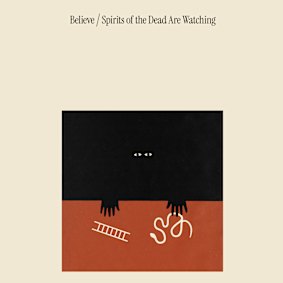
Believe’s Spirits of the Dead Are Watching: polished and primal jazz improvisations.
Believe, Spirits of the Dead Are Watching
At its most interactive and imaginative, spontaneously created music can be as organic as the wind in the trees or the roar of the waves. But to reach beyond the common self-consciousness of humans making “art” requires letting go of self, of ego and of preconceptions. The player must exist entirely in the moment and in the music’s midst, hearing it as a whole, rather than concentrating on his or her part.
Believe consists of four of the most polished and yet primal improvisers Sydney has produced: alto saxophonist Peter Farrar, pianist Novak Manojlovic, bassist Clayton Thomas and drummer Laurence Pike. The polish comes not only in the mastery of their instruments, but in their interaction. They don’t pounce on each other’s ideas, for pouncing’s too slow; the moment’s already passed. They play simultaneous ideas that form a mosaic of accord.
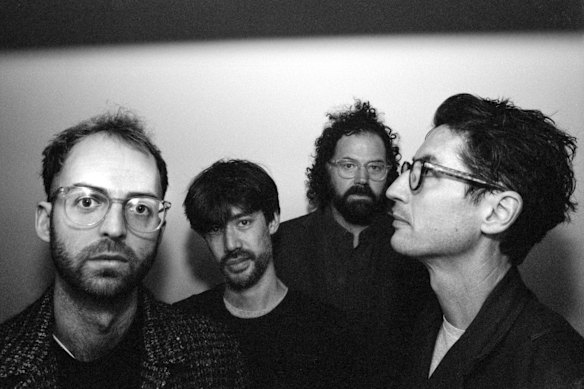
Sydney supergroup Believe includes alto saxophonist Peter Farrar, pianist Novak Manojlovic, bassist Clayton Thomas, drummer Laurence Pike.Credit: Mclean Stephenson
The primality comes in the way the music shakes up your central nervous system, from brain to coccyx. Key to this is the sounds they make. Farrar, one of the half-dozen most significant saxophonists the country’s ever produced, generates a warmth of timbre and breadth of overtones that can make his alto sound like a tenor. Add his circular breathing and extended techniques, and the instrument, at the opening of the title track, bellows like some distraught beast, and sounds like it’s not being played so much as is somehow playing itself.
With Manojlovic’s piano – whether he’s using the keys or plucking the strings directly – there’s a dialogue between brittleness, robustness and an autumnal lyricism. In the opening sequence of the title track, his lines and sounds have such fragility that it’s like hearing crystal shatter in very slow motion.
Then there’s Thomas’ double bass: a mighty sound, such as the earth might make could it talk. Many bassists who are adept at their instrument don’t necessarily think like bass players. Thomas creates monolithic blocks of sound that are foundations for music that soars or sprawls above them, yet also offers sinuousness and eeriness, with his own array of surprising textures and lines thickening the percussive weave during the long-form, multifaceted Already Not Yet. Pike, meanwhile, long an innovator on the drums, creates whole palettes of shifting colours and breaking waves of energy, density, texture and rhythm, with the other three also contributing percussion, notably on Already Not Yet.
The album contains three spontaneous compositions, and I know no more sophisticated activity of which humans are capable than freely improvising at this level. Idiomatically, the music can be heard as free jazz of the sort that’s been around for 65 years, but when played on this plane it transcends definitions and seems like you’ve opened a window and nature has poured these sounds into your ears, triggering responses from imagination, gut and heart. I wish I lived in the house with that window. John Shand
Rageflower, Infinite Highs, End of Times
Two years ago, Sydney’s Madeleine Powers decided to pack it in and get a desk job. The crushing demands of trying to make it as an artist were overwhelming, and, for the moment, the safety of a government nine-to-five was calling.
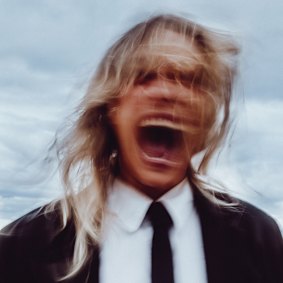
Rageflower’s Infinite Highs, End of Times: cinematic pop with a dash of country.
Powers’ time at the public service coalface was rewarding, she recently wrote on Instagram, but in the end her “stubborn creative heart” won out and Rageflower was born. Infinite Highs, End of Times arrives as Rageflower’s debut EP, and it’s a sharply written and arresting record.
Fans of the cinematic, emotional pop of MUNA and Phoebe Bridgers will find plenty to dig into, particularly on the darkly sketched Angel Things and Everyone’s Girl (featuring fellow Sydney act, jnr.).
Like with Bridgers and MUNA, there’s a hefty dash of country on Infinite Highs: the standout, gut-punching Kerosene sounds like it could have fallen off a Sheryl Crow album.
Powers’ vocal performance is a knock-out across Infinite Highs, capable of a Natalie Maines-style belt or a delicate whisper. As for that infamous office gig, Powers immortalises the stagnation and fury in the brilliant Desk Job, which whips itself into a spiralling, serrated mess of guitars and screams. Jules LeFevre
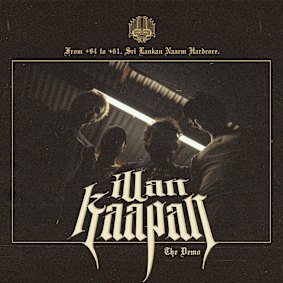
Illaan Kapaan’s The Demo: blistering Sri Lankan-Australia hardcore.
Illan Kaapan, The Demo
Illaan Kapaan’s debut EP, The Demo, has just four tracks containing 8 minutes and 13 seconds of music. The Naarm-based hardcore band, all Sri Lankan, does a lot in that brief time.
They blitz the melody from Ranidu Lankage’s 2004 Sinhalese hip-hop hit Ahankara Nagare into the EP’s opening riff, discard the veil hiding our true selves on Pain Mask, and confront familial grief on In Memory. Fear of Shame explores its Sinhalese translation, “lajja baya”, a form of self-policing linked to displays of modesty that the band ties to the expectations of cultural assimilation experienced by migrants to Australia.
My best friend is Sri Lankan, a member of the Burgher ethnic minority descended from the island’s local peoples and Dutch colonists. His family was forced from Sri Lanka by the racist Sinhala Only Act and allowed to settle here through the racist White Australia Policy because of their partial European heritage.
His words sum up The Demo better than I can as a white critic: “Recent events have left me feeling angry, with nowhere to put it. It’s felt visceral and proud listening to [The Demo]. Shame is a big concept in Lankan/South Asian communities, the idea of saving face, which correlates to the shame many migrants and people of colour face about simply existing in a land that parades the fact they want them out. Plus, it’s mastered well and slaps as a record.” It certainly does. Nick Buckley
To read more from Spectrum, visit our page here.
