
Robin Smith, former England cricketer, dies aged 62
By Will Macpherson and Scyld Berry
Robin Smith, the former England cricketer famous for being one of the world’s best batsmen in an era of fearsome fast bowling, has died suddenly at his home in Perth, aged 62.
Smith, affectionately known as “the Judge” because of his curly hair that resembled a wig, played 62 Tests for England between 1988 and 1996, scoring 4236 runs at 43.7 with nine centuries, and has been described as Hampshire cricket’s “greatest hero”.
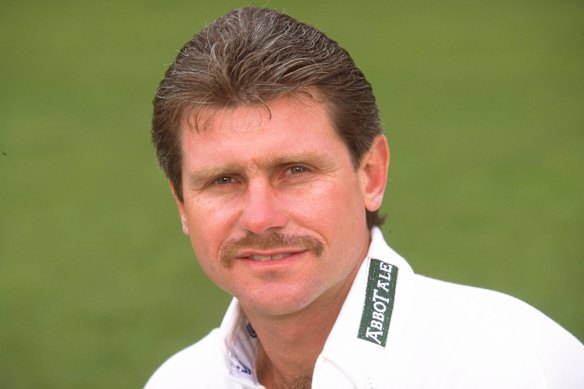
Former England cricketer Robin Smith has died at age 62.Credit: Getty Images
The circumstances around Smith’s death remain unclear. A statement from his family read: “Robin died unexpectedly at his South Perth apartment on Monday 1st December. The cause of his death is at present unknown.
“This is an immensely difficult period for us all whilst we try to come to terms with our bereavement, and we would therefore much appreciate consideration for our privacy by media and cricket followers alike.”
Smith had endured personal troubles, including battles with alcoholism and mental health struggles that meant he twice came close to taking his own life. Last year, he spent seven months in hospital battling cirrhosis of the liver. Most recently, his long-term partner Karin had been undergoing emergency stem cell treatment following a diagnosis of multiple sclerosis.
He will be best remembered for his rasping cut shot, one of the English game’s most memorable strokes, and his superb, fearless ability against fast bowling when wearing a helmet without a visor or grille.
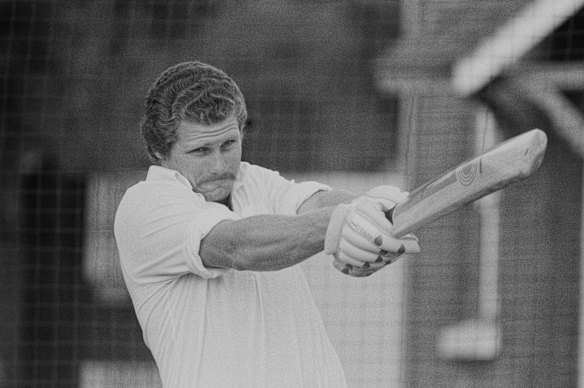
Robin Smith in action in 1983. The former England cricketer was famous for being one of the world’s best batsmen in an era of fearsome fast bowling.Credit: Getty Images
Smith, who was born in South Africa, relocated to Western Australia in his retirement, and only last month attended the first Ashes Test in Perth, where he caught up with old friends and team-mates. He was also invited by coach Andrew “Freddie” Flintoff to address the England Lions squad at Lilac Hill, where the development side were playing.
He played for Hampshire from 1988 to 2002 and scored more than 30,000 runs for the county. He captained the club from 1998 to 2002, having helped them win the Benson & Hedges Cup in 1988 and 1992, and the NatWest Trophy in 1991.
Kevin Pietersen, the former England and Hampshire batsman, joined a number of former cricketers in paying tribute to Smith.
“Heartbreaking to hear about the tragic loss of Robin Smith! Always have the fondest memories of The Judge! My heart goes out to his entire family and friendship group,” Pietersen said on social media.
Rod Bransgrove, Hampshire’s former owner, said Smith’s “enthusiasm for county cricket did not affect performances for his country and demonstrated a club commitment rarely seen these days”.
He added: “Robin Smith is one of the greatest, if not the greatest, of all time Hampshire Cricket heroes. He was a batsman of awesome power and control and amongst the most courageous players this club has ever seen – especially against bowling of real pace.
“More than anything, The Judge connected with everyone he came into contact with. He was one of the most popular players ever to play the game we all love, and he will be hugely missed by players, members, staff and supporters – not only in Hampshire, but throughout the country and beyond.”
The England and Wales Cricket Board’s chairman, Richard Thompson, added: “Robin Smith was a player who stood toe to toe with some of the quickest bowlers in the world, meeting spells of hostile fast bowling with a defiant smile and an incredible resilience. He did so in a way that gave England fans enormous pride, and no shortage of entertainment.”
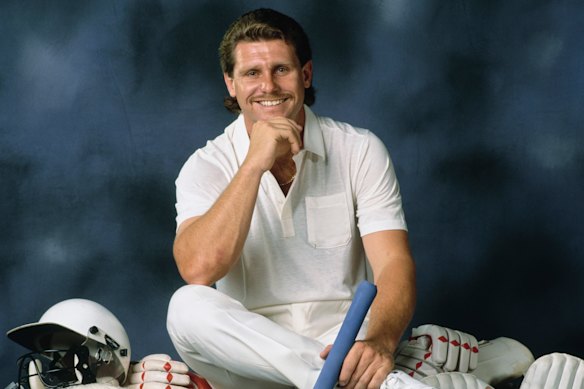
Robin Smith pictured for a studio portrait circa 1989 in London, England.Credit: Hulton Archive
Smith was born in Durban in 1963, and was the younger brother of Chris, who also went on to play for Hampshire and won eight Test caps for England. Robin reached greater heights, though, and was a central figure for England in an era where the selectors regularly chopped and changed, and opposition teams – including the mighty West Indies – were strong. Three of Smith’s Test centuries came against the West Indies.
Smith’s former Hampshire team-mate, Kevan James, spoke about his death on BBC Solent Radio.
“It’s been horrible,” he said. “It’s a sad day, but when you look at someone’s career… At the time, in the Eighthies and Nineties, he was England’s best batter.
“He was a super player, particularly of fast bowling in an era where the West Indies had all these fast bowlers. He was one of the few England batters who stood up to them and basically gave as good as he got.”
Supremely brave on the field but plagued by uncertainty off it
Robin Smith faced fast bowling full-on, even if, tragically, the same could not be said for life itself.
Smith was universally known as “Judgey” for the shape of his hair. He was one of the bravest batsmen ever to take on the West Indies when they were in effect the world Test champions, owing to the calibre of their incredible fast-bowling contingent.
Smith strode out to the middle, mighty of forearm, murderous of square cut, and never gave a hint of the uncertainties which plagued him off the field. Those who could take down West Indies were very few but alongside Allan Lamb, Graham Gooch, Allan Border, who was also born in South Africa of a British parent, was Smith.
Smith’s father had installed a bowling machine in the garden of their family home in Durban when such machines were novelties, not ten-a-penny in academies. Smith’s square cut was born here, and he soon had the forearms to match his technique.
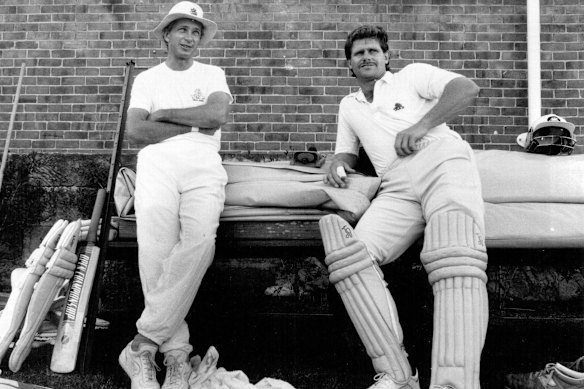
Robin Smith, right, with David Gower and at the SCG in 1990.Credit: Michele Mossop
Far from being prolific against medium-pacers on three-day county pitches while playing for Hampshire, Smith instantly looked a Test batsman when he made the step up. That could not be said of every England player in the 1988 series against West Indies.
Smith made his debut in the fourth Test at Headingley, when the all-rounder Roger Harper was somehow selected by West Indies. Not one over of Harper’s off-spin was bowled as England were mown down for 201 and 138.
Chris Cowdrey had been picked as England’s captain for this game, which was perhaps not entirely a coincidence as the chairman of England’s selectors, Peter May, was his godfather. Cowdrey was out of his depth, and never represented England again. Smith entered the arena with England 80 for four, and batted to the manner born.
It helped that Lamb was at the other end, of the same background, and equipped with the same square cut and courage. Still, it was a huge challenge for a man on his Test debut to face Curtly Ambrose, Malcolm Marshall, Winston Benjamin and Courtney Walsh. Thanks to that upbringing, Smith was immediately up to speed. His first-innings score of 38 does not fully reflect it; but he shared a century partnership before Lamb endured the occupational hazard when batting against West Indies, and retired hurt.
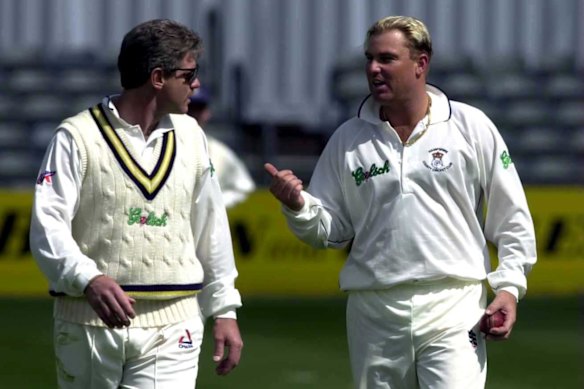
Shane Warne talks with his captain Robin Smith during the Benson and Hedges Cup game between Essex and Hampshire.Credit: Graham Chadwick/ALLSPORT
Smith averaged 43 in 62 Tests overall (he also played 71 one-day internationals), and 44 against West Indies. He hit two centuries in the 1991 series, and 175 in his final Test against them. This was after Brian Lara had scored 375 in Antigua. Fatigued as England were, they still matched the home side’s total of 593.
In 1989, when England were a pitiful rabble in the face of Australia, Smith stood up taller than any other batsman to make two more hundreds. Australia did not have a spinner of much note on that tour; but they did on their next in 1993 (Shane Warne) and Smith’s batting gradually tailed off.
Those mighty forearms were not so much use when it came to defending against Warne, Anil Kumble and Mushtaq Ahmed. Smith did make a hundred in the Colombo Test of 1993, but he was pushed up to open and avoid the worst of Muttiah Muralitharan and Sri Lanka’s other spinners. Bowling machines, when he was a teenager, could not replicate spin as they do now.
Rather prematurely, Smith was abandoned after England’s 1995-96 tour of South Africa. He went on to do fine and conscientious service as the captain of Hampshire from 1998 to 2002, and already had his medals for winning cup finals for his county at Lord’s.
He will be fondly remembered, for his supreme, pugilistic bravery against fast bowling and for his human frailties, but above all perhaps for an innings of 167 not out against Australia in 1993, the highest for England in limited-overs cricket until that point.
In a one-day international of 55 overs per side at Edgbaston he made his runs off 163 balls, in the days when batting at a run a ball was rare. No Shane Warne to face in that game, only the off-spinner Tim May. England still lost, as they were wont to do in those days against Australia, but never for want of Smith’s trying.
