
India’s Bangladesh Dilemma: Strategic Partner or Political Liability?
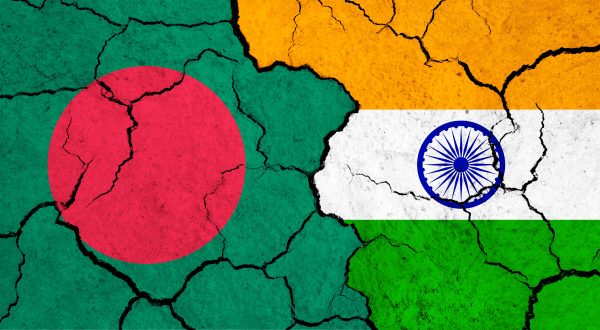
For much of the last decade, Bangladesh was celebrated as the most successful example of India’s “Neighborhood First” policy — a stable, cooperative, strategically aligned South Asian neighbor. From counterinsurgency cooperation to booming trade and unprecedented connectivity, Bangladesh-India relations after 2014 were often described as a rare win in an otherwise turbulent region. Yet, by late 2024 and into 2025, this “Shonali Adhyaya” (Golden Chapter) had begun to look increasingly volatile.
On August 5, 2024, following protests and violence, Prime Minister Sheikh Hasina arrived in India “at short notice for safety reasons.” Her plans to travel to London have since faced a “technical roadblock” and so she continues to reside in India. This has further fueled anti-India feelings in Bangladesh where the International Crimes Tribunal has since pronounced a death sentence upon her.
India’s dilemma today is stark: can Bangladesh still be a strategic partner or has it forever become a political headache?
Skewed Over-Investments
India’s engagement with Bangladesh since 2009 when Sheikh Hasina returned to power had been deep and multidimensional. Bilateral trade rose from $6.2 billion for 2014-15 to $14.24 billion in 2022–23, making Bangladesh India’s largest trading partner in South Asia. It was also India’s largest development partner for this period with India extending four Lines of Credits amounting to $8 billion, the highest to any neighbor, financing railways, ports, power transmission, and roads.
Security cooperation reached unprecedented levels with Dhaka’s “commendable action” against Bangladesh-based safe heavens of insurgents of India’s northeastern region. This had greatly boosted trust and cooperation. At one point, there were 70 ongoing bilateral institutional mechanisms covering security, trade, energy, connectivity, defense, rivers, maritime, science and technology and so on.
But this success perhaps bred skewed over-investments. India began to equate Bangladesh’s stability with regime continuity, assuming that a cooperative government in Dhaka would indefinitely underwrite India’s interests. In hindsight, India’s contingency planning for political disruption, leadership change, or legitimacy crises remained underdeveloped.
Predictability Over Prudence
India’s Bangladesh policy during this period privileged predictability over pluralism. While Western partners repeatedly questioned the credibility of Bangladesh’s elections under Hasina, India not only failed to persuade the opposition to enter the electoral fray but maintained public silence; framing the issue as an internal matter of Bangladesh. This was intended to preserve easy access and influence.
The cost of this approach is now becoming evident. As protests, opposition boycotts, and allegations of political repression intensify, India’s image among Bangladesh’s simmering and once subdued urban middle class and youth — nearly 45 percent of the population is under 25 — reveal their alienation during Hasina’s rule. Small South Asian nations often blame India for problems at home but in Bangladesh, Hasina’s stay in India has transformed anti-India whispers into a powerful mainstream hyperbole.
Bangladesh’s internal polarization means that strategic commitments made by the Hasina government stand politically delegitimized by her opponents. What India treated as institutionalized gains increasingly look like regime-contingent arrangements.
India’s security dividends in Bangladesh — counterterrorism cooperation, intelligence sharing, and transit access to the Northeast — were once seen as irreversible. They were not. Security cooperation has always depended less on treaties than on political consensus within Dhaka, which is currently absent.
The Emotional Trap of 1971
As violence enters the political arena it alters all norms and narratives; frenzied emotions have replaced institutions. Emotions were important in India’s Bangladesh policy as well. This was shaped by memories of India’s role in Bangladesh’s liberation, and intense cultural linkages generating a sense of moral entitlement and obligation absent in India’s relations with Pakistan, Nepal, or Sri Lanka.
This emotional capital once facilitated trust, but also constrained India from staying up to speed with changing ground realities. India now realizes how political discourse in Bangladesh has undergone a “subtle but grave” generational shift and moved decisively beyond liberation nostalgia. A generation born after 1971 evaluates India less as a benefactor and more as a powerful neighbor. India, however, often behaves as if historical goodwill guarantees political alignment forever.
Even even pro-India governments saw incentives in appearing anti-India domestically. Infrastructure projects, transit agreements, and energy imports — many of which objectively benefit Bangladesh — were frequently framed by opposition forces as concessions to India. It helped Sheikh Hasina in silencing her detractors
Of course, radical forces in Bangladesh are also using this anti-India sentiment to externalize responsibility for chaos. GDP growth has fallen from 7.88 percent in 2019 to 3.8 percent for 2025. According to a World Bank report, Bangladesh, which brought 34 million out of poverty during Hasina’s rule, has seen 3 million or more sliding this year below the poverty line. This is what makes India a convenient political foil, engaged yet expendable.
Anxiety about China and U.S.
China and the United States loom large in Indian thinking on Bangladesh, but often in exaggerated form. Both former prime ministers Imran Khan of Pakistan and Sheikh Hasina blamed the United States for their falls, igniting speculation. Simplified dyads are likewise built on Khalida Zia being pro-China and Sheikh Hasina being friendly toward India.
No doubt, Beijing is Bangladesh’s largest trading partner and a major investor with investments under the Belt and Road Initiative totaling $40 billion. But unlike India, China’s political leverage in Dhaka remains transactional rather than ideological or emotional.
Ironically, India’s fear of losing Bangladesh to China and Pakistan weakens its bargaining posture. Dhaka has learned to leverage Sino-Indian-Pak competition, extracting economic benefits from all while committing strategically to none. India’s anxiety has reduced its willingness recalibrate ties or apply pressure for fear of justifying India-as-bully discourse.
At the same time, India’s silence on political violence, media freedom, and human rights, meant to protect bilateral ties, has ceded normative space to Western actors, particularly the United States and the European Union, which have imposed visa restrictions and publicly criticized delays in electoral processes.
As Bangladesh’s crisis becomes internationalized — through diaspora activism, global media, and sanctions debates — India’s traditional preference for quiet bilateralism looks increasingly inadequate.
In this, India’s connectivity without constituencies stands out as a major flaw of India’s Bangladesh engagement. India’s investments in rail links, inland waterways, ports like Mongla and Chittagong, and power grid interconnections have transformed India’s access to its Northeast as also its connectivity with Bangladesh.
Dhaka often projects this connectivity as disproportionately serving Indian strategic and economic priorities, while benefits for ordinary Bangladeshis are less visible. The absence of well groomed India constituencies has allowed connectivity being labeled as asymmetric. Infrastructure without social legitimacy becomes politically vulnerable.
Regime Access vs. State Resilience
At the heart of India’s Bangladesh dilemma lies a structural dilemma. Should India continue to prioritize access to the incumbent regimes, or should it invest in long-term state and societal resilience across political divisions?
So far, India had chosen the former. The risk is clear: if regime legitimacy continues to repeatedly erode, India may find itself closely aligned with governments but increasingly distant from the society they govern.
The Bangladeshi nation is not collapsing but it is surely transforming. Its politics is more volatile, its society more vocal, and its international environment more intrusive. For India, this transformation exposes the limits of its “Neighborhood First” policy; a policy built perhaps more for stability than sustainability.
The proof lies in Bangladesh once being India’s most comfortable neighbor to becoming its most challenging one, forcing New Delhi to confront a difficult truth: strategic partnerships that ignore domestic politics eventually become strategic liabilities.
The challenge for India is no longer how to ensure Bangladesh’s stability, but how to engage a Bangladesh that is politically restless, socially mobilized, and strategically self-aware. Whether India adapts — or remains trapped in its own success story — will shape South Asia’s future way more than any single election coming February.
