
Bangladesh’s Welfare Fund Case and the Warning India Should Not Miss
International
oi-Gaurav Sharma

Bangladesh's growing unrest is often explained as a political problem - a messy transition, rival factions colliding, or old grievances resurfacing. That explanation is convenient, but it does not fully explain what is unfolding on the ground. What the country is experiencing today looks less like a sudden breakdown and more like the delayed outcome of weakened institutions, where accountability thinned out quietly and law slowly lost its deterrent power.
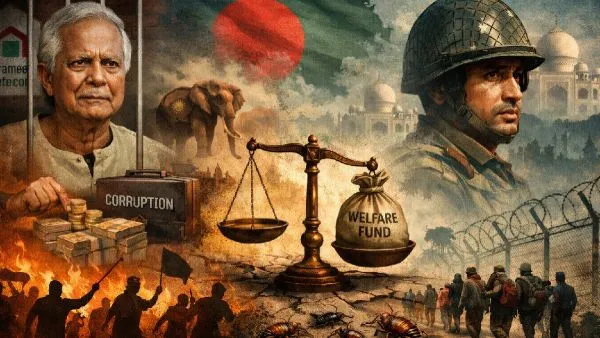
Seen from that perspective, the Grameen Telecom welfare fund case involving Muhammad Yunus is not an isolated corporate dispute. It is a signal. And for India, it is one that deserves attention.
The article discusses the Grameen Telecom welfare fund case involving Muhammad Yunus in Bangladesh, where a portion of profits meant for employee welfare was allegedly moved without worker consent, and its implications on the country's rising instability. It highlights the erosion of trust in institutions and the potential spillover effects for neighboring countries like India due to weak governance.
A Legal Obligation, Not a Grey Area
The case centres on a requirement that leaves little room for interpretation. Under Bangladesh's labour laws, companies are mandated to set aside a portion of their profits for employee welfare. This money is legally protected. It is not meant to circulate within corporate accounts or be used at management's discretion. Its purpose is narrow by design: worker welfare, support, and security.
In the Grameen Telecom matter, Bangladesh's Anti-Corruption Commission has alleged that roughly Tk 25 crore collected under this provision was moved into structures controlled by management, without worker consent. Yunus, who previously served as chairman of the company, has denied wrongdoing and described the case as harassment. The matter is before the courts, and legally, the presumption of innocence applies.
That legal process will take its course. But the broader significance of the case lies elsewhere.
Reputation and the Cost of Deferred Scrutiny
For decades, Yunus has enjoyed an extraordinary level of public trust, both inside Bangladesh and internationally. His work in microfinance placed him in a category few others occupy - not merely as a corporate leader, but as a moral figure. Over time, that stature shaped how institutions linked to him were viewed. Scrutiny softened. Oversight became less urgent.
This is not unique to Bangladesh. Across many countries, organisations built around social missions often benefit from reputational insulation. The risk is structural. When compliance depends on goodwill rather than enforcement, legal boundaries become elastic. Welfare funds exist precisely to prevent that drift - to ensure workers' rights do not hinge on intent or reputation.
Any serious dispute over how such funds were handled cuts directly into public confidence.
Disorder Does Not Appear in Isolation
Bangladesh today is seeing a troubling rise in mob violence, attacks on journalists, intimidation of minorities, and incidents triggered by rumours spreading online. These are often discussed as separate law-and-order failures. In reality, they share a common root.
Violence thrives when people stop believing that rules are applied evenly. When citizens suspect that influence matters more than law, the authority of institutions weakens. In that space, informal power takes over - mobs act where courts are mistrusted, and fear fills gaps left by enforcement.
This is where the welfare fund case intersects with the wider instability. Whether or not it is ultimately proven in court, it reinforces a perception - already widespread - that the system bends under weight. And perceptions, in fragile moments, matter as much as verdicts.
Workers, Trust, and the Quiet Breakdown
Perhaps the most revealing part of this story has little to do with politics. Workers quoted in Bangladeshi media have said they were unaware of the scale of welfare funds accumulated in their name and felt disconnected from decisions about their use. Their frustration is practical, not ideological.
When workers lose faith in the protections promised by law, distrust spreads quickly. It moves from workplaces to neighbourhoods, from institutions to the state itself. In Bangladesh, that erosion is now visible in public life.
Why India Cannot Treat This as Internal Noise
Bangladesh's instability does not end at its borders. History has shown that political disorder, economic stress, and communal tension there often produce spillover effects - refugee pressure, cross-border crime, radical networks, and security challenges along India's eastern frontier.
Weak governance creates openings. When a state struggles to enforce labour protections against influential institutions, it raises questions about its capacity to deal with more serious threats. For India, this is not speculation. It is a pattern observed repeatedly in the region.
A Larger Choice Bangladesh Is Being Forced to Make
The Yunus case does not cancel past achievements, nor does it determine guilt. That remains the court's responsibility. But it has forced a question into public view that Bangladesh can no longer avoid.
Does law still outweigh reputation? Or has influence quietly replaced enforcement?
Bangladesh appears to be approaching a point where that question will be answered not by speeches or elections, but by outcomes. Either accountability becomes visible and consistent - regardless of stature - or violence and informal power will continue to set the rules.
The welfare fund case is not a distraction from Bangladesh's unrest. It is part of the same story. And for India, watching developments next door, it is less a headline than a warning.
(Ashu Mann is an Associate Fellow at the Centre for Land Warfare Studies. He was awarded the Vice Chief of the Army Staff Commendation card on Army Day 2025. He is pursuing a PhD from Amity University, Noida, in Defence and Strategic Studies. His research focuses include the India-China territorial dispute, great power rivalry, and Chinese foreign policy.)
-

Video: Split-Second Turn, Truck Topples Onto Bolero in Rampur, Driver Crushed to Death
-

Two Key Suspects in Osman Hadi Murder Escaped to India via Meghalaya Border: Dhaka Police
-
What Is Somaliland, Where Is It and Why Israel’s Recognition Has Sparked Global Backlash
-

8th Pay Commission Update: Estimated Pay Scale Revision and Fitment Factor for Level 1 to 18 Explained
-

Bajrang Dal Workers Beat 2 Muslim Men Attending Hindu Friend's Party
-

‘80 Drones in 36 Hours’: Pakistan Confirms Strike on Nur Khan Airbase in Operation Sindoor
-

Tamil Nadu Train Attack on Migrant Worker: Four Juveniles Detained After Viral Video Sparks Political Row
-

Aries Horoscope For Today, December 28, Sunday - You Will Feel On Top Of The World!
-
Bangladesh Responds To India Over Hindu Minorities Violence And Diplomatic Tensions
-

Gold, Silver Rate Today, December 29: Gold at Record High, MCX Gold Near Rs 1.40 Lakh, Silver Soars
-
Fuel Only With PUCC, Permanent Ban on Non-BS6 Vehicles in Delhi: Environment Minister Sirsa
-

Mexico: 13 Dead, Nearly 100 Injured After Interoceanic Train Derails in Oaxaca


