
2025 in South Asia: A Year of Economic and Political Shocks
Every year is eventful in South Asia. But 2025 wasn’t just turbulent; it destabilized the region structurally. This was due to the convergence of multiple shocks. Many countries in the region experienced domestic political upheaval, interstate military escalation, and climate disasters. Long-held assumptions on the role of exports, especially to developed countries, collapsed due to the tariffs imposed by the United States. These developments took place at a time when millions of South Asians were quickly losing patience with the political establishments that had long ruled these countries.
South Asia seemed to be on the verge of a polycrisis, but South Asian elites haven’t been able to present a new path forward. The only thing that remained unchanged during the year was the acrimonious relationship between India and Pakistan.
Return of Mass Politics, and the Crisis of Representation
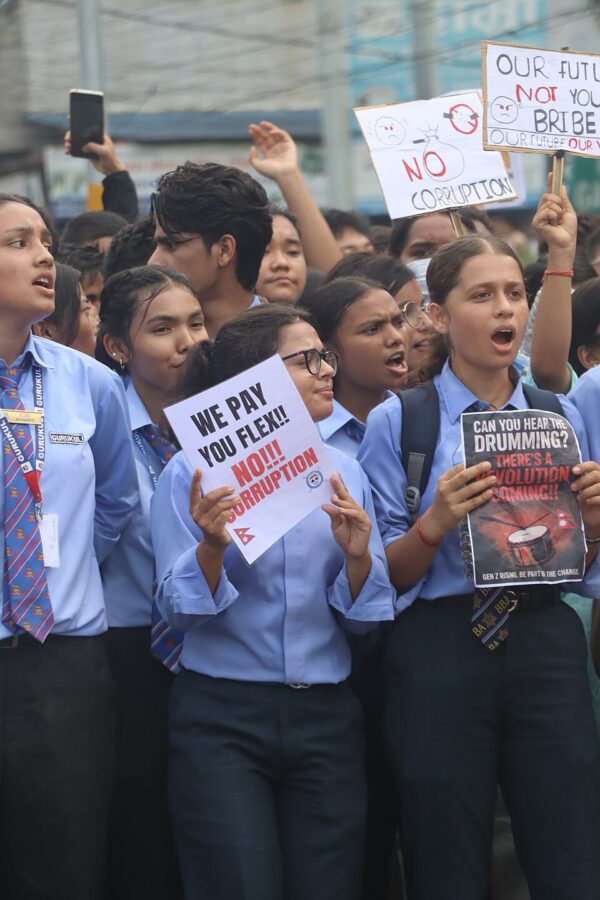
As in 2024, mass politics in the form of protests toppled a South Asian government in 2025. In Nepal, youth-led protests in September forced the resignation of Prime Minister K. P. Sharma Oli. The immediate triggers for the protests ranged from bad governance to arrogant elites who can’t read the room, but the deeper drivers – economic precarity, rising unemployment and living costs, and a political system that does not offer meaningful participation – were unmistakable.
Nepal’s upheaval was not an anomaly, but a continuation of earlier mass movements in Sri Lanka (2022) and Bangladesh (2024) led by digitally connected youth and supported by political parties. The success of these anti-elite mobilizations should have alerted the Oli government, but it was slow in learning from the mistakes of others, like many fossilized South Asian political establishments.
However, despite the success of these movements in removing incumbents from power, except for Sri Lanka, they have struggled to translate disruption into institutional renewal. In fact, the events of 2025 showed that the gap between political mobilization and political transformation was widening. Nearly a year and a half after the departure of Bangladesh’s Sheikh Hasina, reform remains partial and contested. None of the main Bangladeshi political parties has moved away from traditions of centralized leadership, opaque financing, and patronage.
In the case of Sri Lanka, the National People’s Power (NPP), which was not part of the political establishment and has extensive cadre-based organizational structures, was a natural choice for many disgruntled voters. There is no such party waiting in the wings either in Bangladesh or Nepal. Religious and identity-based parties such as the Bangladesh Jamaat-e-Islami seem to have gained ground because they have better organizational discipline and grassroots networks, but whether the emergence of Islamists as a strong political force is a positive development for Bangladesh remains to be seen.
Meanwhile, new political groups, including student-led parties, seem to be popular among certain sections in urban areas and have garnered social media attention. Yet, these groups have little organizational reach beyond metropolitan centers. Law and order has not been restored and violence has become normalized in Bangladesh. Instead of restoring democratic credibility, these dynamics have deepened public cynicism ahead of crucial elections scheduled for early 2026 in Bangladesh and Nepal.
India-Pakistan: Escalation Under the Nuclear Shadow
If domestic upheaval constituted one axis of instability, interstate conflict constituted another. The military conflict between India and Pakistan in May was the most serious military confrontation between the two nuclear-armed rivals in decades. As target sets expanded, and the two strongest nations in the region carried out deeper strikes, sustained missile and air operations, and overt nuclear saber-rattling, other nations in South Asia could only watch helplessly.
A ceasefire was eventually secured, following the involvement of the United States. However, the confrontation has likely fundamentally altered regional risk perceptions. The Indian government has said it now considers major terrorist attacks as acts of war and that its responses, using conventional weapons, would not be constrained by nuclear risk. This is a departure from earlier restraint-focused doctrines.
The conflict also brought forth another fault line: water security. During the crisis, the Indus Waters Treaty briefly became part of the strategic calculation. Indian media hinted that, as the upper riparian country, India could wield strategic pressure. The World Bank-brokered treaty allocates about 80 percent of the river’s waters to Pakistan, whose agriculture relies heavily on the Indus waters. In a region already under climate stress, even limited disruption in the timing of water releases, rather than an outright cutoff, could trigger food shortages, inflation, and social unrest, raising the risk of escalation between two nuclear-armed neighbors.
Ultimately, the crisis revived long-standing concerns about South Asia’s crisis-management architecture, the importance of SAARC, and the power the U.S. wields over both India and Pakistan.
Trump’s Tariffs and the Collapse of Export Assumptions
Protectionism expanded and accelerated in 2025, driven by the new administration in the United States. U.S. President Donald Trump moved quickly to impose tariffs on all countries that traded with the U.S, tightened rules of origin, and linked market access explicitly to labor, migration, and strategic concessions.
The United States is the largest single export partner for many South Asian nations. Around 18 percent of Indian and Pakistani exports are sent to the U.S. The figure is about 25 percent for Sri Lanka, and 20 percent for Bangladesh. Thus, the consequences were immediate and severe.
The impact was most acute in Bangladesh and Sri Lanka, both heavily dependent on garment exports to the U.S. In Bangladesh, garments account for more than four-fifths of export earnings. Sri Lanka is in a similar situation. Apparel exports account for over 40 percent of export revenue. The sector employs over 350,000 people directly. While both countries now face a tariff of about 20 percent for their exports, down from the over 40 percent that was initially proposed, the new tariffs squeeze margins in the industry that employs millions, particularly women.
India faces a different but equally consequential challenge. Although its export basket is more diversified than Sri Lanka or Bangladesh, Trump’s tariffs, restrictions on H-1B visas, remittances, and curbs on energy imports undermined New Delhi’s assumption that strategic alignment with Washington would shield it from economic coercion. India’s plight in 2025 revealed the costs of hedging in a world where market access itself has become a geopolitical weapon.
While Pakistan’s export exposure to the U.S is significant, the economic pressure it was subjected to in 2025 was softened by the fact that Islamabad seems to have become strategically important to Washington, particularly after the India–Pakistan crisis. Trump’s repeated claiming of credit for the ceasefire between the two countries and declaration that India lost seven aircraft in its war with Pakistan embarrassed India.
Across South Asia, U.S. tariffs shattered a core post-1990s assumption: that export-oriented growth would remain insulated from geopolitics. Globalization is running out of steam, and South Asian economies, already constrained by debt, inequality, and climate risk, now need to find a new economic paradigm, fast.
U.S. Volatility Replaces Strategic Predictability
Trump not only disrupted trade but also exacerbated volatility in South Asia’s strategic environment. India’s early optimism about Trump 2.0 quickly faded over tariffs, immigration restrictions, and energy sanctions. Many believed that New Delhi was an indispensable ally for the U.S. in its attempts to contain China and that India could shape Washington’s behavior because of this importance. Both assumptions have been significantly undermined.
Pakistan, by contrast, received unexpected diplomatic goodwill from the United States. Counterterrorism cooperation, renewed Gulf engagement, and U.S. interest in regional stability elevated Islamabad’s strategic relevance.
Smaller South Asian countries were pushed toward hedging strategies, diversifying partners, deepening ties with China, and prioritizing economic autonomy. The result was a region less anchored to any single external power, but also more exposed to great-power bargaining.
China’s Steady Hand and India’s Neighborhood Dilemma
In 2025, China emerged as the steadier, more reliable partner for many South Asian nations. Beijing continued infrastructure investment and diplomatic engagement across South Asia, particularly in Bangladesh, Sri Lanka, and Nepal. China has also avoided entanglement in domestic political disputes. This restraint enhanced China’s image as a predictable, if transactional, partner during a period of uncertainty.
On the other hand, India’s relationship with its neighbors suffered several setbacks. Relations with Bangladesh deteriorated following the ouster of Sheikh Hasina. In Nepal, anti-elite protests included strands of skepticism toward India itself.
These developments highlighted a central challenge for India in 2026. As it pursues its ambitions to be a global power, its stock in South Asia has fallen. On the other hand, there is no guarantee that the U.S will come to India’s aid during a faceoff with China, which is rapidly becoming not only the largest economy in the world but also a leader in key technologies of the future.
Climate Change, Cyclone Ditwah, and the Limits of State Capacity
Climate change was a direct driver of political, economic, and governance stress. Cyclone Ditwah struck Sri Lanka in late November and overwhelmed a country with weakened state institutions due to IMF-induced austerity.
Sri Lanka received nearly 13 billion cubic meters of water in just 24 hours on November 28. This is equal to about 10 percent of Sri Lanka’s average annual rainfall. Floods and landslides affected all 25 districts, displaced over 2 million people, damaged or destroyed more than 100,000 homes, and inflicted a $4.1-billion loss on agriculture, transport infrastructure, energy systems, and enterprises. Ditwah was a systemic stress test for Sri Lanka’s NPP government, as well as the country’s fiscal resilience and social contract.
Sri Lanka is not the only country vulnerable to climatic shocks. In Bangladesh, rising sea levels and cyclones threaten export zones and urban labor markets. In Pakistan, floods and heatwaves destroy crops and lead to the displacement of hundreds of thousands. In India, water scarcity increasingly shapes electoral politics and inter-state tensions. Climate shocks are no longer sporadic; they are structural disruptors that influence debt, inequality, migration, and political legitimacy.
Maldives: Managing Strategic Anxiety in a Climate-exposed State
The Maldives offered a subtler lesson in 2025 on how a small state can recalibrate strategically without triggering regional escalation.
At the start of the year, many expected the Maldives to become a geopolitical flashpoint. President Mohamed Muizzu had come to power criticizing Indian military presence in the Indian Ocean archipelago. Many considered him to be closely aligned with China. Early disputes over Indian-operated surveillance aircraft, Chinese research vessel visits, and Pakistani naval port calls seemed to confirm these beliefs.
Yet by year’s end, the Maldives had stabilized relations with India, culminating in Prime Minister Narendra Modi’s visit to mark the 60th anniversary of Maldivian independence. Activities that might have provoked alarm in New Delhi were deliberately downplayed rather than amplified into crises.
Climate vulnerability remains central to the Maldives’ diplomacy. As one of the world’s most climate-exposed nations, sea-level rise and extreme weather shape its foreign policy priorities. In 2025, climate finance and adaptation featured as prominently as security, allowing Malé to frame partnerships around shared survival imperatives rather than alignment.
Afghanistan and the Collapse of Old Assumptions
One of the strategically significant but often under-scrutinized developments of 2025 was the deepening rift between Pakistan and the Taliban authorities. Rising militant attacks inside Pakistan, cross-border strikes, and diplomatic breakdowns underscored the collapse of Islamabad’s long-held assumption that a Taliban government would guarantee security.
India seems to have a better relationship with Afghanistan as they work with Kabul to protect humanitarian interests and avoid strategic isolation. This is another example of the unravelling of long-standing regional assumptions in 2025, leaving South Asian states navigating unfamiliar strategic terrain.
A Region at a Crossroads
As 2025 drew to a close, South Asia stood at a crossroads. Elections scheduled for 2026 in Bangladesh and Nepal will test whether political systems can absorb popular demands without reverting to repression or elite bargains. India and Pakistan face a more dangerous deterrence environment than at any time in two decades. Export-dependent economies confront a harsher global trade regime with limited room for maneuver.
The defining question is no longer whether South Asia is changing, but whether institutions can adapt fast enough to manage that change. The year revealed immense political energy, especially among younger generations, but also the persistence of patronage, intolerance, and strategic mistrust.
2025 was a warning for South Asian political elites. Without deeper democratic reform, credible economic inclusion, climate resilience, and regional crisis management, the shocks of this year risk becoming the new normal for South Asia.
