
‘Respectful Responder’: How India Is Reshaping Regional Security Partnership
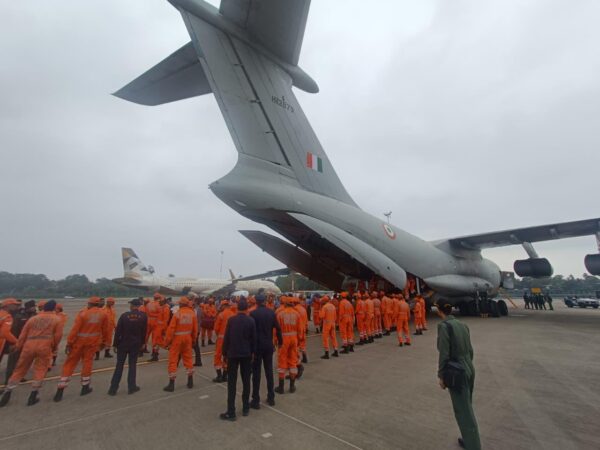
In the last week of December, India announced a $450 million “reconstruction package” for Sri Lanka to help the island nation recover from the devastating impact of Cyclone Ditwah. The cyclone battered Sri Lanka in late 2025 and the Indian Navy undertook comprehensive humanitarian assistance and disaster relief (HADR) operations under Operation Sagar Bandhu. Indian naval ships INS Vikrant and INS Udaygiri, which were present in Colombo as part of the 75th Anniversary International Fleet Review (IFR-2025) of the Sri Lanka Navy, were tasked at short notice to provide immediate relief based on emerging requirements ashore. Ship-borne helicopters were deployed for aerial reconnaissance of the affected areas and augmented ongoing search and rescue efforts. INS Sukanya was also deployed, carrying critical relief supplies.
Operation Sagar Bandhu represented the distinct approach to regional engagement that India has been carefully cultivating: being a “respectful responder” rather than an uninvited provider.
For years, India has grappled with the label of “net security provider” – a term first coined by U.S. officials at the 2009 Shangri-La Dialogue to describe India’s emerging role in the Indian Ocean Region. The net security provider framework, while acknowledging India’s growing capabilities, carried uncomfortable implications. It suggested comprehensive coverage, unilateral responsibility, and by extension, a big-brother posture that made smaller neighbors nervous. Pakistan’s warnings about Indian hegemonism, the Maldives’ “India Out” campaign, and Bangladesh’s consistent hedging behavior all reflected regional discomfort with the idea of India as a self-appointed regional policeman.
The 2020 shift toward describing India as a “preferred security partner” represented strategic recalibration. As then-Foreign Secretary Nirupama Rao candidly admitted in 2010, India cannot carry the burden of regional security alone. The question wasn’t whether India should play a role – its geography, economy, and military capabilities make engagement inevitable – but how that role should be framed and operationalized. The answer, increasingly evident in operations like Sagar Bandhu, lies in what I call the “respectful responder” framework.
Three principles define this approach. First, no unsolicited intervention. India waits for a request from the impacted neighbor. New Delhi, due to its own colonial experiences, respects sovereignty in a region where colonial memories remain fresh and interference anxieties run deep. When the 2004 tsunami struck, India’s immediate response to its own citizens was followed by assistance to neighbors only after formal requests. Cyclone Ditwah relief came after Sri Lankan authorities reached out, not because New Delhi decided Colombo needed help.
Second, no political conditionality. Unlike development assistance that comes tangled with governance reforms, debt restructuring, or strategic alignments, India’s humanitarian response remains apolitical. When Operation Sagar delivered COVID-19 supplies to the Maldives in 2020 – even as the “India Out” campaign demanding withdrawal of Indian military personnel was gaining steam in the Maldives – New Delhi didn’t leverage the crisis for concessions. The medical supplies and vaccines arrived without quid pro quo negotiations. This stands in sharp contrast to concerns about China’s “vaccine diplomacy,” where COVID-19 vaccines were leveraged to force political concessions, or Western humanitarian intervention debates around “responsibility to protect” that can morph into regime change justifications.
Third, host government authority remains paramount. Indian naval personnel don’t establish independent command structures or bypass local authorities. They work through, not around, national governments. This deference to local leadership, even when it slows operations, builds long-term trust more effectively than efficient but high-handed interventions. In Sri Lanka’s case, relief distribution coordinated with local disaster management authorities, ensuring Indians were seen as supporting partners rather than taking over.
This framework addresses the inherent contradiction in India’s regional position. On one hand, India’s peninsular geography, two aircraft carriers, and expanding naval capabilities make it the obvious regional power. With 80 percent of its trade and 90 percent of energy resources passing through the Indian Ocean, New Delhi has enormous stakes in maritime security. On the other hand, India faces continental threats from China and Pakistan, budget constraints that limit platform acquisition, and a defense industry still recovering from decades of import dependence. The Navy’s 130 ships, while substantial, fall short of the estimated 200 vessels needed for sustained coverage across both the Arabian Sea and Bay of Bengal simultaneously.
The respectful responder approach reconciles ambition with capacity. Rather than claiming comprehensive security provision – which India cannot deliver – it positions India as the regional actor that neighbors actively choose to call first. This preference must be earned repeatedly through reliability, noninterference, and genuine partnership. Cyclone Ditwah relief is part of a track record, following India’s similar responses to Cyclone Mocha in Myanmar in 2023, repeated floods in Bangladesh, and the 2014 Malé water crisis. Each successful operation without political strings attached incrementally shifts regional perceptions.
Yet, challenges remain. China’s presence in the Indian Ocean – from the Djibouti base to submarine deployments at Colombo and Karachi – and its Belt and Road Initiative offers alternatives that smaller states exploit for hedging. Beijing’s deeper pockets mean it can outbid India on infrastructure projects. Its willingness to supply arms commercially – China provides 63 percent of Pakistan’s defense imports and 71 percent of Bangladesh’s – appeals to governments wary of Western conditionality and Indian hegemony.
India can’t match Chinese spending, but it has other advantages: geographic proximity enabling 48-hour response times, cultural and historical ties reducing threat perceptions, and crucially, non-hegemonic intent backed by constitutional commitment to peaceful coexistence. Article 51 of India’s Constitution mandates promoting international peace, maintaining just relations between nations, and resolving disputes through arbitration – principles that, when operationalized consistently, differentiate Indian engagement from both Western interventionism and Chinese transactionalism.
The respectful responder framework also requires domestic investments within India. Technological upgrades – unmanned systems, artificial intelligence-enabled maritime domain awareness, and enhanced satellite surveillance – remain underfunded relative to continental defense priorities. As things currently stand, the Andaman and Nicobar Islands’ strategic potential stays partly unrealized. Budget allocations for sustained humanitarian stocks and rapid deployment capabilities compete with weapons procurement for China and Pakistan contingencies.
As Cyclone Ditwah relief operations wind down, the question isn’t whether India can be a net security provider – clearly, comprehensive coverage exceeds its current capabilities. The question is whether India can consistently be the partner that regional states call first, confident that assistance will arrive swiftly, operate respectfully, and leave without overstaying or extracting political prices. Operations like Sagar Bandhu suggest the answer is increasingly yes. But maintaining that preferred status requires continuous investment – in capabilities, certainly, but also in respect that can create collaborative partnerships.
The Indian Ocean’s future security architecture won’t be unipolar Indian dominance or Chinese displacement of Indian influence. It will be multipolar engagement where smaller states choose partners based on demonstrated reliability and genuine respect for sovereignty. Geography and capabilities create advantages, but only sustained respectful response converts those advantages into the preference that truly matters.
