
At A New York Literary Gathering, A Classical Indian Language Makes A Contemporary Global Claim
International
oi-Oneindia Staff

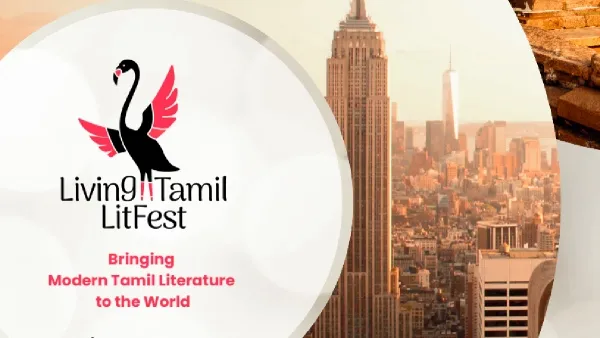
NEW YORK, On Fifth Avenue, where institutions narrate the long memory of Western medicine, art, and learning, another archive of human experience will briefly take centre stage this spring. Inside the New York Academy of Medicine, on April 3 and 4, a language far older than the buildings that surround it will speak to the world not in reverence, but in conversation.
The Living Tamil LitFest, organized by the Vishnupuram Literary Circle (USA), will be held at the New York Academy of Medicine on April 3rd and 4th, seeking to bring modern Tamil literature to a global audience. The festival, featuring writers and translators from across the globe, aims to explore the rich literary tradition through translation, dialogue, and contemporary themes, including caste, gender, and modern life.
The Living Tamil LitFest, organised by the Vishnupuram Literary Circle (USA), is an attempt to reposition modern Tamil literature within global literary discourse. It does so without spectacle, celebrity theatrics, or market urgency. Instead, it relies on writers, translators, and readers, many of them spread across continents, to argue, patiently and persuasively, that one of the world's most enduring literary traditions still has much to say about the present.
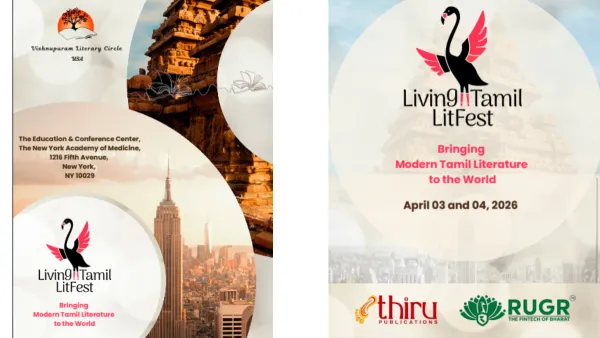
Tamil is among the oldest living classical languages, yet its modern literature, shaped by colonialism, social reform, radical politics, and migration, remains largely inaccessible beyond its linguistic borders. The New York festival seeks to change that condition, not by simplifying the literature, but by trusting translation, dialogue, and sustained attention.
A literary project, not a showcase
Unlike large international festivals that function as cultural tourism, Living Tamil LitFest has been conceived as a working literary forum. All sessions will be conducted in English, with Tamil discussions translated in real time, an editorial choice that reflects the festival's core audience: second- and third-generation Tamils abroad, non-Tamil readers, translators, scholars, and writers curious about literary traditions beyond the Anglophone canon.
The organising body, Vishnupuram Literary Circle, is a non-profit organisation formed by readers and writers who have spent more than a decade building an ecosystem around Tamil literature. Its work ranges from translation initiatives and editorial mentorship to year-round online discussions and annual in-person forums in the United States. The New York edition marks its most outward-facing effort so far.
The stated aim is precise: to bring modern Tamil literature to global readers and to younger members of the Tamil diaspora who may no longer read the language fluently but still seek a cultural and intellectual inheritance.
The modern Tamil imagination
Modern Tamil literature emerged through rupture rather than continuity. From the early twentieth century onwards, writers challenged religious orthodoxy, caste hierarchies, feudal morality, and literary conservatism. Figures such as Pudhumaipithan, Ka. Na. Subramaniam, Ku. Azhagirisamy, Sundara Ramaswamy, Ashokamitran, and K. Rajanarayanan redefined realism, irony, and narrative economy in Indian writing, often decades ahead of broader national recognition.
What distinguishes this tradition is not merely its themes but its discipline. Tamil prose, at its best, is spare, ethically alert, and resistant to sentimentality. It is a literature that distrusts easy resolution.
The festival's programme reflects this lineage. Writers from India, Sri Lanka, Singapore, Malaysia, Switzerland, Canada, Australia, and the United States will speak not only about their work, but about the conditions that produced it: civil war, displacement, urbanisation, caste violence, gendered labour, ecological loss, and the pressures of modern life.
Writers across borders
Among the central figures at the festival are A. Muttulingam and Jeyamohan, two writers whose careers represent distinct yet complementary trajectories within Tamil literature.
Muttulingam, born in Sri Lanka and long based in Canada, is known for his quietly observant short stories and essays shaped by travel, exile, and an unforced humanism. His work resists ideological noise, favouring clarity of perception.
Jeyamohan, one of contemporary India's most prolific literary intellectuals, has produced an expansive body of novels, criticism, biographies, and philosophical writing. His influence extends beyond literature into debates on ethics, tradition, and modernity. Vishnupuram Literary Circle itself originated as a readers' collective around his work.
Their presence signals the festival's seriousness: this is not a sampling of voices, but a sustained engagement with the intellectual spine of modern Tamil writing.
Translation at the centre
If there is one unifying theme at Living Tamil LitFest, it is translation, not as a secondary act, but as a form of authorship.
Sessions led by translators such as N. Kalyana Raman, Priyamvada Ramkumar, Suchitra Ramachandran, and Thomas Hitoshi Pruiksma will examine the practical and ethical demands of translating Tamil literature into English. Questions of caste registers, regional idiom, humour, silence, and narrative rhythm will be central to these discussions.
Pruiksma's recent translation of the Tirukkural has demonstrated how classical Tamil thought can speak meaningfully to contemporary global audiences without being flattened. Younger translators-many of them students and early-career writers from the Tamil diaspora-will also present their work, pointing to a future in which translation is both cultural recovery and creative practice.
The emphasis is deliberate. For a literature to travel, it must be translated well, and with humility.
Beyond nostalgia
Diaspora cultural events often lean towards memory and loss. Living Tamil LitFest consciously avoids this posture. The programme focuses on contemporary writing, current debates, and unresolved questions. Panels will address Sri Lankan war literature, feminist and Dalit writing, experimental fiction, the relationship between cinema and literature, and the evolving politics of language.
Writers such as Perundevi Srinivasan, Sayanthan, Tamizh Prabha, Vennila Ambalavanan, Lakshmi Saravanakumar, and others bring with them a range of social and aesthetic commitments. Their work insists that Tamil literature is not a closed tradition, but one constantly negotiating power, history, and form.
Cultural visibility without dilution
The festival has received public support from figures such as Kamal Haasan and Mani Ratnam, artists who have carried Tamil narratives to global audiences through cinema. Their endorsement adds visibility, but the festival itself remains anchored in literature rather than celebrity.
That distinction matters. Living Tamil LitFest is not seeking validation from the global centre; it is asserting presence. By hosting the festival in New York, the organisers are placing Tamil literature within the everyday geography of global intellectual exchange.
A quiet confidence
There is something deliberately restrained about the way Living Tamil LitFest presents itself. No grand claims are made about universality or supremacy. Instead, the festival offers something rarer: confidence without insistence.
At a time when English dominates global publishing, initiatives like this suggest another model, one in which world literature is expanded not by assimilation, but by attentive listening. Tamil literature, in this setting, does not ask to be accommodated. It asks to be read.
For two days in April, in a building devoted to knowledge and care, that request will be made plainly. And for those willing to listen, it may change how the map of contemporary literature is drawn.
(Ashutosh Kumar Thakur is a writer, literary critic, and curator based in Bangalore.)
-
Hyderabad Gold Silver Rate Today, February 6, 2026: Gold Falls Again, Silver Drops ₹20,000 Per Kg
-
New OTT Releases This Week: 33 New Films & Series In Telugu, Tamil, Bengali, Hindi In Feb 1st Week
-
With Love Movie Review: Soundarya Rajinikanth's Film Gets Rave Response
-
Hyderabad High-Speed Bullet Train Corridors Linking Major Cities Announced, Kavach Centre Announced
-
Gold Silver Price Today, February 6, 2026: City-Wise Precious Metals Face Volatility As Silver Extends Losses
-
Harshit Rana Ruled Out Of T20 World Cup 2026, Mohammed Siraj Replaces Him In India Squad
-
US Warning To Citizens To Leave Iran Resurfaces As Nuclear Talks Set To Begin In Oman
-

Dhurandhar Lifetime Box Office Collection: The Journey of Rs 28 Cr Opening To Rs 1300 Cr Worldwide
-
Punjab AAP Leader Lucky Oberoi Shot Dead In Jalandhar Outside Gurudwara
-
Bengaluru–Chennai Highway Disruption Enters Day 3 as NH 44 Cave In Hits Chandapura and Attibele
-
Advantage Vidarbha 2026: Jeet Adani Outlines ₹70,000 Crore Vision To Power Region’s Growth
-
U19 World Cup 2026: India Bags Title For The 6th Time, Who's The Star Performers, Key Stats And Key Highlights


