
Bangladesh heading towards absolute uncertainty
There are moments in the life of a nation when the political noise is so deafening, the confusion so layered, that one must pause to examine the deeper tremors beneath the surface. Bangladesh, today, stands at such a crossroads—bruised by reckless rhetoric, weakened by factional zeal, and drifting toward a horizon clouded with perilous uncertainty. And what makes this moment particularly unsettling is not only the chaos emanating from within, but also the dangerously muddled narratives shaping the country from without.
Take, for instance, the astonishing remarks by Lt Gen Ahmed Shareef Chaudhry of Pakistan’s ISPR, who placed Imran Khan and Sheikh Mujibur Rahman in the same category of “traitors.” That alone would have been offensive, ahistorical, and deeply manipulative. But the real tragedy lies in how certain political factions in Dhaka have begun echoing the same distortions—downgrading our Liberation War to a mere “resistance movement” or, worse, painting it as an Indian conspiracy. If this were simply political mischief, one might ignore it. But it is more than that: it is a calculated attempt to hollow out the moral core of Bangladesh’s sovereignty.
Nations do not crumble only when borders are breached; they crumble when their founding truths are delegitimized from within. When history becomes negotiable, identity becomes unstable. And once identity is unstable, sovereignty becomes a matter of convenience rather than conviction. Bangladesh is now experiencing that slow-motion erosion.
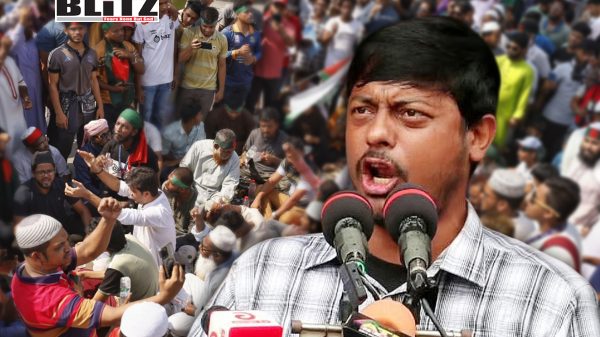
Then comes the reckless bravado of politicians desperate for relevance. A leading figure from the National Citizen Party (NCP), Nasir Uddin Patwary, recently threatened that India’s investments in Bangladesh would be “destroyed” if New Delhi dared to poke their noses in the coming election. This is not statesmanship. This is the vocabulary of a bar-room brawl. Foreign investment is not a switch that can be turned on and off at will; it is a fragile ecosystem built on trust, consistency, and the perception of long-term stability.
Threatening one major investor today, and others—China, the United States, Japan—will instinctively reach for the exit tomorrow. Investors hate uncertainty more than anything else, and they flee from countries where politics replaces policy, where threats replace diplomacy, and where unpredictability becomes routine. Bangladesh has worked for decades to shed its reputation as a volatile frontier market. It would be a tragedy to revert to that past because of a few loud voices intoxicated by short-term populism.
But instability is never only external; it grows from within. Our remittance lifeline—one of the engines of the national economy—is showing alarming signs of strain. The misconduct of a minority of expatriate workers has begun to tarnish the reputation of the many. Countries that once welcomed Bangladeshi laborers are tightening their gates. The same pattern is evident among Bangladeshi students abroad, many now facing unprecedented scrutiny. When a nation’s young people are treated with suspicion overseas, the damage is not merely diplomatic or economic; it eats away at long-term opportunity.
Into this already precarious environment stepped Dr Muhammad Yunus, hailed by some as the moral savior who would restore Bangladesh’s fractured democracy. Yet the rise of ultraconservative and extremist elements during the same period casts a long shadow over those expectations. It would be unfair not to blame Dr Yunus personally for every spike in radical activity. He patronized and globalized the radical figures as his legitimizers. And leadership, especially moral leadership, is measured not only by personal accomplishments but also by the environment one cultivates. And that environment today is more combustible than ever.
Bangladesh is now routinely grouped with Pakistan in security assessments—an unsettling development for a country that fought a bloody war to escape Pakistan’s political and ideological shadow. When extremism expands its footprint, investment contracts, diplomacy becomes defensive, and global perceptions harden in ways that are difficult to reverse.
The West seeks to discipline Bangladesh simply because it is a Muslim-majority nation. The turmoil in countries like Syria, Libya, Iraq—even Bangladesh—and claim that wherever political change has erupted through mass movements in the Muslim world, stability has remained elusive, often deteriorating further with time. By contrast, it’s note that nations such as Nepal, Sri Lanka, or Thailand—non-Muslim societies that experienced similarly disruptive political transitions—managed to restore order within months.
The Western nations truly harbored an inherent hostility toward Muslim-majority countries. It is observed globally that the western nations are conspiring with urgent issues like weakening institutions, rising extremism, declining investor confidence, and a political culture addicted to confrontation rather than compromise. To make their agenda successful, they spend billions of dollars through NGOs and other channels.
Which brings us to the final and perhaps most ominous point: the seductive illusions of “imminent change.” Revolutions are easy to romanticize, especially by those who believe they will inherit the power that follows. But change, unmanaged and unmoored from institutional safeguards, can be catastrophic. Nations do not drift into chaos overnight; they are nudged toward it by those who shout the loudest about salvation without offering a roadmap to stability.
In Bangladesh today, the voices celebrating “transition” sound less like reformers and more like arsonists holding a match over a dry field. Their slogans promise rebirth, but their methods invite breakdown. And breakdown, once triggered, rarely stops at the point its architects intend.
Bangladesh stands on a dangerous precipice—its politics polarized, its global reputation bruised, its economic prospects narrowing, its historical foundations under assault. This is a moment that demands sobriety, not showmanship; patriotism, not provocation; leadership, not loudness.
History is full of nations that mistook turbulence for transformation and paid a terrible price. The challenge for Bangladesh now is to step back from the brink, reject the politics of reckless rhetoric, and rebuild the civic stability that once allowed it to rise against all odds. The uncertainty ahead is real. But uncertainty is not destiny—unless we continue to behave as though it is.
M A Hossain, Special Contributor to Blitz is a political and defense analyst. He regularly writes for local and international newspapers.
