
Bradman loved spin bowling. He would hate the pace monotony of this Ashes
On match eve at the Sydney Cricket Ground, Australia’s assistant coach and decorated former spin bowler Daniel Vettori shrugged his shoulders, in a gesture of defeat for his art.
It was becoming increasingly clear that the hosts were going to snub the off-breaks of Todd Murphy for the second Ashes Test in succession, and the fourth time in their past six matches.
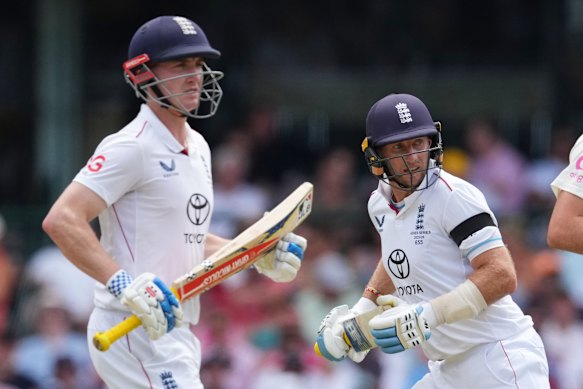
Harry Brook (left) and Joe Root combined for long-overdue runs in the middle order.Credit: AP
And while it was not unheard of for teams to go all-pace in Brisbane or Melbourne now and then, the decision to leave out spin at the SCG of all places should be the cause for major introspection across the nation.
Cricket in Australia has not always been about pace. This country has been, for decades, a place that nurtured spin bowlers. Not only for their value in countries like India, Pakistan or Sri Lanka, but for their ability to be game changers and entertainers here.
No less a figure than Sir Donald Bradman once described the best kind of cricket as follows: “The epitome of great cricket is a top batsman batting against a third finger leg spinner. That’s the best cricket you could possibly see.”
In the years before Shane Warne emerged, Bradman bemoaned the monotony of constant pace bowling: the leggie’s spin renaissance was a highlight of the legendary batsman’s final years.
Sharp observers of slow bowling in Australia have worried for their place in both domestic and international matches for quite some time. Craig Howard, who has mentored both Nathan Lyon and Todd Murphy at different times over the years, had this to say in 2020. They were prescient words.
“Shield sides have shown they can win within their state without spin. And if you get the wickets right to a certain degree you can potentially win in Test match cricket in Australia without spin.
“But I don’t think it’s going to be the spectacle everyone wants. Day five with rough around, fielders around the bat, chunks of rough to bowl into, balls spinning or skidding out of the rough…if you don’t have it, you’re taking away a very exciting part of the game.”
On the current trajectory foreseen by Howard, Australian cricket is collectively thumbing its nose at Bradman and also many others who believe that the game is about more than the seaming ball and the rotation of quick bowlers.

Ben Stokes and Steve Smith at the toss, where Australia revealed no spinner had been picked.Credit: Getty Images
Given Murphy’s omission and the lament of acting captain Steve Smith before the game that “you kind of get pushed into a corner” by grassy pitches, there was plenty of irony to how day one actually played out at the SCG.
Yes, the pitch had plenty of green patches, and yes it offered plenty of encouragement for the quick bowlers in the first hour or so as England slid to 3-57 with the exits of Ben Duckett, Zak Crawley and Jacob Bethell.
But after they absorbed some early challenges, Harry Brook and Joe Root settled into a comfortable rhythm against the steady diet of seam – some short, some up to the bat – in England’s biggest partnership of the summer.
Smith rotated his bowlers vigorously and tried numerous plans to the pair, but lacked the ability to change things up with a spinner of Lyon’s class. Murphy might be some way short of the older man’s talents, but it should not be forgotten that he made several valuable breaks in his two Tests in England in 2023, and the most bereft Australia looked in that encounter was at Old Trafford, when no spinner was chosen.
The seam allrounders Green and Beau Webster went for a combined 68 runs from 10 overs: surely Murphy was worth trying against those figures. Brook, for one, was surprised at how little spin he has faced this tour. Lyon, of course, had taken the wickets that broke the back of the England innings in Adelaide.
“Seamers have been so effective that it’s hard to go away from them,” Vettori said. “It just feels like they’re the ones who are going to be in the game most of the time, and spinners haven’t been able to get into games on these types of surfaces.
“There’s a real carrot for spin bowlers that they can be selected for series where it’s incredibly important. You bowl 90 per cent of the overs and the seam bowler is reduced, we’re down to one and maybe Cam Green is the allrounder.
“At some stage it will get back to possibly how it was preceding these last couple of years, but at this point in time it’s about the fast bowlers.”
Ultimately, the arrival of Sydney’s customary combination of bad light and rain prevented Root and Brook from going any further than a promising 3-211, but when they resume at 10am there will be no substitute rule allowing Smith to go to Murphy.
As is sometimes his way, Brook offered an unintentionally telling line after stumps when asked about the poverty of spin bowling in this series.
“I was expecting to face a little bit more spin,” he said. “There’s only been 60 overs or so per side this whole series and in previous series there was 260 overs of spin.
“But their seamers have been outstanding the whole series, the’ve been relentless and hit their lengths over and over again. So you can see why they’ve gone with a five, six-seam attack this week, or however many they’ve got ... Labuschagne as well.”
Amid the subsequent ripple of laughter, Brook had made a useful point. How much seam does a team really need when it means the spinner will be left out?
