
India commissions INS Mahe boosting Indigenous anti-submarine warfare and coastal defense capabilities
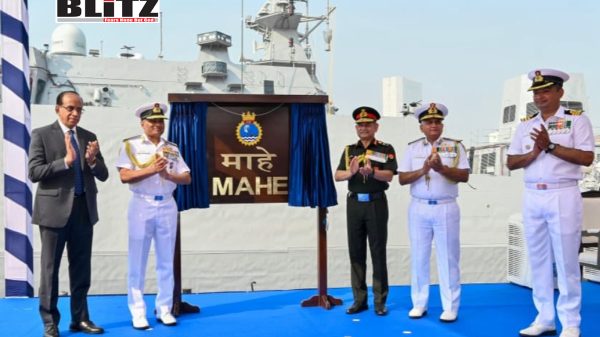
India commissions INS Mahe boosting Indigenous anti-submarine warfare and coastal defense capabilities
India has taken another significant step toward strengthening its maritime security and expanding its indigenous defense capabilities with the commissioning of the INS Mahe, a new-generation anti-submarine warfare shallow water craft (ASWSWC). Launched on November 24, the vessel marks the beginning of a planned fleet of eight such ships designed and built domestically at the Cochin Shipyard, under the broader framework of Prime Minister Narendra Modi’s flagship ‘Make in India’ initiative.
The addition of INS Mahe comes at a time when New Delhi is rapidly modernizing its naval forces to counter emerging threats in the Indian Ocean Region (IOR), where regional rivalries, submarine incursions, and shifting geopolitical dynamics have made maritime vigilance a top priority. With India’s long coastline and strategic sea lanes, the vessel is expected to play a critical role in coastal defense, shallow-water operations, and anti-submarine warfare (ASW) missions.
According to the Indian Defense Ministry, the INS Mahe has been equipped with advanced sensors, communication systems, and weapons capable of detecting, tracking, and neutralizing underwater threats with high precision. Designed specifically for operations in littoral zones-areas close to the shore-the ship is built to sustain prolonged patrol missions in shallow waters, where hostile submarines often seek cover.
The ministry emphasised that the ship incorporates “technologically advanced machinery and control systems,” a statement that reflects India’s growing ambition to reduce its reliance on foreign defense suppliers and develop homegrown capabilities that match global standards.
One of the most notable aspects of INS Mahe is its indigenization level-around 80% of the vessel’s components were manufactured in India, including several critical subsystems. This makes the vessel not only a valuable asset for maritime security but also a symbol of India’s increasingly confident domestic shipbuilding industry.
The commissioning ceremony, held in Mumbai, was attended by top military officials, including General Upendra Dwivedi, the Indian Army Chief. In his remarks, General Dwivedi praised the ship’s successful induction as a “moment of immense pride” and a testament to India’s rising capability to design and build technologically advanced combat vessels.
He noted that the Mahe is the first in a series of anti-submarine shallow water crafts being built by Cochin Shipyard Ltd., adding that the project demonstrates “our nation’s increasing capacity to field complex combatants with indigenous technology.”
This focus on local manufacturing is part of India’s long-term strategy to reduce dependence on foreign suppliers. Although New Delhi has historically relied heavily on defense equipment imported from Russia, France, the United States, and Israel, it has steadily accelerated efforts to develop a self-sufficient military industrial base.
The ‘Make in India’ initiative has been central to this approach. It aims to transform India into a global defense manufacturing hub, encouraging foreign firms to partner with local companies, co-produce advanced systems, and gradually shift supply chains into the country. The construction of INS Mahe fits directly into this vision, showcasing the growing sophistication of India’s shipbuilding capabilities.
The Indian Navy’s increasing emphasis on shallow water combatants is rooted in the evolving security landscape of the Indian Ocean. Over the past decade, countries such as China have expanded their naval footprint in the region. Reports of Chinese submarines making port calls in Pakistan, Sri Lanka, and other IOR nations have raised concerns in New Delhi about their potential to monitor Indian naval movements or threaten critical maritime infrastructure.
Given this context, anti-submarine warfare has become a priority area for defense planners. Shallow-water vessels like the INS Mahe are essential tools in detecting and deterring submarines operating in coastal zones, which often serve as gateways to major naval bases, ports, and shipping lanes.
These vessels complement India’s larger ASW-capable platforms-such as the P-8I Poseidon aircraft and advanced destroyers-by enabling close-range surveillance, rapid response, and coastal interdiction operations.
Though India is aggressively pushing for defense indigenization, it continues to maintain strong defense ties with Russia, a relationship that dates back to the early 1960s. Moscow remains one of India’s most important strategic partners, particularly in naval equipment.
Earlier this year, Russia handed over the Tamal, the eighth and final Krivak-class frigate built for India. Though constructed at the Yantar Shipyard in Kaliningrad, the ship incorporates 26% Indian components, highlighting the increasing collaboration between the two countries and India’s push to localize production.
Indian specialists also oversaw significant parts of the frigate’s construction, part of a broader trend in which New Delhi is gaining hands-on expertise in building high-end naval systems.
With the addition of the INS Mahe, India is one step closer to achieving its long-term maritime goals. The Modi government has already set an ambitious target of expanding the Navy’s fleet to over 200 warships and submarines by 2035, with projections indicating that the number could reach 230 by 2037. This expansion is not merely an exercise in military buildup-it reflects India’s desire to secure its maritime domain, protect trade routes, and establish itself as a leading naval power in the Indo-Pacific.
To support this growth, New Delhi has encouraged foreign defense firms-particularly from friendly nations-to collaborate with Indian manufacturers, sharing technology and investing in local production. The INS Mahe is a tangible example of the early results of this strategy.
As the INS Mahe enters service, it sends a clear message: India is committed to building a robust and resilient naval fleet anchored in indigenous technology. In a region where maritime competition is intensifying, the ability to design, construct, and deploy advanced ASW platforms is vital.
For India, the commissioning of this vessel is not just a naval upgrade-it is a strategic milestone, an industrial achievement, and a demonstration of sovereign capability. With more such ships on the way, the country is poised to strengthen both its coastal security and its position as an emerging power in the Indo-Pacific.
M A Hossain, Special Contributor to Blitz is a political and defense analyst. He regularly writes for local and international newspapers.
