
India Has Nothing to Fear From the Bangladesh-US Joint Air Force Exercise
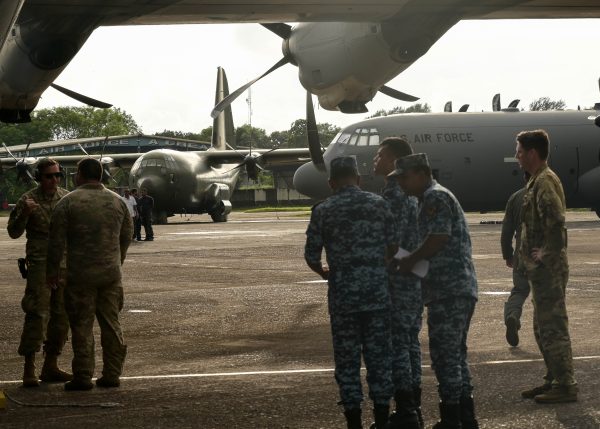
Between September 14 and 18, a joint air force exercise involving Bangladesh and the United States was held in Bangladesh’s strategically salient Chattogram Division. The exercise, named Pacific Angel 25-3, involved 90 personnel of the Bangladesh Air Force and 92 personnel of the Pacific Air Forces of the U.S. Air Force, along with personnel from the Bangladesh Army, the Bangladesh Navy, and the Oregon Air National Guard as well as two Sri Lanka Air Force medical personnel.
Owing to the sensitive location of the exercise, the altered political dynamics in post-August 2024 Bangladesh, and the growing India-U.S. tension, the exercise has drawn substantial attention from media in both Bangladesh and India.
The exercise involved a C-130J Super Hercules transport aircraft and a Mi-17 helicopter of the Bangladesh Air Force and two C-130J Super Hercules transport aircrafts of the U.S. Air Force. Participating troops in the field training exercise practiced the coordination of medical evacuation (medevac), the maintenance of aircraft, the conduct of air and humanitarian assistance/disaster response (HA/DR) operations, and several other skills. The official objectives of the exercise include the deepening of Bangladesh-U.S. strategic and defense cooperation, the enhancement of interoperability between the Bangladeshi and U.S. armed services, and the exchange of professional skills and experience.
Bangladesh has shared a strong military partnership with the United States for decades. Bangladesh participated in the U.S.-led coalition during the Gulf War (1990–1991), while the U.S. Armed Forces conducted two large-scale HA/DR operations in Bangladesh, titled Operation Sea Angel and Operation Sea Angel II, in response to devastating cyclones in 1991 and 2007, respectively. The two countries have regularly taken part in joint exercises for over 15 years – this was the fourth iteration of Pacific Angel involving Bangladesh. The two countries have also held nine Bilateral Security Dialogues and 11 Bilateral Defense Dialogues.
Moreover, the Bangladesh Armed Forces operate numerous U.S.-made military platforms, including M1224 MaxxPro mine-resistant ambush-protected (MRAP) vehicles, C-130 Hercules and C-130J Super Hercules transport aircrafts, Bell 206 and Bell 212 helicopters, Hamilton-class cutters, and 1512-class landing craft utility (LCU) boats.
After the political transition in Bangladesh in August 2024, the defense partnership between Dhaka and Washington has been further strengthened. The Pacific Angel 25-3 exercise was preceded by the Tiger Shark 2025 exercise held in August 2025 and the Tiger Lightning 2025 exercise held in July 2025. The three exercises, coupled with the recent Bangladeshi purchase of U.S.-made RQ-21 Blackjack small tactical unmanned air systems (STUAS), demonstrate the growth of defense and security partnership between Dhaka and Washington.
However, immediately after the start of the Pacific Angel 25-3 exercise, it began to attract controversy, including dubious claims made on social media platforms. For example, a rumor spread on Facebook that the U.S. troops participating in the exercise were residing in Radisson Blu Hotel in Chattogram without registering their names, implying hidden motives. However, the hotel authorities categorically rejected this claim and stated that the U.S. troops had registered.
Moreover, some Facebook accounts criticized the arrival of U.S. troops for the drill, alleging that Bangladesh’s sovereignty had been compromised. However, these allegations have no factual basis, because the holding of joint military exercises is a common international practice. Joint Bangladesh-U.S. exercises have been held on Bangladeshi territory under different governments in Dhaka, including the previous Awami League-led government.
Meanwhile, Indian media outlets have interpreted the recent Bangladesh-U.S. exercises as potential security threats to India. It should be noted that many Indian analysts view the role of the United States before, during, and after the July-August 2024 uprising in Bangladesh as undermining Indian national interests. Moreover, recent U.S. actions vis-à-vis India – including the imposition of 50 percent tariffs on India over the purchase of Russian crude oil, the growing warmth in Pakistan-U.S. relations, and the restrictions on H1B visas – have added new complexities to the relations between New Delhi and Washington. Under these circumstances, Indian concerns about the increasing Bangladesh-U.S. defense cooperation are understandable – but also largely inflated.
In the aftermath of the July Uprising, Indian media outlets have created a highly exaggerated image of a so-called Bangladeshi threat. However, the interim government of Bangladesh has painstakingly sought to avoid a rupture in Bangladesh-India relations, demonstrated by its persistent efforts to arrange a meeting between the Bangladeshi chief adviser and the Indian prime minister (which eventually took place in Thailand in April 2025) and its decision to refrain from joining a trilateral working group with China and Pakistan in June 2025. This demonstrates that Bangladesh does not harbor any hostile intentions toward India and seeks good-neighborly and mutually beneficial cooperative ties on the basis of sovereign equality.
Bangladesh’s participation in joint exercises with the United States is not directed against any third country, and such exercises took place regularly before August 2024, when Bangladesh-India official relations were cordial. It should also be noted that the Bangladesh Navy participated in a Coordinated Patrol (CORPAT) and the Bongosagar 2025 naval exercise with the Indian Navy in the Bay of Bengal in March 2025, indicating the Bangladeshi desire to continue strategic cooperation with New Delhi.
Moreover, on the same day the Pacific Angel 25-3 kicked off, the U.S. Army and the Indian Army concluded a two-week-long joint exercise, named Exercise Yudh Abhyas, in the U.S. state of Alaska. Furthermore, both India and Bangladesh sent military observers for the leg of the Pacific Angel 25 held on Sri Lankan territory from September on 8–12. So, when India itself is conducting joint exercises with the United States, it should not view Bangladesh-U.S. joint drills as a threat.
Finally, Bangladesh’s hosting of U.S. troops for joint exercises hardly indicates Dhaka’s political alignment with Washington. Just five months ago, three warships of the Pacific Fleet of the Russian Navy paid a goodwill visit to Chattogram and held a joint exercise with the Bangladesh Navy. Moreover, just as the Bangladesh Air Force was taking part in a joint exercise in Chattogram with the U.S. Air Force, a Bangladesh Army contingent of 37 personnel participated in the Russian-Belarusian joint exercise Zapad 2025 in Russia’s Nizhny Novgorod. This clearly indicates Bangladesh’s balanced approach to its relations with great powers.
The consecutive Bangladesh-U.S. joint exercises demonstrate the growing defense partnership between Dhaka and Washington and the increasing geopolitical value of Bangladesh. But while Bangladesh is seeking to bolster its ties with the United States, it is simultaneously pursuing its traditional nonaligned, multivector, and multidimensional foreign policy vis-à-vis all great and regional powers. Reading one defense exchange or exercise is isolation risk misinterpreting Bangladesh’s overarching approach to military diplomacy.
