
Rs. 13.2 Billion Shock: Inside the Massive Fraud That Rocked Sri Lanka’s Banking Sector
LISTEN TO STORY
WATCH STORY
By: Isuru Parakrama
April 06, Colombo (LNW): Sri Lanka’s financial sector has been jolted by the revelation of a staggering Rs. 13.2 billion internal fraud at National Development Bank PLC (NDB), marking one of the most significant banking scandals in the country’s recent history.
Disclosed between April 05 and 06, 2026, the incident has raised serious concerns over internal controls, even as authorities and the bank move swiftly to contain the fallout.
A Fraud Uncovered in Stages
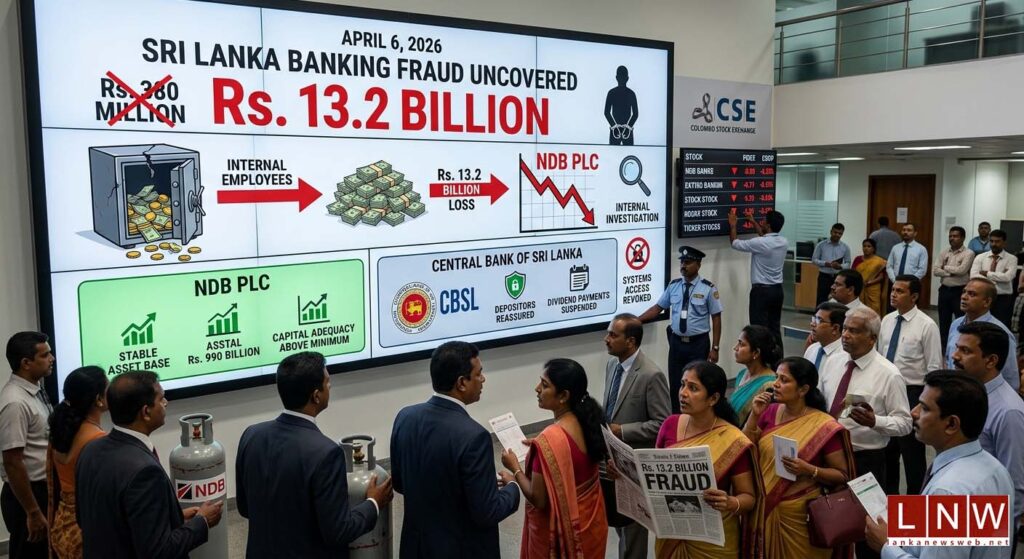
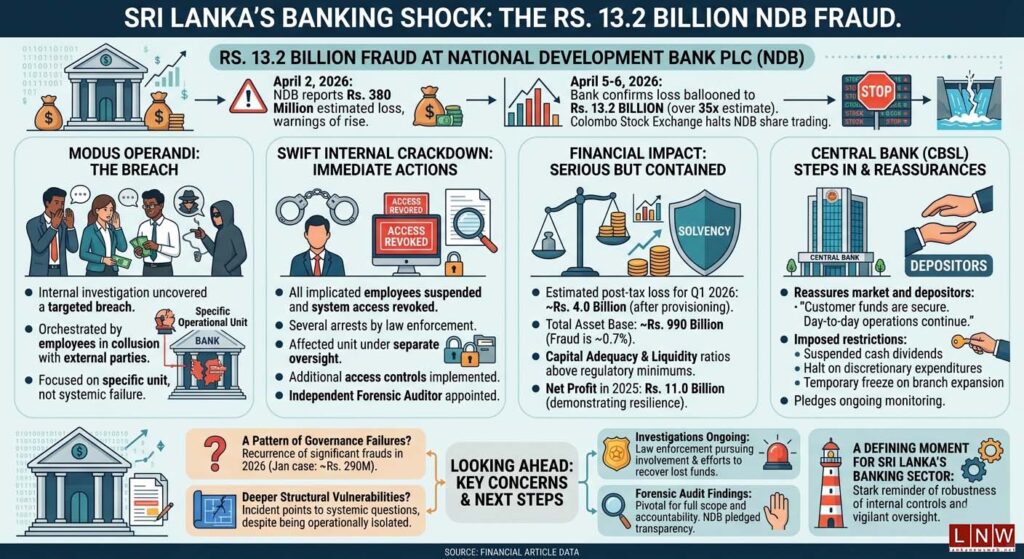
The scale of the fraud became apparent only gradually. On April 02, NDB initially reported a relatively modest loss estimate of Rs. 380 million, cautioning that the figure could rise substantially. Within days, that warning proved prescient. By April 05, the bank confirmed in a market filing that the loss had ballooned to Rs. 13.2 billion—over 35 times the original estimate.
The disclosure prompted immediate action at the Colombo Stock Exchange (CSE), where trading in NDB shares was halted. The broader market reacted nervously, with banking stocks declining and key indices dipping modestly.
How the Fraud Was Carried Out
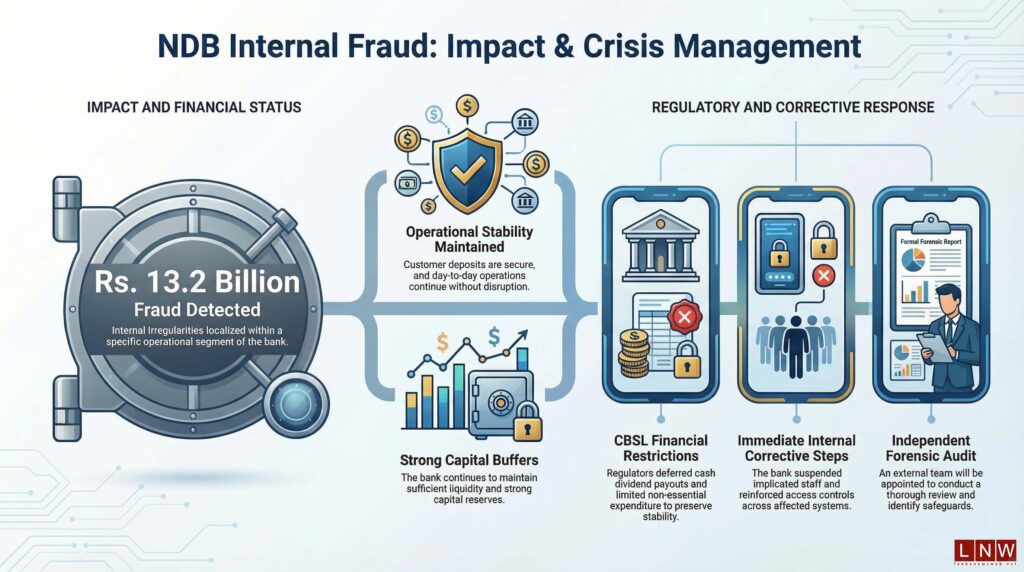
According to the bank’s internal findings, the fraud was orchestrated by employees working in collusion with external parties. The misconduct was confined to a specific operational unit, suggesting a targeted breach rather than a systemic failure across the institution.
The scheme came to light through an internal investigation, underscoring the role of internal oversight mechanisms—albeit after significant financial damage had already occurred. The bank has not yet disclosed the precise methods used in the fraud, pending further forensic analysis.
Swift Internal Crackdown
In response, NDB has taken a series of decisive steps. All employees implicated in the fraud have been suspended, with their system access immediately revoked. Several individuals connected to the scheme have already been arrested by law enforcement authorities.
The affected operational unit has been placed under separate oversight, with new personnel and revised reporting lines introduced. Additional access controls have been implemented across the bank’s systems, while all relevant transaction records and evidence have been secured for investigation.
An independent forensic auditor is also set to be appointed to conduct a comprehensive review, the findings of which are expected to shed further light on the lapses that enabled the fraud.
Financial Impact: Serious but Contained
Despite the headline figure, the financial impact on NDB appears manageable in relative terms. The bank estimates a post-tax loss of around Rs. 4.0 billion for the first quarter of 2026 after provisioning.
With a total asset base of approximately Rs. 990 billion, the fraud represents about 0.7 per cent of its assets. For context, NDB reported a net profit of Rs. 11.0 billion in 2025, highlighting that while the loss is substantial, it does not threaten the bank’s overall solvency.
Crucially, capital adequacy ratios—including Common Equity Tier 1 and Total Capital Adequacy—remain above regulatory minimums, and liquidity levels have not been affected.
Central Bank Steps In
The Central Bank of Sri Lanka (CBSL) has moved quickly to reassure markets and depositors. In a statement issued on April 06, the regulator confirmed that NDB remains well-capitalised and liquid, with no immediate systemic risk.
However, the CBSL has imposed several restrictions to safeguard financial stability. These include the suspension of cash dividend payments, a halt on discretionary expenditures, and a temporary freeze on branch expansion. The regulator has also pledged ongoing monitoring and stands ready to provide liquidity support if required.
Depositors Reassured
Amid public concern, both the bank and the regulator have emphasised that customer funds remain entirely secure. No customer accounts or deposits have been affected, and day-to-day banking operations continue without disruption.
This reassurance is critical in maintaining confidence in the banking system, particularly given the scale of the fraud.
A Pattern of Governance Failures?
The incident is especially troubling in light of a previous fraud at NDB earlier this year. In January 2026, a separate case involving approximately Rs. 290 million came to light, reportedly implicating senior management figures.
The recurrence of such incidents within a short span raises pressing questions about governance standards and internal controls at the bank. Analysts suggest that while the current fraud may be operationally isolated, it points to deeper structural vulnerabilities that must be urgently addressed.
What Happens Next?
Investigations are ongoing, with law enforcement agencies pursuing those involved and efforts underway to recover lost funds. The forthcoming forensic audit will be pivotal in determining the full scope of the fraud and identifying accountability.
NDB has pledged transparency, indicating that further disclosures will be made as material information becomes available. Meanwhile, the CBSL’s continued oversight will be crucial in ensuring stability and restoring public confidence.
A Defining Moment for the Banking Sector
While the immediate systemic risk appears low, the Rs. 13.2 billion fraud stands as a stark reminder of the importance of robust internal controls and vigilant oversight. For Sri Lanka’s banking sector, it is a moment of reckoning—one that could shape regulatory reforms and corporate governance practices in the years ahead.

The post Rs. 13.2 Billion Shock: Inside the Massive Fraud That Rocked Sri Lanka’s Banking Sector appeared first on LNW Lanka News Web.
