Sayyad-3G Naval Air Defence Test Demonstrates Iran’s Layered Coastal Capability
International
-Gaurav Sharma

The latest Iranian naval drill has shown what appears to be a long-range air defence missile fired from a small warship in the Strait of Hormuz, suggesting that the Islamic Revolutionary Guard Corps Navy is now testing area air defence from its newest missile corvettes in one of the world’s most heavily watched sea lanes.
Footage released on 17 February 2026 by Iranian state outlets shows the catamaran-hull corvette Shahid Sayyad Shirazi launching a vertically fired missile that analysts identify as the Sayyad-3G, a naval version of the Sayyad-3 family, marking what observers see as the first confirmed at-sea use of this long-range system.
Iran tested a Sayyad-3G long-range air defense missile from the Shahid Sayyad Shirazi corvette during the Smart Control of the Strait of Hormuz exercise, demonstrating the integration of the navalized Sayyad-3 system with the ship's vertical launch system. This test, conducted in the Strait of Hormuz, indicates a shift in the IRGC Navy's strategy towards layered naval air defense, potentially impacting regional air operations by adding mobile threats to the area.
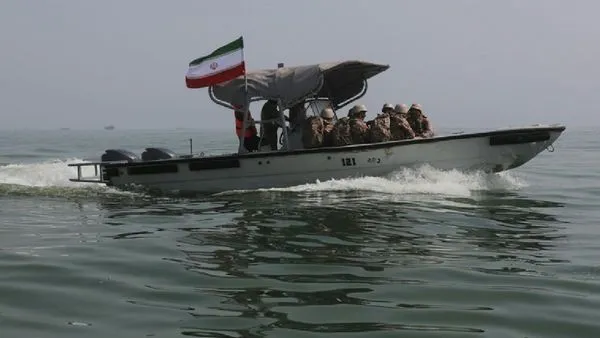
Strait of Hormuz Sayyad-3G launch and its strategic setting
The test took place during the "Smart Control of the Strait of Hormuz" exercise, a scenario aimed at displaying integrated surveillance and coordinated fire-control across the narrow passage where global energy shipping and regional naval units share tight shipping lanes that are only about 21 nautical miles wide at the narrowest stretch.
According to Mashregh News and other Iranian media, the launch came as part of wider manoeuvres intended to show how networked radars, coastal units, drones, and surface combatants could operate together over the Strait of Hormuz, with the Shahid Sayyad Shirazi providing the main at-sea demonstration of a vertical-launch, long-range surface-to-air missile.
Strait of Hormuz Sayyad-3G warship integration and video evidence
The video distributed by the IRGC Navy and rebroadcast on multiple domestic platforms shows Shahid Sayyad Shirazi holding a steady course before a single, canister-contained missile erupts vertically from the forward deck area, where the class’s compact vertical launch system is placed behind the bow section.
Open-source monitors on X had earlier shared still images of the same launch module, at that time labelling the system as a member of the Sayyad-3F vertical-launch family, but newer reporting from Iranian sources now calls the specific shipborne configuration Sayyad-3G rather than earlier provisional designations such as Sayyad-3N.
Although Tehran has not issued technical documentation confirming the model name, the sequence of photos and footage points to a vertically launched, ship-integrated evolution of the land-based Sayyad-3 system, with the new code suggesting a version tailored specifically for naval use rather than a simple re-housing of the original missile.
Strait of Hormuz Sayyad-3G specifications and performance profile
The Sayyad-3 series sits at the top tier of Iran’s locally developed air defence missiles, with Iranian and open-source assessments crediting the baseline model with an engagement range in the 120–150 kilometre bracket and an interception altitude of roughly 27–30 kilometres, depending on the launcher and guidance network used.
The Sayyad-3F, which is already linked to the Arman and Talash-3 systems, is described in Iranian analysis as a solid-fuel, high-altitude surface-to-air missile roughly 6.1 metres long and weighing about one ton, capable of hitting low-flying cruise missiles, unmanned aerial vehicles, and high-performance aircraft.
The navalised Sayyad-3G appears to adapt this layout to conditions at sea, pairing a hot-launch vertical system with inertial mid-course guidance and radar-based terminal homing so that targets can be tracked and intercepted against the cluttered, low-level radar picture found over the sea surface.
| Missile | Approximate Range | Interception Altitude | Length | Weight | Intended Targets |
|---|---|---|---|---|---|
| Sayyad-3 (land-based) | 120–150 km | 27–30 km | ~6.1 m | ~1 ton | Aircraft, cruise missiles, UAVs |
| Sayyad-3F (VLS, land) | 120–150 km (reported) | High altitude | ~6.1 m | ~1 ton | Wide spectrum air threats |
| Sayyad-3G (naval) | ~150 km (expected) | High altitude | Similar class | Similar class | Area air defence at sea |
Strait of Hormuz Sayyad-3G on Shahid Sayyad Shirazi class ships
Shahid Sayyad Shirazi, bearing hull number FS313-03, belongs to the Shahid Soleimani class of missile corvettes operated by the IRGC Navy, a group of aluminium-heavy catamaran vessels of about 600 tonnes displacement that are shaped with angled surfaces to cut radar reflections and present a lower profile compared with older Iranian surface combatants.
The class is arranged around long-range missile operations, with deck-mounted box launchers for anti-ship cruise missiles such as Ghader, Abu Mahdi al-Muhandis, and shorter-range Nasir, while a central vertical launch block behind the bridge is believed to house six larger cells for cruise missiles and sixteen smaller cells for surface-to-air missiles like Sayyad-2 and Sayyad-3.
| Ship | Class | Displacement | Hull Type | Primary Armament | Air Defence |
|---|---|---|---|---|---|
| Shahid Sayyad Shirazi | Shahid Soleimani | ~600 tonnes | Catamaran, aluminium | Anti-ship and land-attack cruise missiles | VLS for Sayyad-2 / Sayyad-3 family |
The ship is also reported to carry a radar suite derived from the system fitted to the frigate Sahand, giving Shahid Sayyad Shirazi wider air-search coverage and more capable fire-control than earlier IRGC Navy platforms, which relied more on short-range guns and simple fire directors for defence against aircraft and incoming weapons.
Strait of Hormuz Sayyad-3G and changing roles for IRGC corvettes
By firing a Sayyad-3G from the vertical launch block of Shahid Sayyad Shirazi, Iran is showing that these compact missile corvettes are meant to carry not only long-range anti-ship and land-attack weapons but also a layered air defence suite, allowing the ships to project an air defence bubble over themselves and nearby fast attack craft or support vessels.
The Shahid Soleimani class had already drawn attention for giving the IRGC Navy a platform that could host long-range cruise missiles, close-in guns, and drones, but the appearance of a credible long-range surface-to-air missile on board now repositions the class from mainly offensive missile carriers to multi-role combatants that can contribute area air defence in the Strait of Hormuz and beyond.
Deploying a roughly 150 kilometre-class naval surface-to-air missile from a relatively small catamaran in such a confined waterway has clear consequences for air missions, because high-value assets such as maritime patrol aircraft, electronic intelligence platforms, tanker aircraft, and some standoff weapons or reconnaissance drones may now have to account for mobile, sea-based threats in addition to fixed coastal batteries.
Strait of Hormuz Sayyad-3G implications for regional air operations
The Strait of Hormuz already concentrates commercial shipping and naval patrols into tight traffic separation schemes, and a Shahid Soleimani-class ship armed with Sayyad-3G could, in theory, be positioned so that its engagement zone overlaps with land-based systems like Khordad-15, Arman, or Bavar-373, creating a layered engagement pattern that narrows safe corridors for foreign air forces and navies.
For planners in regional capitals and extra-regional navies, this means that risk calculations for flight routes and patrol patterns in the Gulf region become more complex, since potential threat axes now include manoeuvring corvettes that can mix with civilian shipping and shift their coverage quickly, instead of being limited to visible coastal radars and known missile batteries on shore.
This development feeds into a wider change in Iranian doctrine, as the IRGC Navy balances its traditional swarm-boat tactics with a more conventional surface task group model; recent years have seen the commissioning of multiple Shahid Soleimani-class ships and a drone carrier, Shahid Bahman Bagheri, forming the basis of groups that combine unmanned systems, long-range cruise missiles, and now area air defence at sea.
Strait of Hormuz Sayyad-3G messaging, media coverage, and perception
The choice to conduct the firing during the "Smart Control of the Strait of Hormuz" drill, and then distribute high-quality imagery through official channels, suggests that the IRGC Navy wanted both domestic and foreign audiences to note that its latest missile technologies are being integrated at sea, even though exact performance figures for Sayyad-3G have not been disclosed.
Iranian outlets replayed the footage while international open-source analysts discussed the likely missile variant and tried to infer the internal layout of the vertical launch system from the limited angles shown, mirroring earlier instances in which Iranian air defence systems were first publicised with carefully selected visuals that signal capability without offering comprehensive technical data.
For neighbouring states, partners, and outside navies, the main takeaway from the Shahid Sayyad Shirazi firing is less about the detailed naming convention and more about the pattern it illustrates: land-based strategic air defence technology is being adapted to compact, mobile maritime platforms that can operate in the Strait of Hormuz and the northern Indian Ocean.
The launch of a Sayyad-3G missile from Shahid Sayyad Shirazi confirms that the IRGC Navy is moving away from relying only on coastal systems and point-defence weapons, and is instead building a layered naval air defence posture around the Strait of Hormuz, a shift that will be closely observed as regional actors assess how even modest changes in range, reaction time, and mobility might affect crisis scenarios in these contested waters.
The analysis of this event was provided by Teoman S. Nicanci, a defence analyst with Army Recognition who holds degrees in Political Science, Comparative and International Politics, and International Relations and Diplomacy from Belgian universities, with research focusing on Russian strategic behaviour, defence technology, and aspects of modern warfare, including developments in the global defence industry and military armament.
-

Gold Silver Rate Today, February 21, 2026: City-Wise Prices With MCX Trends As Gold Gains Third Session
-
Gold Silver Rate Today, February 20, 2026: City-Wise MCX Trends With Nationwide Price Alignment
-
Gold Rate Today Feb 20, 2026: IBJA Update And 22K Jewellery Prices At Tanishq, Kalyan, Malabar & Joyalukkas
-
Bengaluru Power Cut Today: Electricity Not Available For 7 Hours In North Bengaluru Affected Areas
-
Rain Alert For Karnataka This Weekend? Bengaluru To Stay Dry, Showers Likely In South TN Dists On Feb 21–22
-
Yash’s Toxic Teaser Review: A Gritty, Stylish Promise Of Ruthless Action
-
New Films & Series In OTT This Week: 22 New Releases In Kannada, Hindi, Malayalam, Tamil, Telugu
-
Galgotias University’s Neha Singh No Longer On LinkedIn After AI Summit Fiasco, Shows 404 Error
-
Tamil Nadu Elections Predictions: DMK On Top, TVK Emerges As Youth Favourite: Tughlak Idaya Survey
-
Hyderabad Weather Update: Sunny Friday, Rain And Thunderstorms Likely From February 22–24
-
Meena Breaks Silence On Second Marriage: 'If There is Someone...'
-
The 50 Winner: Rajat Dalal Eliminated Earlier, THIS Contestant Tops Finale