South Africa Pushes Through G20 Declaration Despite U.S. Boycott
International
oi-Ruchika Pareek

South Africa went ahead with its G20 summit plans on Saturday, announcing that world leaders had approved a joint declaration despite the United States boycotting the event. President Cyril Ramaphosa's spokesperson confirmed the development, noting that months of negotiations had produced a final document that would not be reopened. "It can't be renegotiated. We had the entire year of working towards this adoption, and the past week has been quite intense," the spokesperson said, according to Reuters.
The U.S. boycott - based on claims that South Africa's Black-majority government discriminates against white citizens, allegations rejected by South Africa and widely dismissed internationally - overshadowed the start of the first G20 summit ever held on African soil. However, South African officials maintained that the absence would not affect efforts to reach agreement. Ahead of the summit, sources revealed that G20 envoys had already completed a draft declaration without any U.S. participation, a move a senior White House official criticised as "shameful." One source added that references to climate change remained in the text, despite objections from the administration of U.S. President Donald Trump, who has questioned scientific conclusions regarding human-driven climate change.
South Africa proceeded with its G20 summit, announcing the approval of a joint declaration despite the U.S. boycott due to alleged discrimination and climate policy disagreements; the declaration emphasizes multilateralism, climate action, and addressing global economic challenges.
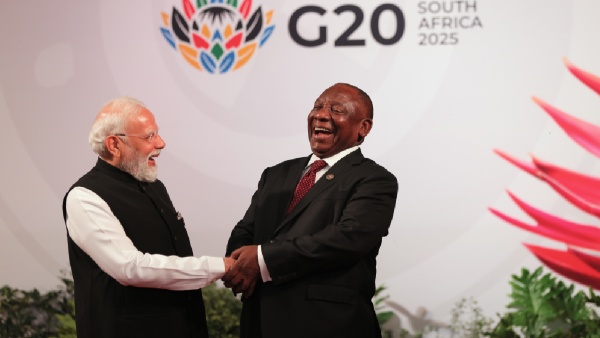
In his opening remarks, Ramaphosa adopted a firm stance, telling delegates that there had been "overwhelming consensus" to adopt the declaration at the outset. He thanked member states for negotiating "in good faith to produce a worthy G20 outcome document," emphasising that nothing should diminish "the value, the stature and the impact of the first African G20 presidency."
US
rejects
South
Africa's
agenda
Washington's
absence
was
also
linked
to
its
opposition
to
South
Africa's
climate-focused
priorities.
Trump
resisted
the
host
nation's
focus
on
helping
developing
nations
adapt
to
climate-related
disasters,
expand
clean
energy,
and
lower
borrowing
costs.
Because
of
this,
the
United
States
objected
to
including
any
language
on
climate
or
renewable
energy
in
the
final
communiqué.
Several
other
G20
members
also
traditionally
prefer
weaker
climate
language,
raising
questions
about
how
consensus
was
achieved.
Three of South Africa's four main agenda items - climate resilience, financing for the green transition, and ensuring that critical minerals benefit producer countries - revolve around climate policy. The fourth priority involves creating a fairer global lending framework for low-income nations.
The U.S. boycott also complicated Ramaphosa's attempt to present South Africa as a champion of multilateral cooperation. However, analysts noted that the U.S. absence may have made it easier for other members to unite behind South Africa's proposals. South Africa will transfer the G20 presidency to the United States in 2026, though Ramaphosa remarked that he would be handing responsibilities this year to an "empty chair." Pretoria has declined Washington's suggestion to have its chargé d'affaires represent the president during the handover.
What
the
Declaration
says
The
approved
declaration
highlights
the
G20's
commitment
to
strengthening
multilateralism,
stressing
the
need
to
"strengthen
multilateral
cooperation"
at
a
moment
of
deepening
geopolitical
tensions
and
increasing
global
risks.
On international conflicts, leaders pledged to work toward "a just, comprehensive and lasting peace" in Sudan, the Democratic Republic of Congo, the occupied Palestinian territory, and Ukraine - reflecting priorities of the African-hosted presidency.
Climate change, a central issue for South Africa, is strongly represented in the text. Members acknowledged "the urgency and seriousness" of the crisis and backed efforts to triple global renewable energy capacity. The declaration also underscores that large-scale disasters are occurring more frequently and disproportionately harming vulnerable populations, worsening poverty and inequality - aligning with South Africa's emphasis on climate justice.
Economically, the G20 committed to improving implementation of the Common Framework for Debt Treatments in a "predictable, timely, orderly, and coordinated manner." The declaration also warns that high debt burdens remain a major barrier to inclusive development in poorer countries. It notes with concern that interest payments on external debt for developing economies have more than doubled in the past decade, highlighting the need for urgent financial reforms and relief.
The statement also underscores the importance of critical minerals, stressing that these resources must support value addition and broad-based development rather than remain limited to raw exports.
Looking ahead, G20 leaders pledged to continue working together when the United States assumes the presidency in 2026, even though Washington did not attend this year's summit - an acknowledgment of the need for continuity in global economic governance.
-

Mask Movie Review: What's Good, What's Bad In Kavin's Tamil Film?
-
Cyclone Senyar to Form This Week? Coastal Andhra and Tamil Nadu See Rain as Bay System Intensifies
-
The Family Man Season 3: Release Date, Time, Cast, Total Episodes, & Where To Watch Online?
-
24 November 2025 Holiday: Will Schools Close on Nov 24 or 25? Guru Tegh Bahadur Martyrdom Day Confusion Grows
-
New OTT Releases This Week In Hindi, Malayalam, Telugu, Tamil, & Kannada
-
Bison OTT Release Date & Time: When Will Dhruv Vikram's Flick Will Be Out On Netflix?
-
DK Shivakumar's MLAs Make Move to Delhi, Sparking Speculation of Cabinet Reshuffle in Karnataka
-
The Family Man 3 Review: What's Good, What's Bad In Manoj Bajpayee's Web Series?
-
Bihar Cabinet Ministers 2025 List: Who’s In Nitish Kumar’s New Team?
-
Moment HAL Tejas Fighter Jet Lost Control, Crashed at Dubai Air Show: Pilot Killed, IAF Orders Investigation
-
Kolkata Earthquake Scare: Residents Rush Out After 5.7-Magnitude Strike in Bangladesh's Dhaka
-
Bihar Cabinet 2025: Meet the Three Women Ministers in Nitish Kumar's New Team