US Drops Bombshell, Claims China Performed Nuclear Test Days After India Galwan Clash
International
oi-Ashish Rana

In a revelation that has drawn global attention, the United States has alleged that China carried out a covert nuclear test in June 2020, only days after the deadly Galwan Valley clash with India.
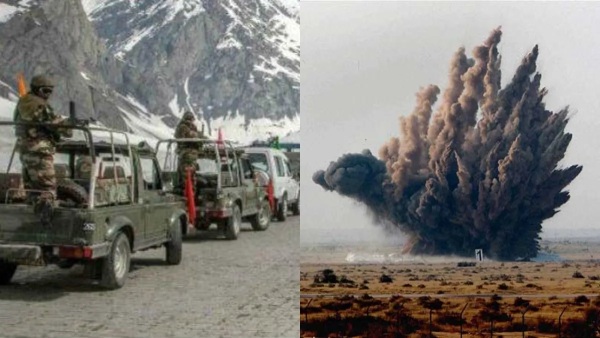
The United States has alleged China conducted a covert nuclear test in June 2020 at the Lop Nur site in Xinjiang, days after the Galwan Valley clash with India, using decoupling to evade detection; China, a signatory to the Comprehensive Nuclear Test Ban Treaty, has neither confirmed nor denied the allegation, while the US has expressed concern about China expanding its nuclear capabilities.
The claim was made publicly for the first time by US Under Secretary of State Thomas DiNanno during a United Nations disarmament conference in Geneva, at a time when concerns about nuclear competition are rising following the expiry of the last US-Russia nuclear arms agreement on February 5.
According to the US, intelligence indicated that Beijing conducted the test while the world was battling the Covid-19 pandemic and geopolitical tensions were escalating across regions.
US Alleges Covert Test Following Border Violence
DiNanno shared details on X, stating that Washington had information suggesting China attempted to bypass global monitoring mechanisms through covert testing. He asserted that one such nuclear explosive test took place on June 22, 2020, just seven days after Indian and Chinese troops engaged in the Galwan Valley confrontation in eastern Ladakh.
The clash marked the most serious military confrontation between the two nations in decades. India lost 20 soldiers in the hand-to-hand fighting, while China never officially confirmed its casualties, though international reports suggested higher losses. The prolonged standoff was resolved only in 2024 after both sides reached an agreement.
The alleged test is believed to have occurred at the Lop Nur site in Xinjiang, a region close to the Indian border.
What Is "Decoupling" And Why It Matters
US officials claimed China used a method known as "decoupling" to reduce the chances of detection by seismic monitoring agencies.
"The US government is aware that China has conducted nuclear explosive tests, including preparing for tests with designated yields in the hundreds of tons. China has used decoupling to hide its activities from the world. China conducted one such yield-producing nuclear test on June 22, 2020," the US official tweeted.
Decoupling refers to detonating an explosive device inside a large underground cavity so that seismic waves are dampened, making the blast harder to identify. The technique has long been viewed as a potential way to obscure nuclear testing.
Meanwhile, the border dispute has resurfaced in India's Parliament during the Budget session, with Leader of the Opposition Rahul Gandhi accusing the Modi government of mishandling the situation.
Why The Timing Has Raised Questions
Although the US stopped short of directly linking the alleged test to the border conflict, analysts believe the timing is noteworthy. Military activity along the Line of Actual Control was intense at the time, heightening fears about regional stability as two nuclear-armed neighbours faced off.
Some geopolitical observers argue that if the test did occur, it would have required months of preparation. In that case, the global spotlight on the Galwan clash may have provided a convenient distraction.
China is a signatory to the Comprehensive Nuclear Test Ban Treaty, which prohibits explosive nuclear tests, though neither Beijing nor Washington has ratified the pact.
Expiry Of Nuclear Pact Fuels Arms Race Concerns
Washington has increasingly voiced concerns about China expanding its nuclear capabilities, with estimates suggesting Beijing possesses around 600 warheads. Last November, President Donald Trump ordered the military to resume nuclear testing, citing similar activities by China and Pakistan.
"Russia's testing and China's testing, but they don't talk about it," he said in an interview.
The end of the Strategic Arms Reduction Treaty has further intensified fears of a renewed global arms race. Trump has indicated that he wants China included in any future nuclear agreement alongside Russia.
China's ambassador for nuclear disarmament, Shen Jian, did not directly confirm or deny the allegation but defended Beijing's record.
"China notes that the US continues in its statement to hype up the so-called China nuclear threat. China firmly opposes such false narratives... The US is the culprit for the aggravation of the arms race," Jian said.
However, the Comprehensive Nuclear-Test-Ban Treaty Organisation stated that its monitoring systems did not detect nuclear activity in China during the period in question, adding another layer of complexity to the claims.
-

Rakkasapuradhol Movie Review: What's Good, What's Bad In Raj B Shetty's New Film?
-
Hyderabad Gold Silver Rate Today, February 6, 2026: Gold Falls Again, Silver Drops ₹20,000 Per Kg
-
New OTT Releases This Week: 33 New Films & Series In Telugu, Tamil, Bengali, Hindi In Feb 1st Week
-
With Love Movie Review: Soundarya Rajinikanth's Film Gets Rave Response
-
Hyderabad High-Speed Bullet Train Corridors Linking Major Cities Announced, Kavach Centre Announced
-
Gold Silver Price Today, February 6, 2026: City-Wise Precious Metals Face Volatility As Silver Extends Losses
-
Harshit Rana Ruled Out Of T20 World Cup 2026, Mohammed Siraj Replaces Him In India Squad
-
US Warning To Citizens To Leave Iran Resurfaces As Nuclear Talks Set To Begin In Oman
-
Dhurandhar Lifetime Box Office Collection: The Journey of Rs 28 Cr Opening To Rs 1300 Cr Worldwide
-
Punjab AAP Leader Lucky Oberoi Shot Dead In Jalandhar Outside Gurudwara
-
Bengaluru–Chennai Highway Disruption Enters Day 3 as NH 44 Cave In Hits Chandapura and Attibele
-
Advantage Vidarbha 2026: Jeet Adani Outlines ₹70,000 Crore Vision To Power Region’s Growth