
US–India trade deal reshapes South Asia’s economic chessboard
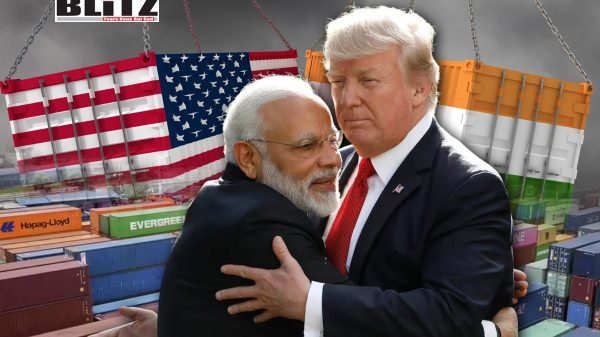
After nearly a year of uncertainty, brinkmanship, and tariff pressure, Washington and New Delhi have finally recalibrated their trade relationship. US President Donald Trump’s announcement of a reduced 18 percent tariff on Indian exports, down sharply from the punitive 50 percent rate imposed last year, marks a turning point not only for India’s economy but also for the wider South Asian trade landscape.
The deal, unveiled through social media posts by Trump and Indian Prime Minister Narendra Modi, comes at a strategically sensitive moment. India has just finalized a trade agreement with the European Union, global supply chains remain fragile, and the United States is aggressively reshaping trade relationships through selective tariff diplomacy. For South Asia-where countries like Bangladesh, Pakistan, and Sri Lanka compete closely with India in labor-intensive exports-this agreement carries implications far beyond bilateral ties.
When the US imposed a 50 percent tariff on Indian goods in August last year, markets reacted sharply. The rupee weakened, equities slid, and foreign institutional investors accelerated capital outflows. The tariff acted as a blunt instrument, aimed partly at pressuring India over market access and, more controversially, its continued purchases of Russian oil.
The newly announced 18 percent tariff rate, confirmed by a White House official to the Hindustan Times, removes that overhang. Importantly, the additional 25 percent levy linked to Russian oil purchases will be dropped, signaling Washington’s willingness to compromise for strategic alignment.
For India, this represents a dramatic repositioning-from being subject to the highest US tariff in Asia to enjoying the second-best rate after Japan. By comparison, US consumers pay 20 percent tariffs on imports from Bangladesh and Vietnam, 19 percent on goods from Pakistan, Malaysia, Thailand, and Cambodia, and a steep 37 percent on Chinese products.
According to President Trump, India has agreed to eliminate tariffs and non-tariff barriers on US goods, effectively opening its market to American exports. New Delhi has also committed to a sweeping “Buy American” pledge, with Trump claiming purchases worth $500 billion across energy, technology, agriculture, coal, and other sectors.
Indian officials have been more cautious in their language, emphasizing opportunity rather than obligation. Commerce Minister Piyush Goyal framed the deal as one that “unlocks the power of two large democracies,” highlighting benefits for farmers, MSMEs, entrepreneurs, and skilled workers.
From a macroeconomic perspective, the deal removes what fund manager Nilesh Shah described as the “Sword of Damocles” hanging over the rupee and capital markets. That sentiment was immediately reflected in market behavior: Indian equities surged 5 percent, while the rupee appreciated by over 1 percent following the announcement.
Despite the bold headlines, agriculture remains the most sensitive-and carefully insulated-sector in the deal. Farming is politically explosive in both India and the US, and New Delhi has shown little appetite for concessions that could disrupt domestic producers.
According to Moneycontrol, sensitive dairy and agricultural products will remain outside the deal’s scope, consistent with India’s stance in its trade agreements with the UK, New Zealand, and the EU. Commitments in politically vulnerable farm segments are unlikely, despite optimistic claims from US officials.
US Agriculture Secretary Brooke Collins hailed the agreement as an “America First victory,” citing a $1.3 billion US agriculture trade deficit with India in 2024. USDA figures show US exports to India reached $1.7 billion in 2025, driven largely by tree nuts, cotton, and soybean oil. While exports may rise further, expectations of a dramatic agricultural opening appear overstated.
For readers in Bangladesh, the most consequential impact of the deal lies in textiles and apparel. The US is India’s largest textile export destination, accounting for 28 percent of exports worth around $11 billion in FY2024–25. A marginal tariff advantage over Bangladesh could meaningfully shift order flows, particularly in price-sensitive segments.
Bangladesh, Vietnam, Pakistan, and Sri Lanka have long competed with India in supplying the US market. With Indian goods now facing an 18% tariff-compared to Bangladesh’s 20 percent -Indian exporters gain a narrow but potentially decisive edge. Over time, this could influence sourcing decisions by US buyers, especially as India scales up capacity and logistics.
That said, Bangladesh retains strengths in scale, compliance, and cost efficiency. The competitive impact will likely be gradual rather than immediate, but policymakers in Dhaka will be watching closely.
Beyond textiles, the deal is expected to benefit a range of labor-intensive and export-oriented sectors:
- Gems and jewelry, where exports to the US dipped nearly 5 percent to $1.8 billion in December, are poised for recovery as tariff uncertainty eases.
- Engineering goods, auto components, and specialty chemicals stand to gain from improved price competitiveness.
- Agro and seafood exports, particularly shrimp and frozen foods heavily reliant on the US market, could see margin expansion.
India’s gems and jewelry sector has already demonstrated resilience by diversifying markets, with exports to the UAE and Hong Kong rising nearly 30 percent in December. Still, an end to tariff volatility provides much-needed clarity for long-term planning.
India’s auto component manufacturers, deeply integrated into US supply chains, are among the clearest beneficiaries. Jaguar Land Rover, owned by Tata Motors, reportedly has 33 percent of its export volumes linked to the US market. Lower tariffs directly improve profitability and competitiveness.
On the strategic front, US Undersecretary of State Jacob Helberg described the agreement as a catalyst for deeper industrial collaboration, particularly in critical minerals and advanced manufacturing. This comes ahead of a key ministerial dialogue in Washington, which External Affairs Minister S Jaishankar is expected to attend.
Electronics Minister Ashwini Vaishnaw framed the deal as an opportunity for co-creation rather than mere trade. As global firms look to diversify away from China, India is positioning itself as a partner in co-developing technologies, from semiconductors to clean energy systems.
This aligns with Washington’s broader strategy of building “trusted supply chains” among politically aligned partners. The trade deal, in this sense, is as much about geopolitics as economics.
Financial markets have clearly welcomed the reset. After months of volatility triggered by the August tariff shock, investor confidence is stabilizing. Foreign institutional investors had sold $3.98 billion worth of Indian equities in January 2026, the highest monthly outflow since the tariffs were imposed. The deal reduces the risk premium attached to India-focused investments.
Still, analysts urge caution. The fine print of the agreement has not yet been made public, and implementation timelines remain unclear. As with many Trump-era trade announcements, political signaling has preceded legal detail.
Overall, the US–India trade deal marks a significant de-escalation and restores predictability to one of the world’s most consequential bilateral economic relationships. Export-driven and labor-intensive sectors in India are likely to gain, margins should improve, and order pipelines can now be planned with greater confidence.
For South Asia as a whole-including Bangladesh-the agreement reshapes competitive dynamics and underscores the importance of strategic trade diplomacy. In an era where tariffs are wielded as geopolitical tools, the India–US deal is a reminder that uncertainty can be as damaging as protectionism-and that its removal can unleash powerful economic momentum.
As the details emerge, the real test will lie not in announcements, but in execution.
Tajul Islam is a Special Correspondent of Blitz. He also is Local Producer of Al Jazeera Arabic channel.
