
When Classrooms Become Battlegrounds: How Queerbaiting Turned Education Reform into Political Ammunition
By: Isuru Parakrama
January 15, Colombo (LNW): What began as a textbook oversight has spiralled into a full-blown political spectacle, revealing how quickly education policy can be hijacked by fearmongering and how queerbaiting has become one of the sharpest tools in Sri Lanka’s oppositional arsenal.
The controversy erupted after a hyperlink embedded in a Grade Six English lesson on “finding friends” was found to redirect to a website, which, on all accounts, is highly pornographic. Although the textbook had been printed, it had not reached students.
The error, once uncovered, prompted swift institutional responses: the Ministry of Education initiated an internal inquiry, police began probing whether the incident was an act of deliberate sabotage, and the head of the National Institute of Education was asked to step aside pending investigations.
Prime Minister Harini Amarasuriya addressed the issue publicly soon after, acknowledging the lapse and outlining corrective measures. Flanked by Cabinet colleagues, she conceded that mistakes had occurred and stressed that mechanisms were already in motion to prevent a recurrence. From a governance standpoint, the response was measured and transparent.
Yet the political reaction that followed bore little resemblance to a good-faith debate on educational standards or administrative accountability. Instead, opposition parties rapidly reframed the issue as an alleged moral conspiracy, accusing the government of using curriculum reform as a covert means of “promoting same-sex relationships”.
In doing so, they shifted public attention away from a technical failure towards an emotive culture war, laced with personal attacks on the Prime Minister herself.
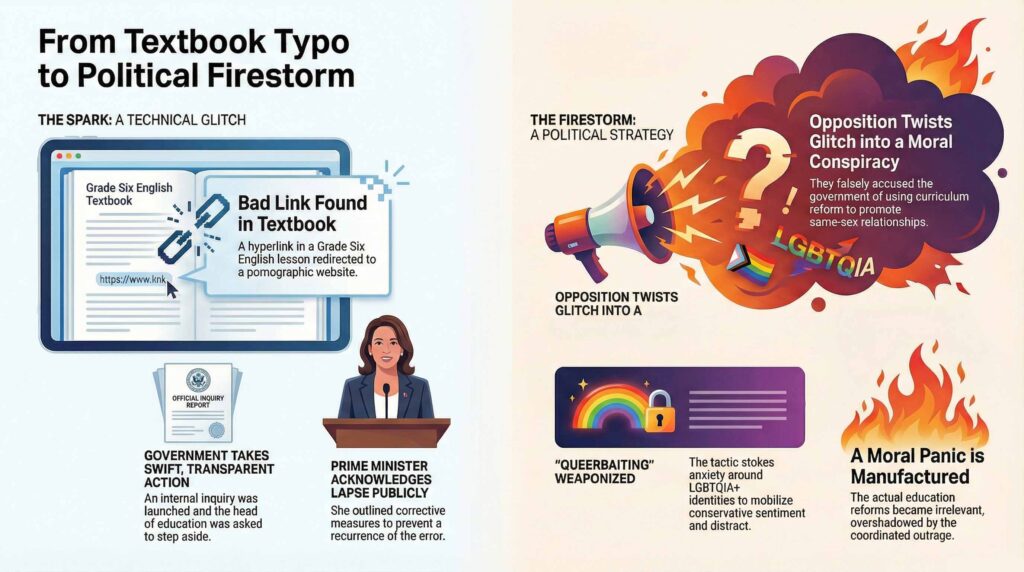
This tactic is neither accidental nor novel. Queerbaiting — the deliberate stoking of anxiety around LGBTQIA+ identities — has increasingly become a convenient political shortcut. By weaponising homophobia, opponents are able to mobilise conservative sentiment, distract from substantive policy discussions, and cast reformists as existential threats to “traditional values”.
In this instance, the reforms themselves were rendered almost irrelevant; what mattered was the creation of a moral panic.
The Samagi Jana Balawegaya (SJB) and the Sri Lanka Podujana Peramuna (SLPP) have both leaned into this narrative, amplifying claims that bear little relation to the actual content or intent of the proposed changes. Fringe groups soon followed, organising protests and public demonstrations that further personalised the attacks. Notably, the Ilankai Tamil Arasu Kachchi (ITAK) declined to join this chorus, instead offering support to the Prime Minister’s efforts to steady the reform process.
Observers of the media landscape have pointed to a striking pattern: the language used across television debates, newspaper columns and social media posts closely mirrors talking points advanced by certain politicians and religious figures. The tone has often been hostile and defamatory, suggesting coordination rather than spontaneous outrage. It is within this echo chamber that political homophobia thrives, presented as moral vigilance but deployed as electoral strategy.
Meanwhile, education specialists have largely endorsed the direction of the reforms, while also conceding that broader consultation should have preceded their rollout. The government has accepted this critique, deferring implementation for Grade Six until 2027. What experts reject, however, is the opposition’s fixation on sexuality. They argue that conflating curriculum reform with the “promotion of same-sex relationships” reflects either a profound misunderstanding or a cynical attempt to derail progress through prejudice.
The rationale against which the retaliatory parties pump hate to strengthen their political campaign is the National Peoples Power’s (NPP) policy proclamation before and after being elected that they are committed to decriminalising consensual same-sex sexual relationships between adults via the provision of amendments to the Penal Code of Sri Lanka, an archaic relic which requires immediate changes in adaptation to the modern world.
Against this backdrop, the Prime Minister has sought dialogue beyond Parliament, including meetings with senior Buddhist clergy in Kandy, where she reportedly provided a detailed briefing on the reforms and their current status. These engagements were said to have been positively received, undermining claims that the government is acting in defiance of social consensus.
The opposition’s next move — a proposed no-confidence motion against the Prime Minister — appears less about parliamentary arithmetic and more about optics. With the government indicating it is willing to allocate time for a full debate, the motion may instead offer a nationally televised platform to counter misinformation. The administration believes such exposure will ultimately expose the emptiness of the allegations and the opportunism behind them.
When queer identities are routinely invoked as scarecrows to discredit policy and demonise leaders, it is clear that homophobia is no longer merely a social prejudice; it has become a calculated political instrument. The real test for the public will be whether they see through the noise — and recognise that fear is being manufactured, not discovered.
Related Stories:
https://lankanewsweb.net/archives/161560/curriculum-controversy-and-cultural-fault-lines-real-issue-versus-growth-of-maggots-on-rotting-flesh/
https://lankanewsweb.net/archives/164822/child-rights-or-moral-panic-mothers-movement-campaign-triggers-widespread-public-debate/
The post When Classrooms Become Battlegrounds: How Queerbaiting Turned Education Reform into Political Ammunition appeared first on LNW Lanka News Web.
