
WHO Confirms Nipah Death in Bangladesh but Says Global Risk Remains Low
LISTEN TO STORY
WATCH STORY
By: Pramod Chinthaka Peiris
February 09, World (LNW): The World Health Organisation (WHO) has confirmed that a woman in her forties has died in Bangladesh after contracting the Nipah virus, while stressing that the likelihood of the disease spreading beyond the region is minimal.
The patient, a resident of Naogaon district in the Rajshahi Division, reportedly fell ill with fever and neurological symptoms in late January. She was hospitalised a week later, where clinical samples were taken and laboratory testing subsequently confirmed Nipah virus infection.
Health authorities noted that she had not travelled recently, but investigations indicated she had consumed raw date palm sap, which is widely recognised as a common source of infection.
Bangladesh formally notified the WHO of the confirmed case on February 03 through the International Health Regulations mechanism. Contact tracing efforts have since identified 35 people who had close interaction with the patient, all of whom have tested negative so far.
The announcement follows the detection of two recent cases in India’s West Bengal state, prompting heightened vigilance across parts of South Asia. Some neighbouring countries have tightened health screening procedures at airports and other entry points. However, the WHO has not advised any restrictions on travel or trade, maintaining that the overall public health risk remains low at national, regional and global levels.
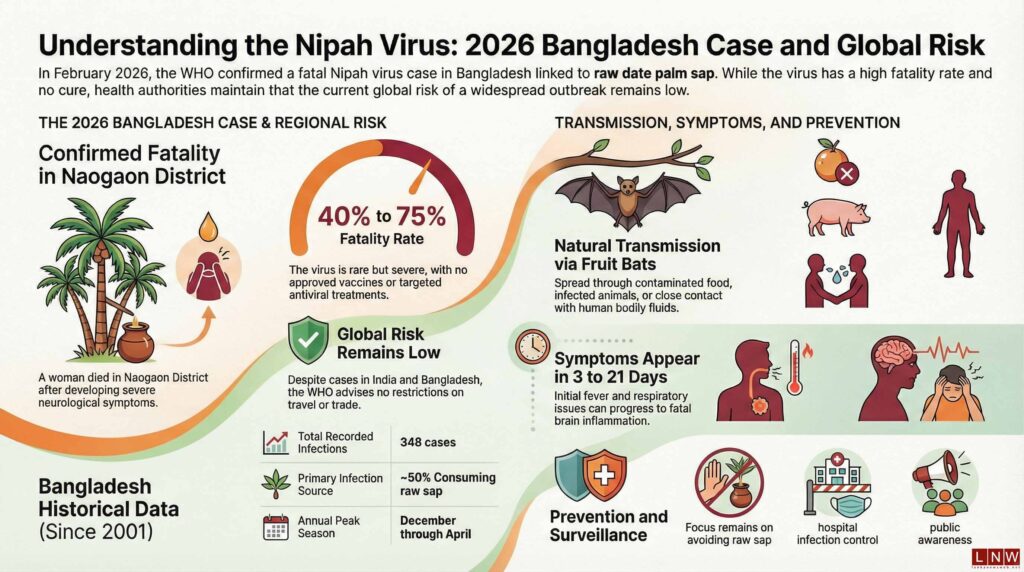
Since first recording cases in 2001, Bangladesh has reported 348 infections, with nearly half linked to the consumption of fresh date palm sap. Nipah outbreaks in the country tend to occur between December and April, coinciding with the sap harvesting season.
There are currently no approved vaccines or targeted antiviral treatments for Nipah virus, which has a notably high fatality rate estimated to range between 40 and 75 per cent. WHO Director-General Tedros Adhanom Ghebreyesus has previously described the disease as rare but severe, emphasising ongoing efforts to strengthen surveillance, improve infection control in hospitals and raise public awareness about prevention.
The virus is naturally carried by fruit bats and can be transmitted to humans through contaminated food, contact with infected animals, or close exposure to bodily fluids of an infected person, particularly in household or healthcare environments. Symptoms can emerge anywhere from three to 21 days after exposure and may include fever, headache, respiratory problems, gastrointestinal illness and confusion. In serious cases, the infection can cause inflammation of the brain and prove fatal, although early medical care can improve outcomes.
While Nipah has caused outbreaks in several Asian countries, no cases have been reported in Sri Lanka to date. Despite its limited geographic spread, health experts continue to view the virus as a significant concern due to its severity, potential for human-to-human transmission and the absence of a definitive cure.
The post WHO Confirms Nipah Death in Bangladesh but Says Global Risk Remains Low appeared first on LNW Lanka News Web.
