
Why Did India’s China-Related Concerns Not Figure on the Agenda of the Colombo Security Conclave in Delhi?
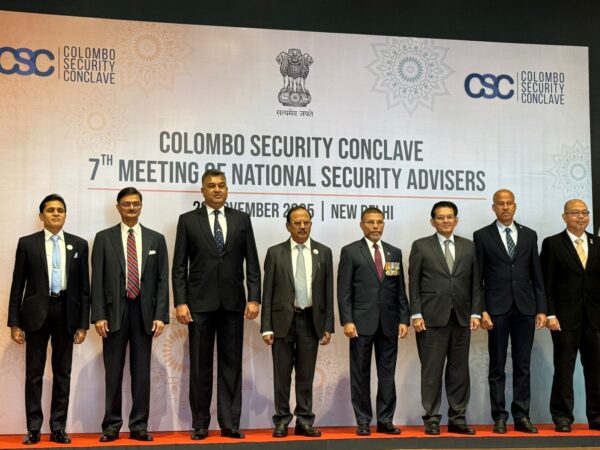
Top national security officials from several Indian Ocean Region (IOR) countries met in New Delhi for the 7th National Security Adviser (NSA) level meeting of the Colombo Security Conclave (CSC) on November 20. They discussed closer coordination in a slew of areas, including counterterrorism, trafficking, transnational organized crime, cybersecurity cooperation, safety of critical infrastructure, and maritime security amid a sharp spike in global uncertainties, exacerbated by the retreat of the U.S. and the rise of China.
Interestingly, India kept the subject of China largely off the agenda of the CSC.
In his speech at the New Delhi meeting, India’s NSA Ajit Doval said: “The ocean is our biggest heritage. It is the engine that propels our economies. As countries joined by shared maritime geographies, it is our responsibility to ensure the safety, security and stability of the region.”
He added, “India is committed to continue working closely with all CSC countries to enhance our collective capacities in dealing with evolving and emerging security challenges.”
The Colombo Security Conclave (CSC) can be traced back to meetings of the Trilateral Cooperation in Maritime Security format, which brought together the national security advisers of Sri Lanka, India, and the Maldives in 2011. After a period of dormancy between 2014 and 2020 — ties between India and the Maldives nosedived in this period — the trilateral forum was revived in 2020, and the grouping evolved into the Colombo Security Conclave, adding new members and sharpening its focus.
Mauritius joined in 2020 and Bangladesh followed in 2024. This year’s New Delhi meeting admitted Seychelles as a member and Malaysia attended the day-long deliberations as a guest country.
The grouping is slowly acquiring a formal shape. At the New Delhi meeting, host India appointed the first secretary general. Besides, the CSC has an agenda that includes specific subjects — maritime safety and security, terrorism and radicalization, trafficking and transnational organized crime, cybersecurity and protection of critical infrastructure and technology, and humanitarian assistance and disaster relief — that member-states will focus on.
According to an Indian government official who spoke to The Diplomat, the topics identified for cooperation are those of priority to all members. “These are issues that affect all the member countries. They are common challenges that need to be dealt with,” the official said, clarifying that these subjects were not proposed by India.
India’s smaller neighbors have long complained that they feel dwarfed and intimidated by India’s size. Moreover, these countries also accuse India of playing “Big Brother” and often pushing its views and concerns on them.
It does seem that at the New Delhi meeting of the CSC, India sought to address the concerns of its smaller neighbors.
The CSC provides its members with an opportunity to open channels of communication and foster dialogue, the Indian government official said. The New Delhi meeting, for instance, provided the NSAs of India and Bangladesh the opportunity to sit down for bilateral discussions amid strained ties.
Earlier this week, a special tribunal in Bangladesh handed the death penalty to former Bangladesh Prime Minister Sheikh Hasina, who has been in India since her ouster from power following student protests in July-August 2024. Bangladesh’s interim government is unhappy with New Delhi for sheltering Hasina. Meanwhile, New Delhi is upset with Dhaka for its alleged reluctance to protect minorities while appeasing Islamist groups, including the Jamaat-e-Islami, and improving relations with Pakistan and China.
The CSC dovetails with some of India’s other initiatives in the Indian Ocean region, like the Security and Growth for All in the Region (SAGAR) concept unveiled in 2015 during Prime Minister Narendra Modi’s visit to Mauritius. A decade later, during his visit to Mauritius again earlier this year, Modi redefined the SAGAR concept to the Mutual and Holistic Advancement for Security and Growth Across Regions (MAHASAGAR).
Both underscore the importance of the IOR for India, and its interest in playing the role of “net security provider” in the region, Samir Bhattacharya, associate fellow at the Observer Research Foundation (ORF) in New Delhi, wrote in an article in Deccan Herald.
According to Abhijit Singh, a former Indian naval officer, currently a visiting fellow at ORF, “The MAHASAGAR and the Colombo Security Conclave, while conceptually distinct, reinforce India’s maritime vision in complementary ways.“
“While the former extends New Delhi’s diplomatic and economic reach across the western Indian Ocean, deepening partnerships along the African littoral, the latter is rooted in the maritime security needs of South Asia — strengthening coastal surveillance, building capacity, and cultivating habits of regional cooperation. Analytically viewed, the CSC provides the security foundation on which MAHASAGAR’s wider Indian Ocean engagement credibly rests,” Singh told The Diplomat.
India’s hosting of the CSC in New Delhi comes at a time it chairs the broader Indian Ocean Rim Association (IORA) from 2025 to 2027. IORA brings together 23 countries from Asia and Africa, besides Australia. All CSC members are also part of IORA, whose secretariat is based in Mauritius.
India has long considered the IOR as lying within its sphere of influence. With Asian countries evolving into major economic growth engines of the world in recent years, the importance of the Indian Ocean region has shot up. The Indian Ocean is now seen as a critical expanse that is crucial to global trade, energy and military strategy due to its shipping lanes, resources and chokepoints. According to some estimates, 40 percent of the world’s offshore oil production comes from the Indian Ocean and 80 percent of the world’s oil shipments travel through its waters.
The increasing economic and corresponding security profile of the IOR has resulted in a spike in Chinese interest in the Indian Ocean. Chinese ships and submarines are regularly reported to be seen in the Indian Ocean.
However, India has avoided bringing its concerns over China’s rising presence in the IOR to the agenda of the CSC. This is because all CSC members have good relations with China.
In the case of Sri Lanka, for instance, “China is Sri Lanka’s second largest trading partner and second import source. Cooperation on major projects is the highlight of China-Sri Lanka relations. Colombo Port City and Hambantota Port have become flagship projects of the Belt and Road cooperation between the two countries,” said a note on bilateral relations on the Chinese Foreign Ministry website. With Mauritius, China has a free trade pact signed in 2019. And since the Muhammad Yunus-led interim government took office in Dhaka, Bangladesh’s foreign policy has visibly tilted towards China.
Given the close Chinese embrace of countries within the CSC, India seems to have wisely kept the challenge Beijing poses to Indian influence out of the grouping’s agenda. It has avoided irking these countries and instead focused on consolidating its ties with them.
India’s neighbors have routinely played the China-India rivalry to their benefit, extracting better terms for themselves.
In addition to cooperation with IOR countries, India has nurtured groupings like the Quad to check China’s rising influence. With the U.S. in retreat and unwilling to shoulder security responsibilities like before, India will have to join hands with countries like Australia and Japan and step up cooperation with them, while keeping smaller Indian Ocean states on its side, to blunt the China challenge.
