
Why Sri Lanka’s Container Depots Need Modern Regulation?
LISTEN TO STORY
WATCH STORY
By: A Special Correspondent
February 13, Colombo (LNW): As global trade becomes faster, more complex, and increasingly competitive, countries that fail to modernise their logistics frameworks risk being left behind. In Sri Lanka, one such challenge has quietly persisted for decades: the outdated regulation of inland container depot operators. More than three years after a formal proposal was submitted in February 2023, the issue remains unresolved, raising important questions about the future of the country’s shipping and logistics sector in 2026.
At the heart of this matter is the way container depot operators are currently governed. Under existing law, they fall within the scope of the Shipping Agents Act No. 10 of 1972. This legislation was designed at a time when Sri Lanka’s trade volumes were modest and its logistics systems relatively simple. Over fifty years later, the country operates in a vastly different environment, shaped by containerisation, digital tracking, international leasing companies, and complex supply chains.
Yet, despite these changes, inland container depots continue to be regulated as though they were conventional shipping agents.
A Sector with a Distinct Role
Inland container depots perform a highly specialised function. Once containers are unloaded by importers, they must be stored securely until shipping lines or leasing firms require them again. These depots act as custodians of valuable equipment that is constantly circulating through global networks.
They are not involved in freight forwarding, vessel operations, or agency services in the traditional sense. Their role is focused on storage, maintenance, handling, and logistics coordination. Treating them as ordinary service providers under old legislation has created legal and operational confusion.
Industry stakeholders have long argued that this mismatch discourages investment, limits infrastructure development, and exposes operators to regulations that are irrelevant to their actual work.
The 2023 Proposal: A Call for Reform
In February 2023, a detailed proposal was submitted to address this problem. It called for a new legislative framework exclusively for inland container depot operators. The document highlighted how existing laws had created what it described as an “anomalistic situation”, preventing the sector from evolving in line with modern trade practices.
The proposal urged policymakers to recognise depot operators as a distinct category and to regulate them through tailored legislation. Among its key recommendations were:
– Introducing a separate Act for container depots
– Removing them from the Shipping Agents Act
– Establishing regulations specific to storage and handling services
– Creating transparent guidelines for rates and charges
– Encouraging infrastructure investment and professional standards
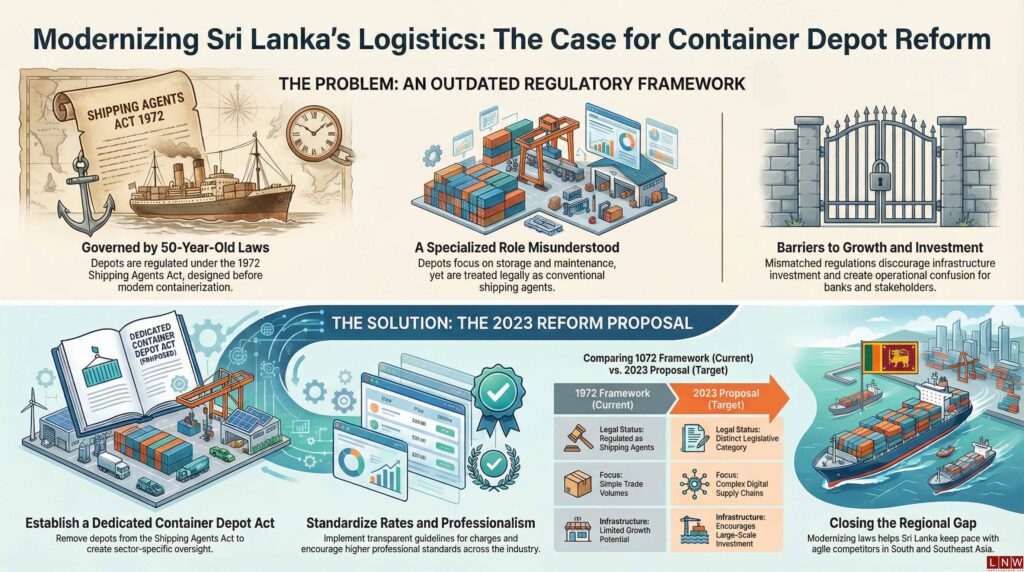
The ultimate objective was clear: to bring legal clarity, promote efficiency, and strengthen Sri Lanka’s position in regional logistics.
Why the Issue Matters in 2026
Three years on, the relevance of this proposal has only grown. Sri Lanka is still working to recover from economic shocks, restore investor confidence, and rebuild its trade networks. Ports, warehouses, and inland logistics hubs are critical components of this recovery.
Without clear and modern regulation, inland container depots face uncertainty. Investors hesitate. Banks become cautious. Operators struggle to expand. In the long term, these weaknesses affect exporters, importers, and consumers alike through higher costs and slower services.
Meanwhile, competing ports in South Asia and Southeast Asia continue to upgrade their legal and regulatory frameworks, offering predictable environments for logistics companies. If Sri Lanka does not keep pace, it risks losing business to more agile neighbours.
The Role of Policymakers
The proposal submitted in 2023 called for action from the Cabinet and the Ministry of Ports, Shipping, and Aviation. It recognised that effective regulation is not about imposing more controls, but about creating rules that reflect reality.
Well-designed legislation could help professionalise the sector, prevent arbitrary pricing, improve safety standards, and encourage long-term planning. It would also reduce disputes between depot operators, shipping lines, and regulators by clearly defining responsibilities.
Most importantly, it would send a signal that Sri Lanka is serious about building a modern logistics ecosystem.
A Missed Opportunity—or a Second Chance?
The delay in implementing these reforms represents a missed opportunity. However, 2026 can still become a turning point. With renewed focus on trade-led growth and regional integration, revisiting this proposal could deliver tangible benefits.
Modernising container depot regulation is not a technical issue confined to industry insiders. It affects export competitiveness, port efficiency, employment, and foreign investment. It shapes how smoothly goods move from factories to ships and from ports to markets.
As Sri Lanka looks ahead, policymakers must recognise that strong infrastructure requires strong institutions and smart laws. The framework governing inland container depots is overdue for renewal.
The question is no longer whether reform is needed, but whether the country is ready to act on it.
If it does, Sri Lanka may yet turn a long-standing regulatory weakness into a strategic advantage in the global logistics race.
The post Why Sri Lanka’s Container Depots Need Modern Regulation? appeared first on LNW Lanka News Web.
