
Yunus slips into China’s deep pocket
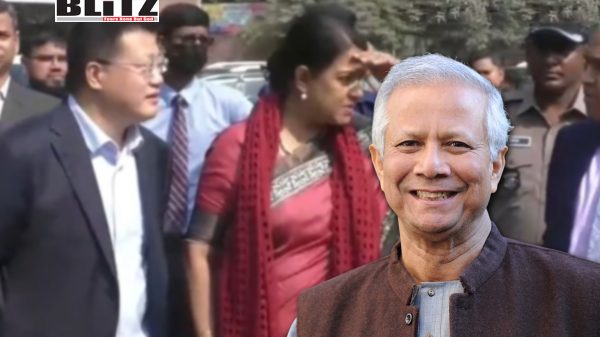
In politics, symbolism is never accidental. Leaders may claim innocence, coincidence, or logistical necessity, but the choices they make—what they touch, where they go, whom they stand beside—speak louder than any press release. In recent weeks, Muhammad Yunus has offered Bangladesh a masterclass in how symbolism can curdle into recklessness. The misuse of an Indian-donated ICU ambulance for political campaigning, followed by the conspicuous involvement of China’s ambassador in a politically sensitive region, is not merely tone-deaf. It is alarming. And it risks pushing Bangladesh into a geopolitical cul-de-sac from which recovery will be costly.
Start with the ambulance.The ICU van gifted by India was intended for one purpose: saving lives in a country chronically short of advanced medical facilities. Bangladesh is not Switzerland; it does not enjoy surplus healthcare capacity. For millions, access to emergency care is the difference between life and death. To divert such a vehicle for a political campaign is not a minor protocol breach. It is an insult—first to the donor, but more importantly to the poor Bangladeshis who were meant to benefit from it. This was not a neutral asset repurposed for convenience. It was a lifeline converted into a billboard.
History is unforgiving to leaders who treat public welfare as a prop. From Perón’s Argentina to Mobutu’s Zaire, the pattern is familiar: when leaders instrumentalize state resources for political theater, institutions erode and trust evaporates. Yunus’s defenders may argue that no patient was harmed in that moment. But ethics are not measured only by immediate casualties. They are measured by intent and precedent. Today an ambulance; tomorrow, perhaps, a hospital wing or a disaster relief fund. Lines, once crossed, rarely redraw themselves.
Then came Rangpur. The Chinese ambassador’s visit to a politically sensitive area—widely known for its strategic geography—was not an innocuous courtesy call. Diplomatic conventions exist for a reason. Under the spirit, if not the letter, of the Geneva Conventions and established diplomatic norms, foreign envoys are expected to refrain from activities that interfere in a host country’s domestic political processes. Escorting an ambassador to witness a referendum campaign is precisely the kind of involvement that raises eyebrows in chancelleries from Delhi to Washington.
This matters because Bangladesh’s foreign policy has long rested on a simple, stabilizing doctrine: friendship to all, malice to none. It is a posture born of vulnerability and wisdom. Small and underdeveloped countries survive not by choosing camps, but by balancing relationships. Yunus, however, appears eager to signal something else. The message is unmistakable: Bangladesh has alternatives; Bangladesh can pivot; Bangladesh can lean into China’s deep pocket if the West hesitates.
One can understand the temptation. China offers fast money, visible infrastructure, and a rhetoric of non-interference that appeals to leaders impatient with Western lectures. But history again offers a cautionary tale. From Sri Lanka’s Hambantota port to parts of Africa now mired in unsustainable debt, the Chinese model often trades short-term gains for long-term leverage. It is not charity; it is strategy. To flirt openly with this bloc, while sidelining traditional partners, is to invite consequences that Yunus may not be around to manage—but his successors certainly will.
The timing makes the signal even starker. By showcasing Chinese proximity, Yunus appears to be sending a pointed note to the Western world, and especially to Donald Trump: pressure me if you must; I have other doors to knock on. This is risky brinkmanship. Great powers do not appreciate being maneuvered through public spectacle. Washington, Brussels, and even Delhi read such gestures not as clever diplomacy, but as alignment. And alignment narrows options.
Domestically, the damage may be worse. Bangladesh’s political fabric is already strained. Using state resources—and foreign gifts—for a referendum campaign deepens polarization and corrodes legitimacy. The quoted claim circulating widely—that “succeeding in holding a referendum on February 12 is more important than the lives of people”—may sound hyperbolic. Yet the imagery of an ICU van rolling through a campaign trail gives it unsettling plausibility. When leaders appear to prioritize political engineering over human need, cynicism flourishes. And cynicism is the enemy of democratic stability.
There is also the moral dimension. Bangladesh has prided itself on ethical signaling in international affairs, often punching above its weight through principled stances in peacekeeping and humanitarian issues. What message does it send when an underdeveloped country, painfully aware of its healthcare deficits, repurposes emergency medical equipment for political messaging? It suggests a troubling drift: that moral calculus is becoming transactional, that ethics can be paused for expediency.
Some will argue that these are overreactions, that politics is messy and symbolism overinterpreted. But geopolitics is a realm where perception is reality. Allies draw conclusions. Investors recalibrate risk. Multilateral partners reassess trust. If the impression hardens that Bangladesh is sliding into a single geopolitical orbit, the costs will be borne not by the political class, but by ordinary citizens—through reduced cooperation, tougher conditionalities, and a narrowing of diplomatic space.
The most sobering irony is that none of this was necessary. Bangladesh could have maintained strategic balance. It could have safeguarded humanitarian assets from political use. It could have kept foreign diplomats at a prudent distance from domestic contests. Instead, it chose spectacle over restraint.
Yunus may believe he is demonstrating independence and leverage. He may even believe he is strengthening his hand ahead of a referendum. But power acquired through such signaling is brittle. It invites backlash abroad and resentment at home. And it leaves a legacy problem for whoever governs next—a Bangladesh perceived as ethically compromised and geopolitically tilted.
In the end, the measure of leadership is not how loudly one declares alternatives, but how carefully one preserves principles. An ambulance is meant to save lives, not votes. Diplomacy is meant to build bridges, not parade allegiances. Bangladesh deserves better than this moment of confusion. And history, relentless as ever, will judge whether Yunus’s leap into China’s deep pocket was strategic foresight—or a costly misstep paid for by the people he claims to serve.
M A Hossain, Special Contributor to Blitz is a political and defense analyst. He regularly writes for local and international newspapers.
