
Children Take Their Fight to Minister as Campaign Against School Corporal Punishment Continues
By: Isuru Parakrama
April 29, Colombo (LNW): Two young child rights advocates have once again brought Sri Lanka’s long-running debate over corporal punishment into the spotlight, urging the government to close legal loopholes that they say continue to leave children vulnerable in schools despite a recent official ban.
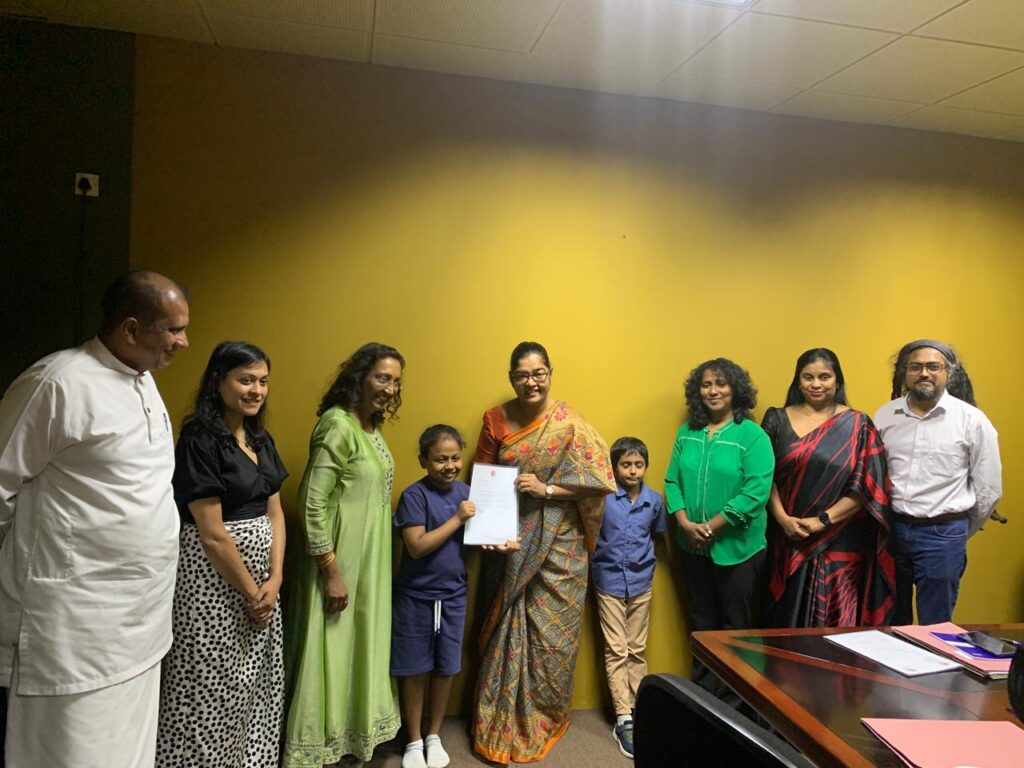
Sahil Manan (11), and Shashyanu Deeghayu Munasinghe (10) have become determined voices in the campaign to end physical punishment of children in educational institutions. The pair first met the Minister of Women and Child Affairs, Saroja Savithri Paulraj, in February last year alongside members of the Child Protection Alliance, where they appealed for stronger legal protections for children.
During that meeting, the minister reportedly assured them that child protection remained a priority for the government. The children left encouraged that meaningful change would soon follow.
However, their optimism faded when planned legal reforms aimed at fully abolishing corporal punishment stalled later in the year, leaving existing provisions in place that campaigners say still permit abusive disciplinary practices under certain circumstances.
Their hopes were briefly revived earlier this month when the Ministry of Education issued Circular 11/2026, formally informing schools that corporal punishment is prohibited. The circular warned that anyone found using physical punishment against children would face action “in terms of the law”.
Yet for Sahil and Shashyanu, the announcement did not go far enough.
In an open letter addressed to the minister ahead of the International Day to End Corporal Punishment (April 30), the children praised the circular but warned that the current legal framework remains inadequate because of loopholes that could undermine enforcement.
They wrote that without changing the law itself, the circular alone would not be enough to ensure children are genuinely protected in classrooms across the country.
The children also reminded the minister that Sri Lanka made international commitments at the First Global Ministerial Conference to End Violence Against Children held in Bogotá in November 2024. Among those pledges were promises to legally prohibit corporal punishment and to create safer school environments by training teachers in positive discipline methods by mid-2025.
According to the two campaigners, those commitments remain unfulfilled, leaving many children still exposed to violence in places meant to provide safety and learning.
In their letter, Sahil and Shashyanu expressed disappointment that many of their peers continue to suffer in silence because they are too frightened to speak openly about abuse by adults in authority. They said they felt compelled to speak not only for themselves but also for countless children who cannot safely raise their voices.
Their appeal also drew attention to growing international evidence about the harm caused by corporal punishment. They referenced a report published by the World Health Organization in August 2025 outlining both the immediate and long-term physical and psychological consequences of children being subjected to violent discipline.
The young advocates argued that ending corporal punishment would not simply protect individual children, but could reshape Sri Lankan society for generations by fostering safer and more respectful learning environments.
“On behalf of all children in Sri Lanka, we urge you to make the promises made in 2024 come true,” they wrote in their closing appeal to the minister.
Their campaign has now become a powerful reminder that the push for children’s rights in Sri Lanka is no longer being led solely by adults — but increasingly by children themselves, demanding that the country match its promises with action.
Full Letter:
Open letter to the Minister of Women and Child Affairs, Hon (Mrs.) Saroja Savithri Paulraj,on the International Day to End Corporal Punishment.
30th April, 2026
Dear Minister Paulraj,
We hope you remember us. We came to meet you on February 28th, 2025 with the Child Protection Alliance to talk about ending corporal punishment in schools in Sri Lanka. This was the photo we took on that day.
You assured us that protecting children was a priority for your government. At the beginning of this month, we were happy to hear that the Education Ministry issued circular 11/2026 informing schools that corporal punishment is banned.
The circular also said that anyone who uses corporal punishment on children will be dealt in terms of the law. But the law has loopholes in it. That’s why we asked, when we met you, for the law to be changed. Unless the law is changed, the circular alone won’t protect children in schools.
At the First Global Ministerial Conference to End Violence Against Children in Bogota in November 2024, Sri Lanka made 4 promises. Two of them were to ban corporal punishment by law, and to create safer schools by training teachers on positive discipline, both by mid-2025. These are published on the website of your Ministry.
We are disappointed that our friends are still suffering in schools because these promises have not been kept. The World Health Organization published a report in August 2025 on the short-term and long-term consequences of corporal punishment. We believe you will agree with us, that it is not fair for our friends to continue to face the risk of these consequences.
Banning corporal punishment will make a huge impact to the society of Sri Lanka, for generations to come. It is our hope that no child will ever have to face being hit, injured, or hurt in any other way.
Because the two of us are safe from corporal punishment, we can talk openly about it. But we know, from friends and family, that most children are afraid to speak about it. So, on behalf of all children in Sri Lanka, we urge you to make the promises made in 2024 come true.
Thank you,
Sahil Manan (11 years old) and Shashyanu Deeghayu Munasinghe (10 years old)
The post Children Take Their Fight to Minister as Campaign Against School Corporal Punishment Continues appeared first on LNW Lanka News Web.
