
Why Has the Maldives Inserted Itself Into the Chagos Sovereignty Dispute?
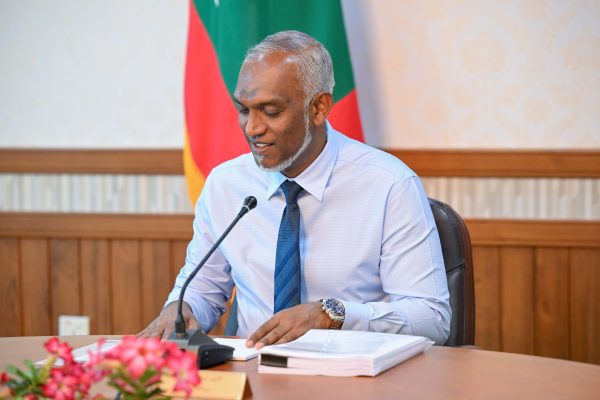
It is official government policy under President Mohamed Muizzu that the Maldives has the strongest claim to the Chagos Islands. His is the first Maldivian administration to assert sovereignty over the archipelago, located in the central Indian Ocean and home to the joint U.K.-U.S. military base on Diego Garcia.
In doing so, Muizzu has inserted the Maldives into the long-running dispute between the United Kingdom and Mauritius over sovereignty over Chagos.
Chagos was administered as a dependency of British Mauritius from 1814 until 1965. That year, three years before Mauritius gained independence, Britain separated the archipelago from Mauritius to create the British Indian Ocean Territory (BIOT) and establish the military base on Diego Garcia. The Chagossian population was then brutally expelled to make way for the base.
The separation ran counter to decolonization principles barring the dismemberment of colonial territories before independence.
Mauritius has objected ever since and, in recent years, has seen international law and global public opinion turn in its favor. In 2019, the International Court of Justice concluded that Mauritius’ decolonization had not been lawfully completed and that Britain should end its administration “as rapidly as possible.” That same year, the United Nations General Assembly overwhelmingly endorsed that position by 116 votes to six.
Mounting pressure eventually led Britain to negotiate with Mauritius, culminating in a 2025 treaty that recognized Mauritian sovereignty while retaining Diego Garcia under a 99-year lease arrangement. Yet the deal remains stalled amid British political opposition and U.S. concerns over the base’s security and continued operation.
Amid these negotiations, the Muizzu administration has asserted that neither the U.K. nor Mauritius has the strongest claim to Chagos, the Maldives does. It therefore opposes any transfer of sovereignty to Mauritius while its own claim remains unresolved.
Muizzu raised this objection in letters to the U.K. government in November 2024 and January 2026, with then Deputy Prime Minister David Lammy in December 2025, and again in a September 2026 letter to Prime Minister Andy Burnham seeking talks.
The government’s case is nebulous. It rests principally on a 16th-century document in which the exiled Sultan Hassan IX claimed title to the “seven islands of Pullobay,” identified in the Maldives with Foalhavahi, or Chagos. The government also cites Maldivian folklore, alleged centuries-old gravestones bearing Dhivehi script, and the islands’ proximity to the Maldives.
The claim also has no precedent in Maldivian diplomacy. In more than 60 years since independence, no previous administration has claimed sovereignty over Chagos.
Previously, Maldivian concerns centered on maritime boundaries, as the Maldives’ EEZ overlapped with waters claimed on the basis of Chagos. Malé kept its position on Chagos sovereignty ambiguous, dealing with either the U.K. or Mauritius depending on which better served its interests. It entered delimitation talks with the U.K. in 1992 and joined Mauritius in a 2011 communiqué opposing the U.K.’s marine protected area around Chagos, which restricted fishing.
The claim of sovereignty over Chagos itself has its origins in the politics surrounding the 2023 presidential election. Opponents of then President Ibrahim Mohamed Solih began conflating the Maldives’ EEZ dispute with Mauritius with the separate issue of sovereignty over Chagos.
The controversy began after it emerged that Solih had written to Mauritian Prime Minister Pravind Jugnauth in August 2022, recognizing Mauritius’ sovereignty over Chagos. This reversed the Maldives’ earlier position as one of only six countries to oppose the 2019 United Nations General Assembly resolution endorsing the ICJ opinion in favor of Mauritius’ claim to Chagos.
Solih’s shift appears to have reflected the growing international legal recognition of Mauritius’ claim. During maritime delimitation proceedings initiated by Mauritius before the International Tribunal for the Law of the Sea (ITLOS), the Maldives argued that the case could not proceed while sovereignty over Chagos remained disputed between Mauritius and the U.K.
ITLOS dismissed that objection, treating sovereignty over Chagos as settled in favor of Mauritius.
Once Solih’s letter became public, however, the dispute turned sharply political.
His opponents argued that recognizing Mauritius’ claim weakened the Maldives’ case before ITLOS. Although the tribunal’s final ruling in April 2023 awarded the Maldives slightly more of the disputed maritime area than Mauritius, the opposition portrayed the outcome as a loss of Maldivian territory.
The rhetoric escalated when the EEZ dispute became entangled with a new sovereignty claim. Former President Mohamed Nasheed, then locked in an internal struggle with President Solih within the ruling MDP, argued that the Maldives itself had a claim to Chagos and that Solih had betrayed Maldivian interests by recognizing Mauritius’ claim. Former President Abdulla Yameen and the opposition Progressive Party of Maldives (PPM) soon adopted the same position. Neither, however, had advanced such a claim while in office.
It was in this political context that Muizzu inherited the issue and turned it into government policy. After Yameen was barred from contesting the 2023 election, Muizzu led the PPM-People’s National Congress (PNC) coalition to victory on a nationalist platform built around defending Maldivian sovereignty.
Alongside the “India Out” campaign, he pledged to recover the Maldives’ “lost” maritime territory. In office, that rhetoric hardened into policy. Muizzu rejected the final ITLOS judgment on the maritime boundary and became the first incumbent Maldivian administration to assert sovereignty over Chagos itself.
Muizzu has formally withdrawn Solih’s 2022 letter supporting Mauritius’ claim and promised to submit evidence supporting the Maldives’ claim to Chagos to relevant international bodies. He has also created a new government office to oversee territorial boundaries and related disputes.
Perhaps most dramatically, in February the government deployed Coast Guard vessels and drones across the full 200-nautical-mile zone it claims, including waters awarded to Mauritius by ITLOS, and intercepted Sri Lankan fishing vessels there. Despite the theatrics, the ITLOS judgment on the maritime boundary is final and not subject to ordinary appeal. Repeating such deployments in waters assigned to Mauritius would therefore risk turning a settled legal dispute into an international incident.
Nor do these actions advance the Maldives’ separate sovereignty claim over Chagos, which has so far gained no international traction. The U.K. has shown little inclination to entertain it, reiterating that Chagos sovereignty remains a bilateral matter between the U.K. and Mauritius and does not concern the Maldives.
Mauritius, meanwhile, suspended diplomatic relations with the Maldives in February 2026.
For now, then, the claim’s clearest impact is domestic rather than international. It allows Muizzu to place Chagos within a broader political narrative about defending Maldivian sovereignty and recovering territory supposedly lost by previous governments. Internationally, however, the claim has yet to alter either the legal or diplomatic landscape surrounding Chagos.
