
Dignity defined in a Nobel Peace Prize
| 3 min read
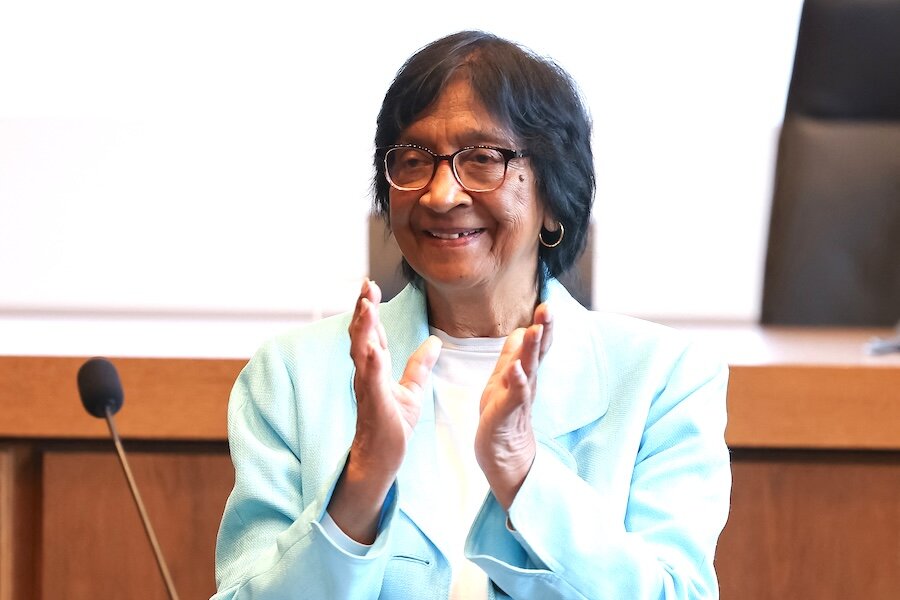
When the five members of the Norwegian Nobel Committee gave this year’s peace prize to Navi Pillay, a human rights lawyer and international judge, they left something out.
Yes, they gave her credit for expanding international law – notably in establishing mass rape as a war crime – and for being “instrumental in ensuring” that crimes against humanity are prosecuted. Born in South Africa to Tamil Indian parents, she has also earned kudos for helping to dismantle apartheid through her law practice.
But soon after learning of the award Oct. 9, Ms. Pallay filled in that missing piece.
“Let me dedicate this award to all the survivors of international crimes,” she told reporters. What she meant by that could be explained by a speech she gave last year.
She said that her motivation has been shaped by a conviction that dignity is universal. “I have seen that affirmed in the eyes of many so-called victims.” In her travels to refugee camps, prisons, and conflict zones, she met victims of torture and survivors of sexual violence. “Their stories haunted me, but they also inspired me. I wanted the world to see their humanity, not just their suffering.”
She says that the truth-telling of such survivors changed the law. “Throughout my career, I have been asked how I kept going in the face of such horror.... My answer is simple: I drew strength from the people whose rights we defend.
“From the Rwandan woman who testified despite her trauma. From the Sri Lankan mother who refused to accept her son’s disappearance. From the activists and lawyers who risk their lives every day to demand freedom.”
“My story ... belongs to all those who believed that the law, even in the darkest times, could be used as a beacon of hope.”
Yet her personal story does shed light on why she has been so open to the inherent dignity of people. Growing up under apartheid, “I was treated like dirt just because of my skin colour,” she told The Guardian. And yet she “learned not to succumb to that.”
Her parents did not earn much money. Yet “we had values: dignity, faith in education, and the conviction that every person, no matter their colour or gender, deserves a chance.”
“We were brought up in the Hindu religion which imposed heavy moral standards, particularly on girls,” she told interviewer Christof Heyns in 2013. “While there was strict control over us, my parents believed in the equality of all their children and educated both boys and girls. It was somewhat revolutionary that they resisted all attempts by the Indian community to marry off their girls at an early age.”
Ms. Pillay is not alone in reminding the world that dignity is a given in each individual. Or, it’s what former U.S. Supreme Court Justice Anthony Kennedy called the “spiritual imperative” of intrinsic dignity.
“Most people know in their innermost being that they have dignity and that this imposes upon others the duty of respect,” he said.
Last year, another Nobel laureate, Oleksandra Matviichuk of Ukraine, wrote that dignity, not victimhood, is the “foundation of our existence.”
Deepen your worldview
with Monitor Highlights.
Politics with respect
Get political stories with respectful analysis.
There‘s a world of new ideas in every
Books newsletter.
There‘s more to life, enrich yours with
Culture & Learning weekly.
Follow humanity‘s discoveries with
Science & Nature stories in your inbox.
Gain a spiritual perspective
from the stories in your inbox.
Want to understand the deeper impact of critical events? Learn the Monitor‘s insight.
Already a subscriber? Log in to hide ads.
“Dignity gives us the strength to fight, even in unbearable circumstances,” she said. “We are not hostages of circumstance – we are participants in this historical process.”
The Nobel committee properly gives credit to peacemakers. Yet the award could easily go to many more people whose indelible dignity inspired those given the award.
