
India’s Gen Z is speaking up
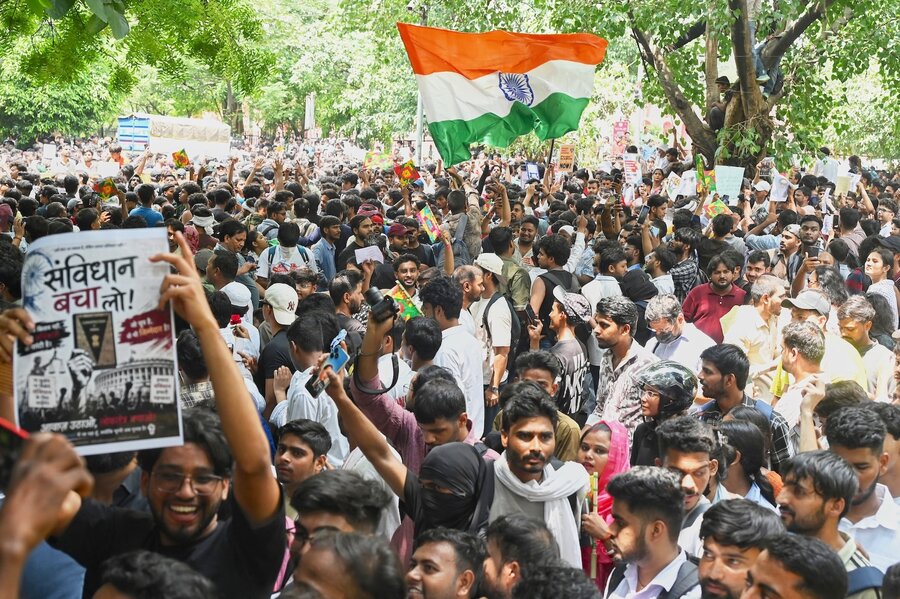
Spontaneous youth-led protests against corruption and unresponsive political leadership have toppled three national governments in South Asia since 2022 – in Sri Lanka, Bangladesh, and Nepal.
By comparison, the goal of the satirically named “cockroach” youth movement in neighboring India seems quite modest: accountability from just one minister and the Ministry of Education on the issue of corruption in the national examination system.
But it’s worth noting that India has the world’s largest population of young people – and that the current largely nonviolent protests are spreading rapidly across the country. Together, these factors have immense implications for national politics and citizens’ expectations for opportunity, responsive government, and social cohesion.
“Perhaps the most remarkable aspect” of this organically evolving movement is “the solidarity it [has] inspired,” according to Bhabani Shankar Nayak, an Indian academic teaching in London. Writing online in Counterview, he observed, “For perhaps the first time on such a scale, online participation merged seamlessly with street mobilisation.”
This is notable at a time when democratic discourse and dissent have been increasingly squeezed under Prime Minister Narendra Modi. During his 12 years of rule, social and religious divisions have been exacerbated, and the government has become adept at controlling access to the internet and social media.
Despite this, the demonstrations have grown organically, and reportedly include citizens of all faiths and generations. Local residents are providing shelter, and people across the country have used delivery apps to donate food and other supplies to the demonstrators.
“The protesters [have] exorcised the corrosive fear that has become second nature to us all with their sheer courage and grace. And humour,” wrote internationally renowned author and activist Arundhati Roy in The Wire this week.
Social media wit has been one unintended motivator behind the student movement. The other was the mid-May cancellation of the national medical school entrance exam, after a question paper was leaked. Millions of students and their families pin their hopes for upward mobility on this highly competitive test, and some 150 such leaks have been alleged since 2014.
A comment by India’s chief justice was the final straw, when he likened unemployed young adults who “don’t have any place in a profession” to “parasites” and “cockroaches.”
“What if all cockroaches come together?” Abhijeet Dipke, an Indian student who recently graduated from Boston University, jokingly mused on social media in response. In a few days, likes were in the millions, and on May 30, he founded the Cockroach Janta Party (CJP) – a play on Mr. Modi’s Bharatiya Janata Party (BJP).
Flying in to New Delhi in June, Mr. Dipke was greeted by supportive crowds. These have now grown into the larger, rolling demonstrations that kicked off Monday, as India’s Parliament opened its monsoon session. The protests are continuing despite internet shutdowns and police crackdowns.
Whether the students will achieve their aim of the education minister’s resignation is uncertain, as Mr. Modi is not known for backing down easily. But it’s clear that the cockroach movement has foregrounded the deeper issue of Indian citizens’ right to political leadership that is honest and responsive.
“Thank you, all you young people, for reminding us about democracy,” commented Geetanjali Shree, another celebrated author and winner of the 2022 International Booker Prize. “Salaam to you. And a plea that the powers that be will do their duty wisely.”
