
The Cost of Mobility: Sri Lanka’s Vehicle Import Dilemma, Fiscal Realities, and Compromises
Cars being unloaded at a Sri Lankan port after the ban on vehicle imports was lifted
 The relationship between the Sri Lankan citizen, the state, and the automobile has long been defined by structural contradictions. For decades, owning a personal motor vehicle has been an ultimate marker of middle-class achievement in the island nation. Yet, for the vast majority, it remains an elusive dream. Following a grueling five-year near-total freeze on automobile imports imposed during the height of the COVID-19 pandemic, and exacerbated by the 2022 sovereign debt default, the Sri Lankan government lifted the ban in early 2025. This historic policy shift was designed to fulfill international lending conditionalities, kickstart domestic economic activity, and inject critically required liquidity into state coffers.
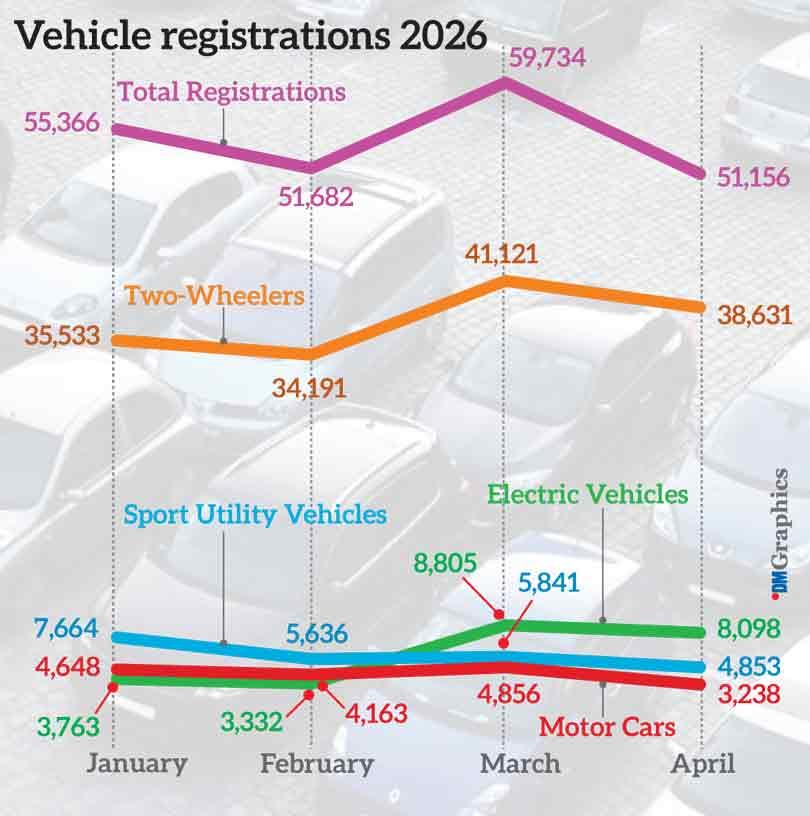
However, the floodgates opened to a complex web of structural issues. The relaxation of restrictions triggered an immediate, aggressive influx of vehicular orders, resulting in hundreds of thousands of new vehicle registrations by late 2025 alone. By mid-2026, the compounding pressures of this influx on macro-fiscal stability, urban infrastructure, and ecological health forced the government to hit the brakes, implementing an abrupt 50% customs duty surcharge in May 2026 to curb foreign exchange outflows.
This article provides a comprehensive, multi-dimensional analysis of Sri Lanka’s vehicle import policy, examining its severe macroeconomic fallout, microeconomic inequities, environmental hazards, infrastructural strain, and the underlying political fractures caused by broken electoral promises.
Macroeconomic Destabilisation: The Forex Drain and Inflationary Pressures
The primary vulnerability of Sri Lanka’s vehicle imports policy lies in its direct, disruptive impact on the balance of payments. Because the country lacks a fully integrated domestic automotive manufacturing industry, every vehicle arriving at the Port of Colombo requires a direct outflow of foreign currency reserves.
The Foreign Exchange and Rupee Vulnerability
When the government reopened vehicle imports, it did so under the assumption that the structural reforms mandated by the International Monetary Fund (IMF) and an improved reserve position (hovering over ($6 billion) could absorb the shock. This proved to be an oversight. The pent-up demand of half a decade manifested as a massive import bill, placing severe pressure on the foreign exchange market. By May 2026, the Sri Lankan Rupee (LKR) had depreciated largely against the US Dollar in less than five months.
This rapid depreciation triggers a dangerous domino effect across the broader economy:
Imported Inflation: As the rupee weakens, the cost of importing essential commodities such as fuel, medicine, and food staples rises proportionally.
The Fuel Loop: Importing more vehicles naturally spikes the domestic demand for refined petroleum products. Consequently, the state is forced to expend its depleted foreign reserves to buy the very fuel needed to run the newly imported vehicles, risking a structural relapse into the fuel queues of 2022.
Debt Servicing Strain: With the nation currently navigating a fragile post-default debt restructuring framework, any unnecessary diversion of hard currency away from reserve accumulation directly undermines Sri Lanka’s long-term sovereign credibility.
Fiscal Dependency and the “Most Taxed Nation” Conundrum
To mitigate the loss of foreign exchange and generate rapid state revenue, successive Sri Lankan administrations have utilised automotive imports as a primary fiscal cash cow. The current landscape has pushed this strategy to its absolute limit, earning Sri Lanka the unenviable reputation of being one of the most aggressively taxed nations in the world for automobiles.
The true cost of bringing a vehicle into Sri Lanka is shaped by an intricate, layered tax architecture that heavily penalises consumers. Under the current 2026 fiscal guidelines, standard internal combustion engine (ICE) vehicles face an astonishing total tax rate of 300% to 450% of their original Cost, Insurance, and Freight (CIF) value. Even localised, smaller displacement compact cars face multi-million-rupee duties, while eco-friendlier electric vehicles (EVs), though lower on the tariff ladder, still carry a 100% to 200% tax burden.
Revenue vs. Equity
From a purely fiscal standpoint, the strategy yields short-term results. Following the lifting of the ban, the Department of Motor Traffic saw its revenues surge by well over 110%, injecting hundreds of billions of rupees into state coffers through luxury taxes and registration fees. However, this fiscal model is deeply regressive. It relies on extracting astronomical sums from a broken transportation market while systematically pricing the middle and lower-income classes out of personal mobility.
The sociopolitical ramifications of this hyper-taxation policy have frayed the social fabric and deeply eroded public trust in democratic institutions.
The Decimation of Middle-Class Aspirations
In modern Sri Lanka, owning a vehicle is not a luxury; it is a defensive necessity driven by the historical inadequacy of public transport. For the middle class, a personal vehicle represents safety, efficiency, and a means of economic advancement. Under the current tax regime, a basic, entry-level Japanese or Indian hatchback that costs $10,000 internationally is transformed into a luxury asset costing upwards of 7 to 10 million LKR.
Consequently, personal mobility has become an exclusive privilege of the political elite, wealthy corporate executives, and wealthy speculators. For the average public servant, teacher, or small business owner, the financial math is completely unworkable. High interest rates on leases, coupled with stagnant wages and an inflationary environment, have permanently deferred the dream of vehicle ownership for the majority of the population.
Broken Election Promises and Political Fallout
This stark inequality stands in direct opposition to the political mandates of the ruling administration. During recent electoral campaigns, populist platforms promised systematic relief to the heavily burdened citizenry, explicitly pledging to make personal transport affordable, rationalise the penal import tariffs, and dismantle the regressive tax structures that punished the working class.
The reality of mid-2026 reveals a complete reversal of those campaign declarations. Faced with structural fiscal deficits and strict IMF revenue targets, the government chose to protect its revenue streams over its electoral vows. The imposition of the temporary 50% Customs Import Duty surcharge in May 2026 represents a pragmatic move to stabilise the rupee, but it serves as a glaring example of a broken democratic contract.
Even if the macroeconomic shocks could be absorbed, Sri Lanka’s physical infrastructure is fundamentally incapable of handling an unmanaged, massive expansion of the national vehicle fleet.
The Gridlock of the Western Province
The overwhelming majority of newly registered vehicles end up concentrated in the Western Province, particularly within the Colombo Metropolitan Area. Sri Lanka’s urban road networks, despite heavy capital investments in expressways over the last decade, are fundamentally bound by rigid spatial constraints. The introduction of hundreds of thousands of new private cars, three-wheelers, and motorcycles onto these roads has triggered severe urban gridlock.
This infrastructural paralysis directly impacts national productivity. Millions of productive man-hours are permanently lost every week as commuters sit in bumper-to-bumper traffic. Furthermore, traffic congestion leads to immense macroeconomic waste via fuel consumption. For logistics providers and supply chains, the prolonged transit times drive up the baseline cost of doing business across the island.
Environmental Degradation, Public Health Liabilities, Air Quality and Emissions Volatility
The environmental consequences of Sri Lanka’s vehicular influx present an understated but critical long-term public health crisis. The sudden addition of hundreds of thousands of internal combustion engines onto a geographically concentrated road network has led to a measurable deterioration in urban air quality. Major intersections in Colombo, Kandy, and turning hubs across the country frequently record elevated Air Quality Index (AQI) levels, characterised by dangerous concentrations of fine particulate matter ($PM{2.5}$) and Nitrogen Oxides ($NO_x$).
The surge in urban air pollution translates directly into escalating public health liabilities. Public hospitals are reporting an increase in chronic respiratory ailments, pediatric asthma, and cardiovascular complications directly linked to poor air quality. This places an auxiliary financial burden on an already strained, state-funded healthcare delivery apparatus. Furthermore, this unmitigated expansion of fossil-fuel-reliant transport directly compromises Sri Lanka’s international climate commitments under the Paris Agreement, moving the nation away from its targets for carbon neutrality and sustainable urban development.
Sri Lanka’s vehicle import policy cannot continue to oscillate indefinitely between the two extremes of total, multi-year bans and sudden, unmanaged market openings protected by prohibitive taxes. Resolving this chronic dilemma requires a comprehensive, long-term policy framework that balances economic stability with equitable mobility.
Strategic Policy Recommendations
Modernise Public Transportation First: The most sustainable way to reduce private vehicle demand is to provide a viable public alternative. Sri Lanka must prioritise the modernization of its railway networks, fast-track Bus Rapid Transit (BRT) corridors, and support private-public partnerships to build clean, safe, and punctual mass transit systems. Transition to an Accountable EV Policy: Instead of blanket surcharges that penalise all vehicles equally, the tariff system should be restructured to heavily favour light Electric Vehicles (EVs) and plug-in hybrids, powered by an expanded domestic renewable energy grid. This selectively curbs the long-term imported fuel bill. Implement Quota-Based, Predictable Import Windows: Rather than volatile policy shifts that destabilise the market, the Central Bank and Ministry of Finance should issue predictable, quarterly import quotas aligned with real-time foreign exchange cash flows, preventing sudden shocks to the rupee.
Conclusion
The crisis surrounding Sri Lanka’s vehicle import policy is a clear reflection of the nation’s broader structural challenges. It exposes an economy caught in a vicious cycle: dependent on vehicle taxes for immediate revenue, yet fundamentally unable to sustain the foreign exchange outflows, infrastructural demands, and environmental costs that those very vehicles impose.
For the average citizen, the car remains an impossibly expensive dream, rendered unreachable by a state that uses hyper-taxation to cover historical structural deficits. For the government, the sudden policy shifts such as the May 2026 duty surcharge highlight how difficult it is to maintain economic stability while under strict international oversight.
True progress will not be achieved through temporary tax surcharges or reactive gazette notifications. It demands a holistic re-engineering of the national transport philosophy one that shifts the focus from penalising private ownership to building a modern, clean, and accessible public transportation network that serves all Sri Lankans equally.
“THERE IS A GREAT DIFFERENCE BETWEEN SAYING AND DOING” – John Haywood’s Dialogue of Proverbs (1546)
The writer is a distinguished International Researcher, Author and analyst with a career spanning over 36 years of service in the Sri Lanka Army, including 20 years in active combat. A seasoned Infantry officer, Major General (Retd) Dr Boniface Perera holds a PhD in Economics and has authoured 17 books and over 200 research articles. His multifaceted expertise bridges the gap between National Security, Global Politics and Economic strategy. As an entrepreneur and International analyst, he provides strategic insights into the intersection of security and economic policy.
He can be reached [email protected]
The post The Cost of Mobility: Sri Lanka’s Vehicle Import Dilemma, Fiscal Realities, and Compromises appeared first on LNW Lanka News Web.
