
China Puts Scientists On Giant Screens. Why Are India’s Hoardings Still All About Stars And Politicians?
International
oi-Prakash KL

Politicians, film stars and sporting icons are familiar faces on giant billboards and public screens across Indian cities. In China, however, scientists are increasingly being given the kind of public visibility usually reserved for celebrities.
In recent weeks, prominent advertising spaces in shopping malls, commercial districts and other public areas in several Chinese cities have featured portraits of some of the country's most celebrated scientists. Rocket scientist Qian Xuesen, Nobel Prize winner Tu Youyou, agricultural scientist Yuan Longping, nuclear physicist Deng Jiaxian and radio astronomer Nan Rendong are among those whose faces have appeared on giant screens.
China prominently displays scientists on public screens, unlike India's billboards featuring politicians and stars, sparking debate on valuing diverse achievements and role models for children.
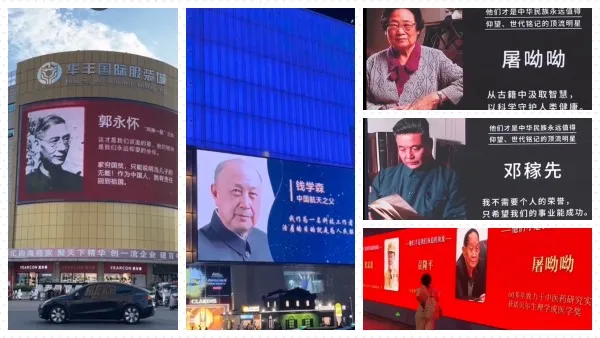
The displays highlight their achievements and contributions rather than promoting a product or a film.
The campaign, which began in places such as Shandong, has spread to Anhui, Inner Mongolia, Jiangxi, Henan and other regions. The prominent placement of the portraits has also drawn public attention, with people stopping to take photographs in front of the displays.
The initiative has prompted a larger conversation in China about the kind of role models society chooses to put in front of its citizens, particularly children. That conversation offers an interesting contrast with India's public spaces, where political leaders, film stars and cricketers continue to command much of the visual landscape.
Who gets the biggest billboard?
Industrialist Harsh Goenka recently highlighted this contrast in a social media post, arguing that public spaces can influence what children learn to admire. "China is putting scientists and researchers on giant public screens, turning science and achievement into something visible and aspirational," Goenka wrote.
He pointed to the prevalence of politicians, film stars and fan posters, particularly in parts of South India, and questioned why scientists, teachers, doctors, engineers, innovators, entrepreneurs, sportspersons and other "nation-builders" could not receive similar visibility.
China is putting scientists on giant screens in public places.
— Harsh Goenka (@hvgoenka) August 31, 2026
In India, our hoardings are dominated by politicians and film stars.
What we celebrate shapes what our children aspire to become. Why not put our scientists, teachers, doctors, innovators and nation-builders up there? pic.twitter.com/hcZyzGbEdz
"What children repeatedly see in public spaces" can shape their perception of who deserves admiration, Goenka suggested. His observation raises a broader question: does visibility itself help determine what a society considers successful?
India certainly does not lack people whose achievements deserve recognition. But many of them rarely appear on the giant hoardings and cut-outs that dominate busy roads and commercial areas.
We remember the vaccine. Do we remember the scientists?
Indian consultant and trainer Sanjay Goel raised a similar question while reflecting on the scientists behind Covaxin, India's indigenous COVID-19 vaccine.
Most Indians remember Covaxin and the urgency of the pandemic. But Goel asked how many people can actually name the scientists who worked on the vaccine.
He used that question to imagine a different kind of Indian cityscape.

Instead of seeing only hoardings featuring politicians, cricketers, actors and advertisements, he imagined public spaces displaying the faces and achievements of army officers, scientists, engineers, doctors and researchers.
Goel argued that such visibility could create opportunities for children to discover role models outside the conventional celebrity world.
A child seeing the face of a scientist on a large public display may ask, "Who is this?" The answer could introduce them to a scientist's work, just as a film poster or sports advertisement familiarises children with actors and sportspersons.
For Goel, that is the power of a role model - not simply that the person is famous, but that their life can influence what a young person chooses to aspire to become.
India has its scientific icons, but only a few become household names. The country has produced scientists and technologists who have achieved extraordinary public recognition.
A.P.J. Abdul Kalam remains the most prominent example. The scientist-turned-President became a household name and an enduring source of inspiration for generations of students. But his level of recognition is unusual.
There are countless scientists, researchers, engineers, doctors and innovators whose work has had a significant impact on the country but whose names remain unknown outside their respective fields.
The issue, therefore, is not that India does not celebrate achievement.
It is about which achievements receive mass visibility. A blockbuster actor can become instantly recognisable because millions see their face on posters, billboards, television and social media. A politician can become a familiar face because party workers place enormous cut-outs and banners across cities.
A cricketer can become a household name through advertising campaigns. But the scientist whose work contributes to a vaccine, the engineer who develops critical infrastructure or the researcher who makes a breakthrough may remain largely invisible.
India's giant cut-out culture
The difference becomes even more pronounced during political events and major film releases. Across Tamil Nadu, Karnataka, Andhra Pradesh, Telangana and other parts of South India, giant cut-outs have long been part of political and film culture.
For major stars such as Rajinikanth, Vijay, Ajith Kumar and Kamal Haasan in Tamil Nadu; Chiranjeevi, Pawan Kalyan, Mahesh Babu, Prabhas and Allu Arjun in the Telugu-speaking states; and Yash, Darshan and Sudeep in Karnataka, film releases can trigger elaborate celebrations outside theatres.

Fans erect towering flex banners and giant wooden or cardboard cut-outs of their favourite stars. Streets around theatres can turn into festival-like spaces, with drums, dancing, firecrackers and crowds gathering hours before a film's first show.
For fans, these displays are expressions of admiration, cut the cut-out culture has also repeatedly raised questions about public safety.
When The Cut-Out Becomes a Danger
In 2019, 23-year-old software engineer Subhasri Ravi was killed in Chennai after an unauthorised life-size hoarding fell on her while she was riding her scooter on the Pallavaram-Thoraipakkam Radial Road.
The hoarding knocked her off the two-wheeler, after which she was hit by a water tanker. She was wearing a helmet and was on her way home from work when the accident occurred. The hoarding reportedly carried images of then Tamil Nadu Chief Minister Edappadi K Palaniswami, Deputy Chief Minister O Panneerselvam and former Chief Minister J Jayalalithaa. It had been put up by a local AIADMK functionary for a family wedding attended by Panneerselvam.
The death triggered widespread outrage over illegal hoardings and the political culture surrounding them.
The risks associated with giant cut-outs have not disappeared.
In January 2026, three people were injured in Hubballi in Karnataka after a massive cut-out installed along Mantur Road collapsed during preparations for an event linked to a Slum Board housing distribution programme. Congress workers had installed large cut-outs of party leaders along the road and near the venue ahead of Chief Minister Siddaramaiah's arrival.
The structures reportedly caught the wind and collapsed onto the crowd, trapping and injuring three people. Police personnel standing nearby also narrowly escaped being hit.

Earlier this year, a 100-foot cut-out of late Kannada actor Vishnuvardhan erected near Prasanna Theatre on Bengaluru's Magadi Road fell after a vehicle passed the area. No injuries were reported, but the incident once again highlighted the scale and potential risks of India's cut-out culture.
Fame is not the same as contribution
There is, of course, nothing wrong with celebrating actors, sportspersons or political leaders. Cinema is an important part of Indian culture. Sport inspires millions. Political leaders occupy an important place in a democracy.
The question is whether these should be the only categories of people receiving such extraordinary public visibility.
A scientist may spend decades working in a laboratory without becoming a recognisable face. A teacher can transform generations of students without ever appearing on a billboard. A doctor can save thousands of lives without having a giant cut-out erected in their honour.
An engineer can design systems used by millions without becoming a celebrity. A soldier can serve the country for years without attracting the kind of public attention given to a film star's latest release.
Their contributions may be less visible, but they are no less significant. This is where the Chinese initiative offers an interesting point of comparison.
What do our public spaces tell us?
A billboard is not merely a piece of advertising. The people and images occupying prominent public spaces also become part of the visual environment in which children grow up.
If the largest screens repeatedly feature celebrities, political leaders and commercial icons, those are the faces children naturally become familiar with. What if those spaces also featured scientists, doctors, teachers, engineers, astronauts, researchers, soldiers and innovators?

Not necessarily instead of actors or sportspersons. But alongside them.
The objective would not be to turn every scientist into a celebrity. Nor would putting a scientist's face on a billboard automatically inspire the next generation of researchers.
As Goel's argument suggests, however, visibility can begin a conversation. A child might see a scientist's portrait and ask who they are. That question could lead to a story about a discovery, an invention, a medical breakthrough or a contribution to the country. That is how an unfamiliar name can become a role model.
Should India copy China?
Probably not the exact model. China's campaign is a state-led effort, and India's social, political and cultural landscape is very different.
But the underlying question is universal. Who do we choose to celebrate?
India does not need fewer film stars, cricketers or political leaders on its public screens. It could simply make room for more people whose contribution extends beyond fame.
Scientists who push the boundaries of knowledge. Doctors who serve communities. Teachers who transform lives. Engineers and innovators who solve difficult problems. Soldiers who serve in extraordinary circumstances. Entrepreneurs who create jobs and build industries. Researchers whose work affects millions but whose names few people know.
Harsh Goenka's question is therefore worth considering in a wider context: if public spaces help tell children who matters, perhaps India could broaden the list of faces it puts before them.
The issue is not whether a scientist deserves a billboard more than an actor. It is whether achievement beyond celebrity deserves a place on the biggest screens in our cities.
China's giant portraits of scientists have turned that question into something visible. India's towering political and film cut-outs, meanwhile, show just how much public space we are already willing to devote to the people we admire.
The real question may simply be: what kind of heroes do we want the next generation to see?
