
Dr Harsha Must Not Allow the CBSL to Whitewash the Rs. 13.8 Billion Fraud
By Banker
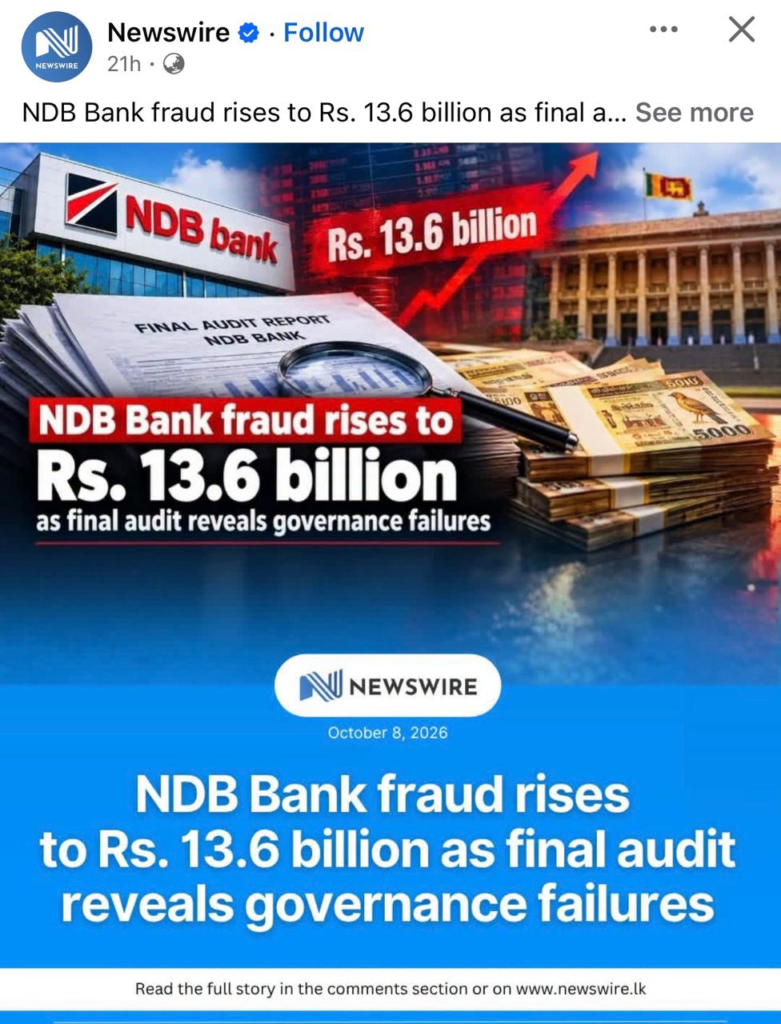
What a joke it is to hear Central Bank of Sri Lanka (CBSL) officials suggest that a general audit could not have uncovered the massive fraud at National Development Bank (NDB). If that is the conclusion, it raises an even more fundamental question: what exactly are external auditors, audit committees and boards expected to do when they review and approve a bank’s financial statements?
When receivables increase dramatically, alarm bells should ring. NDB’s Common Electronic Fund Transfer (CEFT) receivables reportedly quadrupled in a year, exceeding Rs. 12 billion in 2025. Surely, such an extraordinary movement warranted deeper scrutiny, independent confirmation and enhanced audit testing. How could a balance of this magnitude escape the attention of the bank’s internal control mechanisms and the external auditor who certified the financial statements as presenting a true and fair view?
The public deserves answers, not explanations that appear to dilute accountability.
Dr Harsha de Silva, Chairman of Parliament’s Committee on Public Finance (CoPF), has rightly questioned why no senior management official, board member or external auditor has yet been held accountable for the Rs. 13.6 billion fraud. His questions are important, and he must ensure that the investigation does not end with a convenient allocation of blame to junior employees.
The forensic review conducted by Deloitte Touche Tohmatsu India LLP reportedly did not identify senior management personnel as directly involved in the fraudulent transactions. But direct involvement and responsibility for governance failures are two different matters. A director need not have participated in a fraudulent transaction to be held accountable for failing to discharge oversight responsibilities.
The same principle applies to the Chief Financial Officer, Chief Executive Officer, Board Audit Committee and external auditor. If financial statements were signed off despite extraordinary movements in receivables, someone must explain what checks were performed, what questions were raised and whether the answers were independently verified.
A forensic investigation should establish not only who perpetrated the fraud, but also how it continued, why existing safeguards failed and whether warning signs were ignored. Without these answers, the exercise risks becoming an investigation into the mechanics of the fraud rather than a meaningful examination of accountability.
Conflict of Interest of Deloitte
The Deloitte report must therefore be scrutinizedindependently. Its findings cannot simply be accepted as the final word, particularly when questions remain about the responsibilities of senior officials and the external auditor. Any suggestion of a conflict of interest must be examined objectively, on evidence, rather than dismissed or assumed.
Independent Expert Committee
Dr Harsha has previously demonstrated his willingness to challenge powerful institutions. When the CBSL increased salaries amid Sri Lanka’s severe economic crisis, he helped appoint a group of experts to examine the matter. That episode established an important principle: even an institution entrusted with regulating the financial system must be subject to scrutiny.
The same standard must apply now.
It is encouraging that the Sri Lanka Accounting and Auditing Standards Monitoring Board has completed its separate investigation into the external auditor’s compliance with auditing standards. Its findings, expected to be released through the appropriate regulatory process, will be crucial. They must be examined thoroughly, and any shortcomings established should lead to appropriate consequences.
The question of audit-industry concentration and potential conflicts of interest also deserves serious attention. The credibility of financial reporting depends on auditors exercising genuine independence, professional scepticism and the courage to challenge management when circumstances demand it.
The CBSL Governor has said that failures extended across several layers of NDB’s oversight. If so, accountability cannot stop at the level of those who executed the transactions. Nor should the absence of an immediate threat to deposits or financial stability diminish the seriousness of the governance failure.
Sri Lanka cannot afford another episode in which a major financial scandal produces extensive reports but limited accountability.
Rise up to the Challenge
Dr Harsha must insist on transparency, independent scrutiny and clear findings on responsibility. The public should be told what went wrong, who failed in their duties and what action will follow. If negligence is established, appropriate regulatory and professional consequences must follow; if criminal conduct is established, the relevant authorities must act.
The integrity of Sri Lanka’s banking system depends not merely on preventing fraud, but on ensuring that those entrusted with oversight are held accountable when controls fail.
The Rs. 13.6 billion NDB fraud must not become another case in which everyone acknowledges that the system failed, yet nobody at the top is held responsible.Dr Harsha de Silva himself an ex Banker must put this right without trying to hep his Royal College friends at NDB .
The post Dr Harsha Must Not Allow the CBSL to Whitewash the Rs. 13.8 Billion Fraud appeared first on LNW Lanka News Web.
