
New Nurdle Survey Highlights Challenges in Linking Coastal Pollution to MSC ELSA 3 Spill
A new study following the MSC ELSA 3 spill has found widespread plastic pollution along Sri Lanka western coast, but warns that the absence of pre-spill baseline data makes it impossible to determine how much contamination resulted from the incident. Researchers urge long-term monitoring and improved source-tracking to distinguish new pollution from legacy and other plastic contamination.
By: A Special Correspondent
July 03, Colombo (LNW): A new scientific assessment of plastic pellet contamination along Sri Lanka’s western coastline has revealed widespread nurdle pollution following the MSC ELSA 3 maritime incident, but researchers caution that a lack of historical baseline data makes it difficult to determine how much of the contamination can be directly attributed to the latest spill.
The study, presented at the 1st International Conference on Marine Science and Sustainability 2026, examined nine beaches along the western coast over a 13-week period between July and September 2025. Researchers documented substantial quantities of plastic nurdles—small pre-production plastic pellets used in manufacturing—across all surveyed locations. However, the findings also underscore a broader scientific challenge facing marine pollution assessments in Sri Lanka, distinguishing new contamination from the lingering impacts of previous pollution events.
The MSC ELSA 3 incident occurred in May 2025 and resulted in extensive shoreline accumulation of plastic pellets. In response, researchers from the Ocean University of Sri Lanka initiated a monitoring programme to measure nurdle abundance, evaluate spatial and temporal patterns, and assess the physical condition of recovered pellets.
Their surveys found significant variation among sites. Some beaches recorded only around 15 pellets during standardised searches, while others yielded more than 3,000 nurdles within the same sampling period. Weekly totals across all locations fluctuated dramatically, ranging from 2,085 pellets to more than 15,000, with notable peaks occurring in late July and late August.
At first glance, such findings could be interpreted as evidence of substantial contamination linked to the MSC ELSA 3 spill. Yet the researchers themselves stop short of making such a direct attribution.
A central limitation identified in the study is the absence of comprehensive baseline data for Sri Lanka’s western coastline. Without detailed information on nurdle abundance before the MSC ELSA 3 incident, scientists cannot confidently determine how much contamination was already present in coastal sediments and beach deposits.
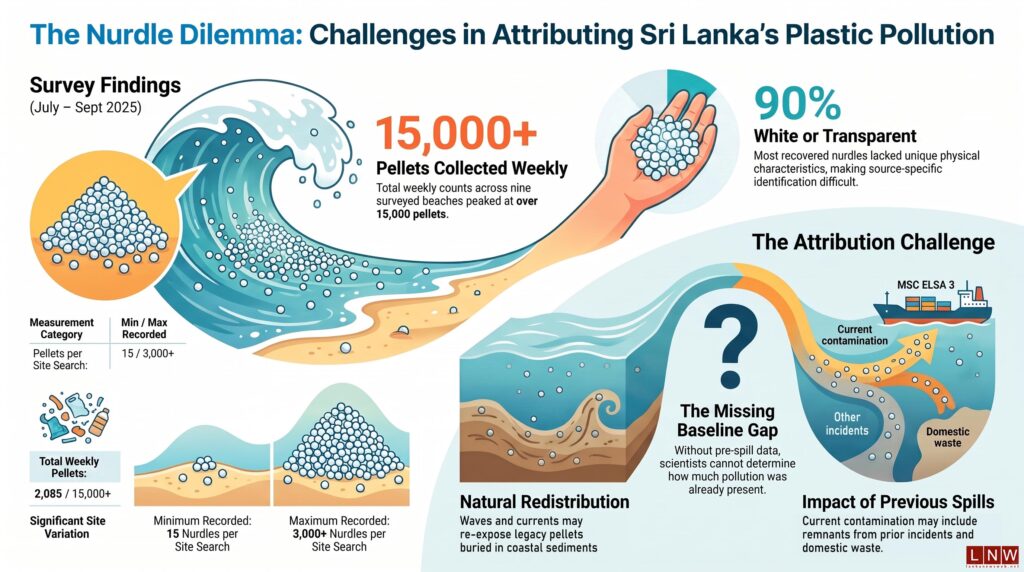
This gap is particularly important because Sri Lanka has experienced previous plastic pellet spill incidents, including the X-Press Pearl incident, yet no comprehensive baseline data was collected prior to that event or during the period between the X-Press Pearl and MSC ELSA 3 incidents.
The new study explicitly notes that residual pellets from earlier spill events may remain buried within coastal sediments and can be periodically reintroduced to beaches through natural coastal processes such as wave action, currents, and sediment transport. However, in the absence of baseline data and source-specific identification, it is not possible to determine whether these legacy pellets originated from the X-Press Pearl spill or other sources. Consequently, some of the pellets observed during the 2025 surveys may not have originated from MSC ELSA 3 at all.
This distinction is more than a technical detail. Determining the source of contamination has important implications for environmental damage assessments, cleanup responsibilities and potential compensation claims. Without reliable baseline measurements or chemical fingerprinting capable of distinguishing pellets from different spill events, establishing causation becomes extremely difficult.
The researchers also point to the dynamic nature of Sri Lanka’s coastal environment as a complicating factor. Waves, tides, currents and the formation of wrack lines continuously redistribute floating and buried debris. Pellets deposited during one incident may be transported, buried, exposed and redistributed again over periods of months or in theory even years.
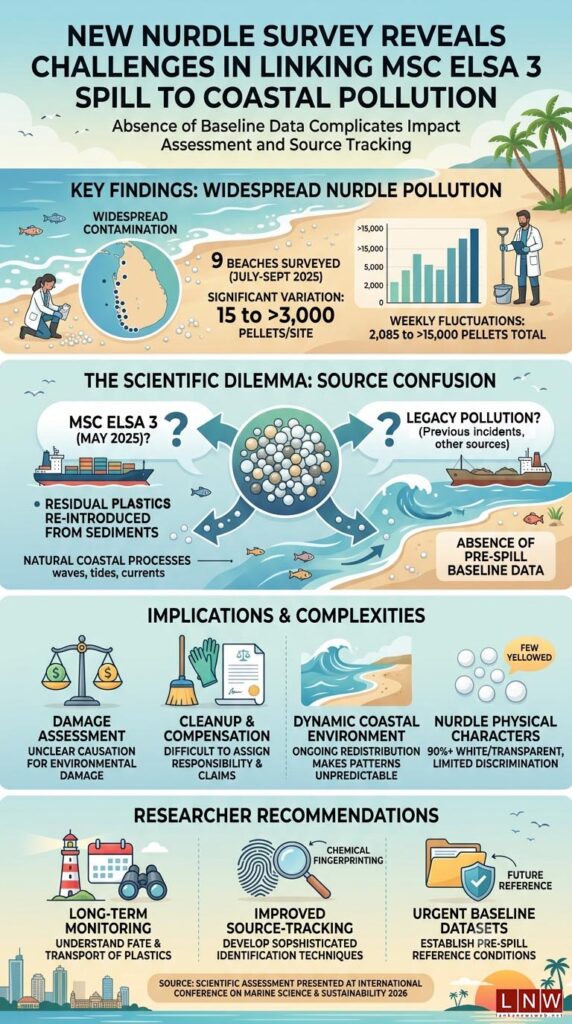
The study’s findings support this interpretation. The observed spikes and declines in pellet abundance did not follow a simple pattern of gradual reduction after the spill. Instead, counts fluctuated significantly from week to week, suggesting ongoing redistribution rather than a single pulse of contamination. Such variability indicates that local coastal currents may play a signification role in determining where and when pellets accumulate.
Researchers also found that more than 90 per cent of recovered pellets were white or transparent, with only small numbers of yellowed pellets and negligible quantities of charred material. While these observations provide useful information about the physical characteristics of the contamination, they do not offer a definitive method for distinguishing between pellets released by different maritime incidents.
Rather than presenting conclusive evidence about the origins of the nurdles, the study is an important reminder of the challenges involved in assessing marine plastic pollution after multiple spill events. The authors describe their work as a preliminary assessment and emphasise the need for long-term monitoring to better understand the fate and transport of plastic pellets in Sri Lankan waters.
Their findings also highlight the importance of urgently establishing robust baseline datasets before future incidents occur. Without pre-spill reference conditions, scientists are often forced to evaluate environmental impacts using incomplete information, making it close to impossible to separate new contamination from historical pollution.
More broadly, the findings should be viewed within the context of Sri Lanka’s wider plastic pollution challenge. Numerous studies have identified land-based domestic sources—including inadequately managed municipal waste, open dumping, littering and river carried pollution—as the dominant contributors to plastic debris entering the country’s coastal and marine environments. The MSC ELSA 3 spill undoubtedly introduced additional plastic pellets to the environment, but determining its precise contribution relative to pre-existing pollution and legacy contamination from earlier events will require sustained monitoring and more sophisticated source-tracking techniques.
References:
Proceedings of the 1st International Conference on Marine Science and Sustainability 2026 | 8th and 9th of June 2026 | Centre for Environmental Studies & Sustainable Development (CESSD); Marine Environment Protection Authority (MEPA); The Open University of sri Lanka (OUSL); Ministry of Environment.
The post New Nurdle Survey Highlights Challenges in Linking Coastal Pollution to MSC ELSA 3 Spill appeared first on LNW Lanka News Web.
