
Pyramid Wilmar sets sights on doubling turnover in five years
Group Managing Director Sajjad Mawzoon (right) and Director/Group Chief Operating Officer Thanveer Siddique – Pix by Sameera Wijesinghe

- Food business giant with dominance in edible oil and fats, consumer goods to add few more big-ticket products
- To enhance local manufacturing and value addition with enabling Govt. policy
- Stresses need for proper regulation of sale of edible oils
- Credits two-decades of success to unwavering commitment to quality and resilience to the adaptability to change whilst being agile
By Nisthar Cassim
Celebrating two decades of pioneering success, the food industry specialist Pyramid Wilmar has set sights on doubling its top line in the next five years with further innovation and value offering both in B2B and consumer segments.
Pyramid Oil Mills, the local oil miller in the year 2004 forged a strategic 50:50 joint venture with Wilmar International Ltd., Asia’s leading agribusiness group, headquartered in Singapore; with over a 1000 manufacturing plants in over 50 countries. Wilmar is a global leader in processing and merchandising palm and lauric oils and also leads the market in flour and rice milling. It is amongst the top 10 raw sugar producers and traders in the world.
The business commenced its first production with Vanaspati ghee for the Indian market under the Indo–Sri Lanka Free Trade Agreement.
In the second year in 2005, the company made a major move acquiring the fats and margarine business from Unilever under the “Masterline” brand. This acquisition significantly strengthened the company’s product portfolio and market presence in the B2B segment. Subsequently they launched their edible oil consumer pack brand under “Fortune”.
Pyramid Wilmar’s core business today has evolved to be one of the largest food manufacturing and marketing companies in the country catering to B2B, Consumer, Institutional and HoReCa segments.
Today, Pyramid Wilmar has diversified interests in plantations (Watawala Plantations PLC), dairy (Watawala Dairy) and hospitality and real estate (Shangri La Hotels in Colombo and Hambantota).
The Group employing around 4,000 people has invested close to $ 1 billion to date whilst its turnover is around $ 250 million.
“Bringing Shangri-La to Sri Lanka in 2010, was a key milestone giving the country the biggest investor confidence in post-war Sri Lanka,” recalls Pyramid Wilmar Group Managing Director Sajjad Mawzoon.
In 2010 Pyramid Wilmar established a facility for the margarine manufacturing sector and commenced in house production under the Masterline brand, added Mawzoon in an interview with the Daily FT along with Pyramid Wilmar Director/Group Chief Operating Officer Thanveer Siddique.
The ‘Fortune’ brand, recently awarded Superbrand status, was launched in 2011 alongside the commencement of in-house edible oil packing operations,
a move that enhanced operational efficiency and strengthened brand control. It also allowed faster market responsiveness and improved supply chain integration for the business.
At present Pyramid Wilmar’s major businesses are edible oils, fats and import of sugar, and trading. In addition to making further inroads into these existing portfolios, Pyramid Wilmar is also exploring a few more big-ticket consumer items as part of doubling the turnover. “Growth to date has been due to increase in market share and product differentiation which has attracted more demand. Growth will come from our fat spread business and differentiating the same, while also considering brand and product line extensions where we see consumer demand. We are trying to launch some products which will purely cater to the Hotels, Restaurants and Caterers (HORECA) segments,” said Director/Group Chief Operating Officer Thanveer Siddique.
In 2017, Pyramid Wilmar launched MeadowLea fat spread, the product was manufactured in Sri Lanka. “This was a moment of pride as Sri Lanka became the only country in the world to manufacture this brand apart from Australia, which is its birthplace,” said Mawzoon.
The Fortune brand was extended to include texturized soya protein retail product range in 2019 and, production of icing sugar under the Fortune brand in 2023. Pyramid Wilmar’s latest addition to the portfolio of brands was Fondré, a healthier fat spread brand developed to meet evolving consumer preferences in 2023.
In 2024, Pyramid Wilmar commenced in-house production of texturized soya protein. This investment enhanced manufacturing self-sufficiency and cost efficiency.
Empowering the bakeries
Pyramid Wilmar also takes pride in empowering the bakery segment with world class fresh products at affordable prices. “We believe in the fact that you have to uplift the entire industry around you,” said Pyramid Wilmar leadership referring to the launch of the Bakery School. The company invests in R&D as part of enhancing the baker’s expertise, know-how and technology.
In terms of plans and scope for launch of new products in its key business segments, Pyramid Wilmar has a conscious strategy.
“We are very careful on what products we want to bring into our business. We want to be able to bring products,which synergise or complement our existing product portfolio. The second most important thing is products which will also further create efficiency in our distribution channel,” explains Siddique.
“The distribution run strategy needs to be integrated very well into the product portfolio. These two are the most important things we factor when deciding what new products we want to bring in. We always strive to bring in world-class brands at an affordable price with differentiation and value addition,” he added.
Support for local manufacturing
With local manufacturing and local value addition segments growing, Pyramid Wilmar is keen that the Government and the policymakers would make the process more enabling, especially with policy consistency.
“For local value addition, import substitution and becoming self-sufficient you need industrialists who are capable of committing investments for the long-term. Policymakers need to understand the business model and the rationale. Ours is a 10-15 year horizon,” Thanveer emphasized.
Such a long-term perspective and support is critical if the food industry is focused on enhancing local manufacture or value addition since the business is price-sensitive, policy-sensitive amidst competing imports and fluctuations in consumer sentiments.
In that context, Pyramid Wilmar credits its long-term success to unwavering commitment to quality. Another facet to its resilience is the adaptability to change whilst being agile in the market. “We are as agile and adaptable to the market. It has given us the first-mover advantages in most of the things we have done,” Mawzoon stressed.
Sri Lanka produces the world’s best fats and margarines
Pyramid Wilmar has invested over $ 50 million in setting up and scaling its local manufacturing and value addition operations in a 10-acre area. Further, modernisation and efficiency and capacity enhancing initiatives are underway as well. Singapore joint venture partner Wilmar’s expertise and experience have helped local manufacturing operations.
“Our plant in Sri Lanka produces the best fats and margarines for the entire world,” declared Mawzoon. “We have been able to carve out a name for ourselves in global giant Wilmar’s international network comprising representation in over 50 countries”. 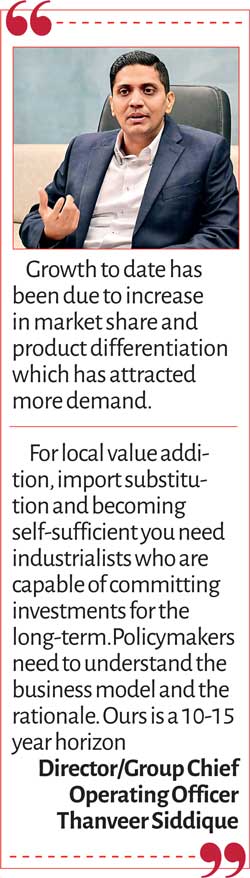
Pyramid Wilmar in 2010 obtained ISO 22000 (Food Safety Management System) and ISO 14001 (Environmental Management System) certifications for manufacturing operations. In 2012 they obtained ISO 9001 (Quality Management System) certification for manufacturing operations, followed by FSSC 22000 Food Safety System certification, and URSA/SEDEX certifications in 2013. These achievements reflect the company’s commitment to international food safety standards and environmental sustainability. In 2018 the manufacturing facility received RSPO and AIB certifications highlighting the company’s commitment to sustainable palm oil sourcing and stringent food safety practices.
Need for proper regulation of sale of edible oils
Among challenges for Pyramid Wilmar and the industry, is lack of effective regulation of the edible oil market. The Company stresses there is a need for a proper framework from the Government.
Sri Lanka is one of the few countries in the world to have no regulatory compliance for oil. In most countries you cannot sell a bottle of oil without being labelled, confirming the packer’s or manufacturer’s name. Sri Lanka remains perhaps the only country where oil can be sold in loose and bulk form. The Consumer Affairs Authority and all the line agencies are really worried about adulteration. In that context some sort of legislation ensuring responsibility and accountability is critical.
From a supply chain angle, Pyramid Wilmar executives observed that the cost of trader retailer margin is above average in comparison to most other countries in the region. In some products, the middlemen could be making more margin than the manufacturer. “This is an inconsistency because on one side you have the industry which has invested heavily, the other side the consumer and you have the middlemen making more money. The costs in this system needs to be re-strategised to ensure consumers get products at an economical price,” they explained.
Reflection of 20-year success
In concluding its 20-year journey, Pyramid Wilmar launched ‘ChefsHunt’ in 2025, a CSR initiative aimed at identifying, nurturing and developing young culinary talent across the country.
As Pyramid Wilmar reflects on two decades of operations, the company takes measured pride in a journey defined by resilience, adaptability, and steady progress, achieved against the backdrop of the many economic and social challenges experienced by Sri Lanka over the past 20 years. From its early foundations in commodity trading, the company has progressively evolved into a creator of trusted, value-added brands that confidently stand alongside some of the most established names in the market.
This transformation has not been driven by a single factor, but rather by a consistent commitment to strengthening the fundamentals of the business, including the collective effort of a dedicated workforce, which has enabled Pyramid Wilmar to remain agile while delivering sustained value to its stakeholders.
As the company looks to the future, it does so with confidence, building on a legacy of thoughtful growth and a clear focus on continuing to innovate, adapt, and contribute meaningfully to the nation’s evolving economic landscape.
DAILY FT
The post Pyramid Wilmar sets sights on doubling turnover in five years appeared first on LNW Lanka News Web.
