
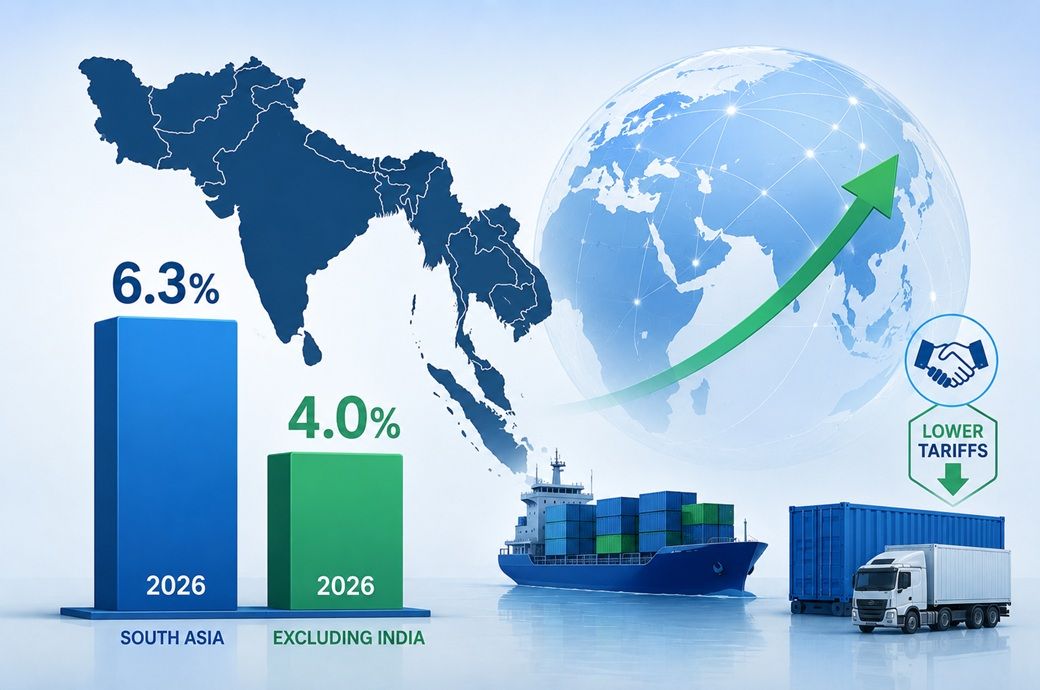
South Asia’s growth expected to soften to 6.3% in 2026: World Bank
Nevertheless, the growth forecast for the region has been marginally upgraded since January, primarily because of more robust domestic demand and stronger export growth in several economies than previously expected.
Improved access to major trading partners, as well as lower US tariffs, is anticipated to contribute to the stronger export performance.
With conflict-related disruptions assumed to wane by the end of the year, growth in SAR is set to pick up to an average rate of 7 per cent per year in 2027-28.
Growth in India is projected to moderate to 6.6 per cent in fiscal 2026-27 (April 2026 to March 2027), reflecting a slowdown in private demand growth owing to higher energy prices and other input costs, though a reduction in goods and services tax rates should somewhat support consumer demand, the report noted.
Reduced US tariffs and the expected implementation of free trade agreements will likely mitigate the impact of weaker external demand in India due to the conflict, particularly on merchandise exports. Growth in the country is then anticipated to rebound over the next two fiscals, driven by firming domestic demand and a pickup in export growth.
Excluding India, growth in the region is forecast to increase to 4 per cent in 2026 from 3.9 per cent in 2025, reflecting some acceleration of growth in Bangladesh, driven by a gradual recovery in investment.
Excluding Bangladesh and India, the projected softening of growth in 2026 in South Asia partly reflects heightened uncertainty and higher input costs, which will weigh on investment, including in Nepal and Sri Lanka.
In several economies, including Bangladesh, Bhutan, India and Maldives, fiscal deficits are anticipated to rise, partly owing to increases in subsidies intended to counteract the surges in energy prices.
In India, reduced revenues due to tax reforms are forecast to be partly offset by slower capital expenditure growth and reductions in non-essential current spending. Revenue collection will likely remain strong in Sri Lanka, maintaining a primary surplus, said the World Bank report.
External balances are also forecast to weaken in the region this year due to the impact of the conflict, including higher costs of energy imports, as well as declines in tourism revenues and remittances. Over 2027-28, current account balances are projected to improve, on aggregate, supported by higher exports, reflecting a rebound in external demand.
Over the forecast horizon, trade agreements and structural reforms undertaken to improve the business environment are set to support foreign direct investment inflows in India. In contrast, despite the reform implementation, a tight business environment is expected to weigh on foreign investment inflows in Nepal.
Inflation in the region is projected to rise in 2026, driven mainly by increases in energy and transport costs, though monetary policies are set to remain stable. Over 2027-28, inflation is expected to soften in most South Asian countries, leading to monetary policy easing, which should boost demand.
With continuing per capita income growth, poverty in the region is anticipated to decline further. However, the pace of decline will be slower than expected in January, mainly reflecting the adverse effects of higher energy and food prices on household welfare, agricultural income and food security, as well as reduced remittances.
Job creation will remain subdued in the region, partly on account of regulatory and structural barriers, widespread informality and skill mismatches, the report added.
Fibre2Fashion News Desk (DS)
