
Police Inactive as Pogrom Unfolded: The Dark Legacy of Black July 43 Years On
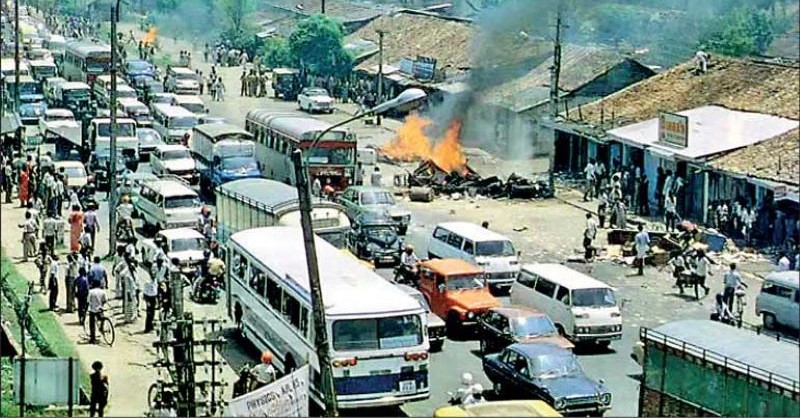
As Sri Lanka marks 43 years since the tragic events of Black July 1983, the current government has reiterated its commitment to preventing the resurgence of racist political agendas that previously plunged the nation into decades of bloodshed and violence.
The organized anti-Tamil pogrom, unleashed under President J.R. Jayewardene’s United National Party (UNP) regime, saw law enforcement systematically rendered inactive while violence raged across the island.
To reflect on the historical context and the catastrophic fallout experienced by both the North and the South, LankaTruth reproduces the full analysis originally authored by journalist M.S.M. Ayub for Lankadeepa:
The Dark Page in History: How Black July Reshaped Sri Lanka
By M.S.M. Ayub (Lankadeepa | July 26, 2026)
Exactly 43 years ago, on July 23, 1983, a single violent event in Thirunelveli, Jaffna, drastically altered the course of Sri Lanka’s history. An ambush that claimed the lives of 13 soldiers transformed what was until then a sporadic, low-intensity separatist conflict into a full-scale civil war that lasted nearly three decades—becoming one of the longest armed conflicts in modern history.
Furthermore, the fallout from Thirunelveli triggered a secondary armed confrontation in the South, which within two years claimed over 60,000 lives, predominantly innocent civilians. This massive loss of life was orchestrated by state armed forces under the UNP administration alongside government-sponsored death squads.
The Trigger and the Outbreak of Violence
By 1983, several Tamil armed groups were fighting for a separate state (Eelam) in the Northern and Eastern provinces. On July 23, the Liberation Tigers of Tamil Eelam (LTTE)—the most militant among these groups—detonated a landmine and opened fire on a military patrol in Thirunelveli, killing 13 soldiers.
While the Southern public had previously heard of isolated attacks killing individual officers, the sudden death of 13 soldiers caused widespread shock, anger, and outrage.
On July 24, as the bodies of the fallen soldiers were brought to Colombo for burial, thousands gathered in the capital. Tensions boiled over, triggering an organized, violent assault against Tamil residents in Colombo. Houses, vehicles, businesses, factories, and cinemas owned by Tamils were torched—in many instances with people trapped inside. The violence quickly spread to almost all regions outside the Northern and Eastern provinces.
Security personnel stationed on the streets remained completely passive, offering no intervention to halt the violence. Not a single shot was fired nor teargas deployed to disperse the rioters, exposing the tacit approval of the ruling UNP government. During the unrest, 53 Tamil prisoners detained at the Welikada High Security Prison were brutally massacred over two consecutive days, with no resistance from prison officials or security forces.
International Geopolitics and the Indo-Lanka Accord
Visiting Indian Foreign Minister P. V. Narasimha Rao witnessed the week-long destruction firsthand. President J. R. Jayewardene remained silent during the first four days of arson and killings before addressing the nation on July 27. However, his speech focused heavily on criticizing Tamil leaders for demanding a separate state rather than warning the rioters—effectively fueling further violence the following day. No rioters were ever held accountable under the law.
Upon returning to India, Rao presented a report to the Indian Parliament highlighting the desperate situation of Tamils in Sri Lanka. Already dissatisfied with Jayewardene’s pro-Western foreign policy, Indian Prime Minister Indira Gandhi leveraged the report and the influx of Tamil refugees fleeing across the Palk Strait to advance India’s geopolitical objectives.
India subsequently provided weapons, military training, and funding to four Tamil armed groups, including the LTTE. Senior Indian diplomats pressed the Sri Lankan government to accept a power-sharing framework, culminating in the 1987 Indo-Lanka Accord and the introduction of the Provincial Council system.
Broader Consequences in the North and South
Global sympathy for the persecuted Tamil population helped separatist groups secure international diplomatic backing. Armed groups opened offices in major world capitals like Paris and London, while thousands of radicalized Tamil youths joined militant organizations for military training in India and Sri Lanka. As the war escalated, a massive Sri Lankan Tamil diaspora was established abroad, which later became a major financial engine for the LTTE.
Concurrently, the UNP government falsely blamed left-wing political parties for orchestrating the 1983 riots, using the crisis to ban the Janatha Vimukthi Peramuna (JVP), the Communist Party of Sri Lanka, and the Nava Sama Samaja Party (NSSP). The primary target was the rapidly growing JVP, whose leader, Rohana Wijeweera, had challenged the validity of the controversial 1982 Referendum in court.
Although bans on the other two parties were eventually lifted, the proscription on the JVP remained in place. Faced with intense state repression, arbitrary arrests, and extrajudicial killings over three years, the JVP turned to armed resistance by 1986.
The resulting state crackdown was devastatingly brutal. Nearly the entire JVP Politburo was executed, including founder Rohana Wijeweera while in military custody. State-sponsored paramilitary death squads—such as PRRA, SRRA, Black Cats, and Yellow Cats—operated with impunity, leaving over 60,000 dead or disappeared in the South.
0
